
Learning a new language while living in a new country is not an academic exercise — it is something you do in every classroom, store, and conversation, every single day. The strategies below are drawn from documented research in second language acquisition; they are not motivational tips or shortcuts.
And if you are in the United States on an F-1 visa, improving your English does more than help your grades: Students already studying in the United States who plan to continue their education can also review the F-1 transfer process and transfer requirements before selecting a new school, which is the foundation of your visa status.
Key Takeaways
- Daily conversation practice — not passive study — is the single biggest driver of how fast you progress.
- The CEFR (A1–C2) framework gives you a concrete map of where you are and how many study hours separate you from your next level.
- The 15-30-15 study method (60 focused minutes per day, split across three sessions) outperforms longer, unfocused study blocks.
- Real fluency requires three things working together: input, output, and feedback. Any study routine missing one of those three will plateau.
- Language apps like Duolingo are a useful supplement — not a full curriculum. Students who treat them as their primary learning tool consistently fall short of proficiency benchmarks.
- If you are an F-1 student, academic underperformance linked to language struggles can affect your full-time enrollment status. Structured instruction through an Intensive ESL Program can help students build English skills more efficiently in a guided learning environment.
Know Where You Stand — The CEFR Proficiency Framework
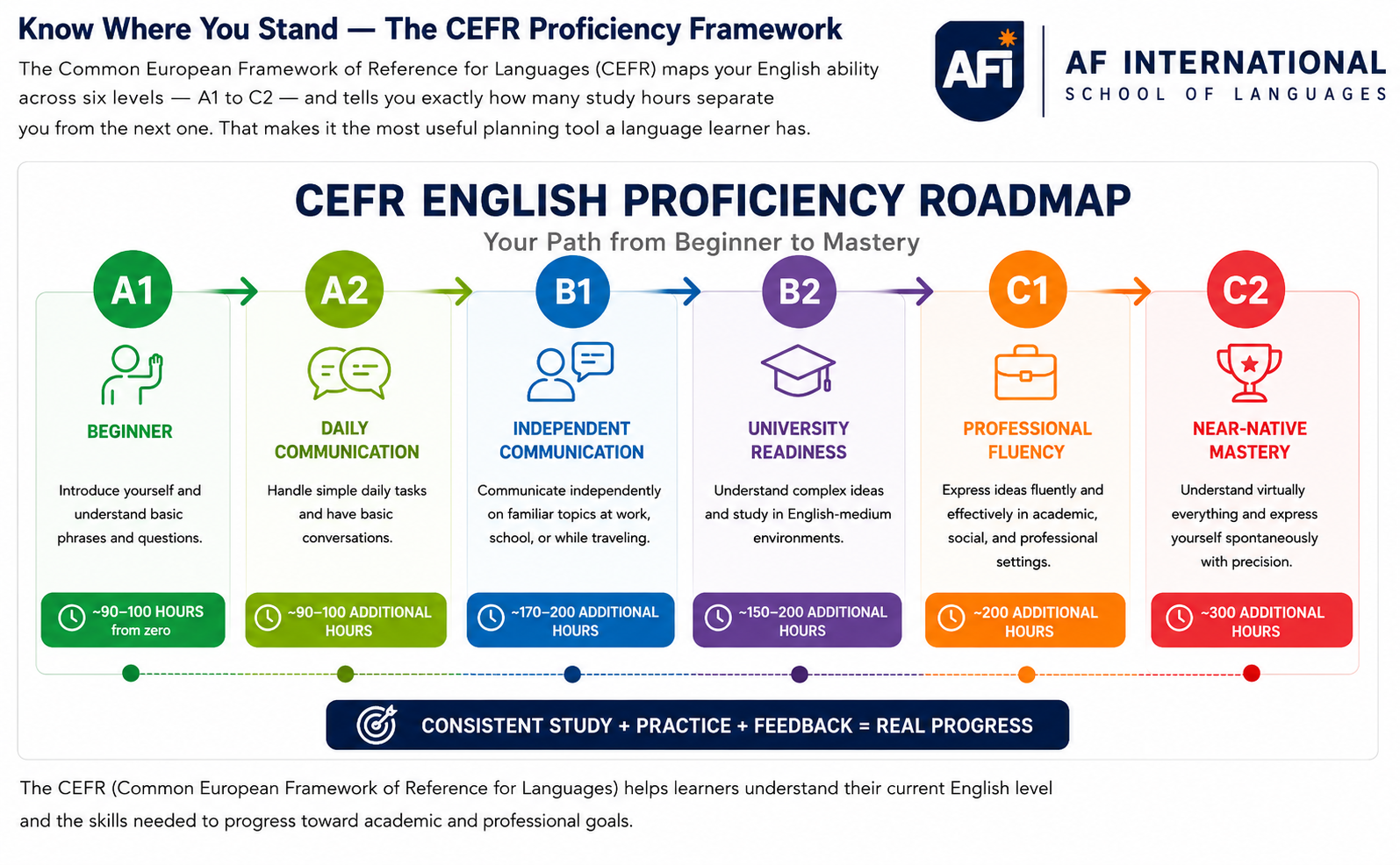
The Common European Framework of Reference for Languages (CEFR) maps your English ability across six levels — A1 to C2 — and tells you exactly how many study hours separate you from the next one. That makes it the most useful planning tool a language learner has.
Cambridge Assessment English[1] uses approximately 200 guided learning hours as a benchmark to move from one level to the next. That number assumes active, structured study — not passive exposure.
| CEFR Level | What You Can Do | Approx. Hours From Previous Level | Real-World Context |
|---|---|---|---|
| A1 — Beginner | Introduce yourself, answer simple questions about familiar topics | 90–100 hours from zero | Can order food and buy a bus ticket |
| A2 — Elementary | Communicate in routine tasks; describe your background and daily routine | ~90–100 additional hours | Can have a basic conversation with a coworker |
| B1 — Intermediate | Handle most situations while traveling; produce simple connected text on familiar topics | ~170–200 additional hours | Can write a clear email and understand a lecture on a familiar subject |
| B2 — Upper Intermediate | Communicate fluently with native speakers without strain; understand complex text | ~150–200 additional hours | Can study in an English-medium university; most AFINT students target this level |
| C1 — Advanced | Express ideas fluently and spontaneously; use language flexibly for social, academic, and professional purposes | ~200 additional hours | Can perform in a professional workplace without language limitations |
| C2 — Mastery | Understand virtually everything heard or read; express yourself spontaneously with precision | ~300 additional hours | Near-native proficiency |
AFINT uses CEFR levels for placement, which means knowing your level before you enroll helps you select the right program from the start.
See AFINT’s English proficiency levels page for a breakdown of how each level maps to its programs.
How AFINT Determines Your English Level
Knowing your current English level is one of the most important first steps in building an effective learning plan. Starting in a class that is too easy can slow your progress, while starting in a class that is too advanced can create unnecessary frustration.
At AF International School of Languages, students complete a placement assessment before beginning classes so we can identify the most appropriate starting level.
Our placement process evaluates:
✔ Speaking and communication ability
✔ Listening comprehension
✔ Grammar and vocabulary knowledge
✔ Reading level and comprehension
✔ Overall confidence and communication skills
Using CEFR-based placement guidelines, our team helps students enter the level that best matches their current ability and learning goals.
Whether you are preparing for university study, improving professional communication skills, or strengthening everyday English, beginning at the right level creates a stronger foundation for progress.
📍 Available at our Pasadena and Thousand Oaks campuses
7 Science-Backed Strategies for Language Acquisition
1. Make Daily Conversation Non-Negotiable
Research on second language acquisition[2] is consistent on this: producing output — speaking and writing — is a necessary part of language acquisition that comprehensible input alone cannot replace.
When you have a real conversation, you are forced to retrieve vocabulary, construct grammar, and process meaning simultaneously — under time pressure. A grammar exercise does not do that. A textbook does not do that.
Many students wait until they feel “ready” to speak. That readiness never arrives on its own. Fluency is built through the act of speaking imperfectly — repeatedly, with correction — not by waiting until you feel confident enough to speak.
One conversation session per day, even 20 minutes, compounds over weeks in ways that passive study simply does not.
2. Use the 15-30-15 Study Method
The 15-30-15 method, popularized by language coaches including polyglot Alex Rawlings, structures 60 minutes of daily practice across three sessions.
It works because it spaces exposure across the day — an application of the distributed practice principle[3], the well-documented finding that memory consolidates better through spaced sessions than through a single long block.
| Session | Duration | What to Do | Examples |
|---|---|---|---|
| Morning — Review | 15 minutes | Revisit vocabulary and phrases from the previous day before the brain gets busy | Flashcards, reviewing yesterday’s notes, re-reading a short passage |
| Midday — New Content | 30 minutes | Introduce new material while attention is at its peak | New vocabulary in context, grammar input, reading, and listening to a podcast |
| Evening — Reinforce | 15 minutes | Consolidate what you learned before sleep, which may support memory consolidation | Write 3 sentences using today’s new words, listen to the day’s podcast again at normal speed |
Sixty minutes feels manageable because it is. The consistency of doing it daily matters more than any single session.
3. Master the Input-Output-Feedback Loop
Second language acquisition research[4] identifies three components that must all be present for real progress: input, output, and feedback. Most learners get one or two of them. Almost no self-study routine includes all three.
Input is reading and listening in the target language — comprehensible input that stretches your understanding just slightly beyond your current level. Watching a TV show in English is input. So is reading an article.
Output is producing the language yourself — speaking and writing. Output forces you to confront the gap between what you think you know and what you can actually produce under pressure.
Students focused on workplace communication and practical speaking skills often benefit from structured programs such as AFINT’s English for Professionals & Communication program, which combines speaking practice with instructor feedback. A teacher, tutor, or language partner who tells you what was wrong — and why — is the component that turns output into learning. Without feedback, errors calcify into habits.
Passive immersion alone (Netflix, podcasts) only covers input. That is why students who consume English media for years often still plateau at conversational fluency. The missing pieces are output and feedback.
4. Try the 4-3-2 Speaking Technique to Build Fluency Fast
Research by Paul Nation (1989)[5] and confirmed by de Jong & Perfetti (2011)[6] found that repeating the same spoken content under decreasing time pressure measurably improves fluency — specifically, words per minute, hesitation frequency, and grammatical accuracy. The technique requires no teacher and can be done with a partner or a voice recorder.
Try This: The 4-3-2 Speaking Technique
What you need: A topic you know something about. A timer. A partner or a voice recorder.
Step 1 — Choose your topic. Pick something you could speak about for a few minutes: your hometown, your field of study, a typical day in your life, or a film you saw recently. Keep it familiar — the goal is fluency, not new vocabulary.
Step 2 — Speak for 4 minutes. Talk about the topic continuously. Do not stop when you make a mistake; keep going. Record or speak to your partner.
Step 3 — Speak again for 3 minutes. Same topic, same content. You are telling the same story but faster, because you have already organized your thoughts. Your brain starts finding shorter, more efficient paths to the same ideas.
Step 4 — Speak again for 2 minutes. Same topic once more. At this speed, you are forcing fluency — communicating the full content under real-time pressure.
Solo adaptation: If you do not have a partner, use your phone’s voice recorder. Play back each recording. You will hear the hesitations drop between rounds.
Why it works: Nation’s research[5] found that repeated task performance under time pressure increases automatic processing of language — the kind of fluency where you speak without mentally translating first.
5. Learn Vocabulary in Context, Not From Lists Alone
Learning a word in isolation gives you a definition. Learning it inside a sentence you actually need — in a moment of real communication — gives you a memory anchor. The difference in retention is substantial.
Spaced repetition — reviewing vocabulary at increasing intervals before forgetting occurs — is grounded in the spacing effect, first documented by Hermann Ebbinghaus in the 1880s and reinforced by modern distributed-practice research.[3] It is the structural principle behind tools like Anki and most modern flashcard apps. It works. But the words that stick fastest are the ones you first encountered in a real exchange: a joke you understood, a sentence you had to construct, a word that embarrassed you because you got it wrong.
A practical target: five new words per day, each written in a sentence that reflects your actual life — not a textbook example. At that pace, you add roughly 1,500 words to your active vocabulary in a year — a meaningful step toward the vocabulary range that B2-level fluency requires.[1]
6. Immerse Yourself in English Outside the Classroom
The classroom covers structured input and feedback. Immersion covers volume. The two work together; neither replaces the other.
Passive immersion means surrounding yourself with the language without necessarily stopping to analyze it: English podcasts during your commute, switching your phone’s language to English, and reading the news in English instead of your native language. This builds automatic recognition of rhythm, common phrases, and natural word order — what Krashen’s comprehensible input hypothesis[7] identifies as the foundation of natural acquisition.
Active immersion means engaging with the language deliberately: journaling in English for 10 minutes before bed, watching a show in English and pausing to look up words you missed, reading an article, and summarizing it in writing.
The distinction matters because passive immersion alone will not move you up a CEFR level. It needs to be paired with the output and feedback steps from Strategy 3.
7. Set Milestone Goals Using Your CEFR Level
“Get better at English” is not a goal. “Reach B2 by December” is.
The CEFR table above gives you the raw inputs: if you are currently at B1 and study with structure for 150–200 hours, B2 is within reach. Break that down by daily study commitment: one focused hour per day (using the 15-30-15 method) puts you at roughly 180 hours in six months.
Goals that are tied to a specific level and a specific timeline are measurable. You can track your progress, adjust when you fall behind, and recognize when you have arrived. Vague goals cannot do any of those things.
Set your current level as the baseline (AFINT’s placement process handles this), name the level you want to reach and by when, then work backward to a daily hour target.
Common Mistakes That Slow Language Progress
The research on language acquisition[2] is detailed on what works. It is equally clear on what does not work.
Waiting until you are “ready” to speak
There is no readiness threshold that arrives before practice. Speaking anxiety fades through exposure to speaking, not through additional studying. The longer you delay, the more the anxiety compounds.
Studying passively without producing output
Watching English content, listening to podcasts, and reading are all valuable — but they are all input. Without writing and speaking practice alongside them, the language does not move from recognition to production.
Skipping feedback
Producing output without correction means errors become habits. A language partner, a teacher, or even a structured self-review of recorded speech introduces the corrective loop that turns mistakes into information.
Using apps as a full curriculum
Duolingo, Babbel, and similar tools have genuine value as daily habit reinforcers and vocabulary supplements. What they cannot replace is conversation practice, structured grammar instruction, and the feedback of a trained teacher. Students who rely on apps as their primary learning tool consistently plateau before B1.
The Work You Do Today Compounds
Every conversation you push through, every 15-30-15 session you complete, and every piece of output you produce with feedback moves you forward on the CEFR scale. Progress is not even — it feels slow, then suddenly it is not. The students who plateau are almost always the ones who skipped the output and feedback steps, not the ones who ran out of time.
Start with your current CEFR level, set your next milestone, and build the daily habits that close the gap. If you want to do that inside a structured program with certified instruction and the SEVP compliance support that helps students remain academically successful while following school attendance and enrollment requirements, AFINT is designed exactly for that.
Building real fluency requires structured, daily practice in a supportive environment. AFINT’s English for Professionals & Communication program and Intensive ESL Programs — Levels 1 to 5 are built to take you from your current level to the next one, with the feedback and instruction that self-study alone cannot deliver.
Call us at 626-689-9362 or visit either campus — Pasadena or Thousand Oaks — to get placed and get started. Our Pasadena campus offers a quieter academic environment near Caltech, restaurants, shopping, and public transportation.
References
- Cambridge Assessment English — Guided Learning Hours and CEFR Levels
- Pannell, J., Partsch, F., & Fuller, N. (2017). The Output Hypothesis: From Theory to Practice. TESOL Working Paper Series, 15, 126–159.
- Cepeda, N. J., Pashler, H., Vul, E., Wixted, J. T., & Rohrer, D. (2006). Distributed practice in verbal recall tasks: A review and quantitative synthesis. Psychological Bulletin, 132(3), 354–380.
- UNC Learning Center — Learning a Second Language
- Nation, I.S.P. (1989). Improving Speaking Fluency. System, 17(3), 377–384.
- de Jong, N. & Perfetti, C.A. (2011). Fluency Training in the ESL Classroom. Language Learning, 61(2), 533–568.
- TeachingEnglish.org.uk — Comprehensible Input (British Council)
Related Resources
- Intensive ESL Program
- English for Professionals & Communication
- ESL Classes in Pasadena
- ESL Classes in Thousand Oaks
- Transfer Your F‑1 Status to AFINT
Build Real English Skills With Structured Practice
Learning English becomes easier when you combine daily practice with live feedback, guided instruction, and a supportive learning environment.
At AF International School of Languages, students receive:
✔ Small interactive classes
✔ CEFR-based placement and progression
✔ Intensive ESL and professional communication programs
✔ Experienced instructors and personalized support
✔ F-1 visa and I-20 support for eligible students
✔ Pasadena and Thousand Oaks campus locations
Whether you are preparing for university study, improving workplace communication, transferring your F-1 status, or building confidence in everyday English, our team is here to help you take the next step.
Take your placement assessment and find your current English level today.
Frequently Asked Questions
The 15-30-15 method is a structured daily study routine popularized by polyglot Alex Rawlings, built on distributed practice principles.[3] It divides one hour of study into three sessions: 15 minutes in the morning for review, 30 minutes midday for new content, and 15 minutes in the evening for reinforcement. The spacing of sessions across the day works with how memory consolidation works — rather than against it.
The 4-3-2 technique is a fluency-building exercise in which a learner speaks on the same topic three times in succession, each time with less time available (4 minutes, then 3, then 2). Decreasing the available time forces the brain to process language more automatically, which reduces hesitation and improves fluency. Research by Nation (1989)[5] and de Jong & Perfetti (2011)[6] documents measurable gains in words per minute and accuracy.
These are the six proficiency levels of the CEFR — the Common European Framework of Reference for Languages. A1 is beginner; C2 is near-native mastery. Each level is defined by what a learner can do with the language, not by years of study. Cambridge Assessment English estimates approximately 200 guided learning hours to move from one level to the next. See the full breakdown in the CEFR table above.
The 5 C’s are a framework from U.S. foreign language education standards:
- Communication: Using the language to communicate in real contexts
- Cultures: Understanding the cultural context behind the language
- Connections: Connecting language learning to other subject areas
- Comparisons: Comparing the new language to your own
- Communities: Using the language outside the classroom, in real communities
No. Duolingo is a useful daily habit tool for vocabulary review and basic grammar exposure. It is not a curriculum. It does not provide speaking practice, structured feedback, or the progressive instruction that moves a learner from one CEFR level to the next. Use it as a supplement, not as your primary learning method.
One focused hour per day — structured across three sessions using the 15-30-15 method — is more effective than longer, unfocused sessions. At one hour per day, you accumulate approximately 180 study hours in six months, which aligns with Cambridge English’s estimate for progressing one CEFR level. Consistency over duration: a reliable daily hour beats an occasional three-hour session.
Intensive language programs accelerate learning by combining high-frequency vocabulary, immersive daily exposure, structured speaking practice, and immediate feedback. Rather than relying on occasional study sessions, students use the language consistently in real situations every day. This combination of repetition, output, and guided instruction is why many students choose an Intensive ESL Program to build confidence and improve English more efficiently.
The timeline depends on your starting level, study consistency, and learning environment. Many learners studying approximately one hour daily with structured practice can see measurable improvement within several months.