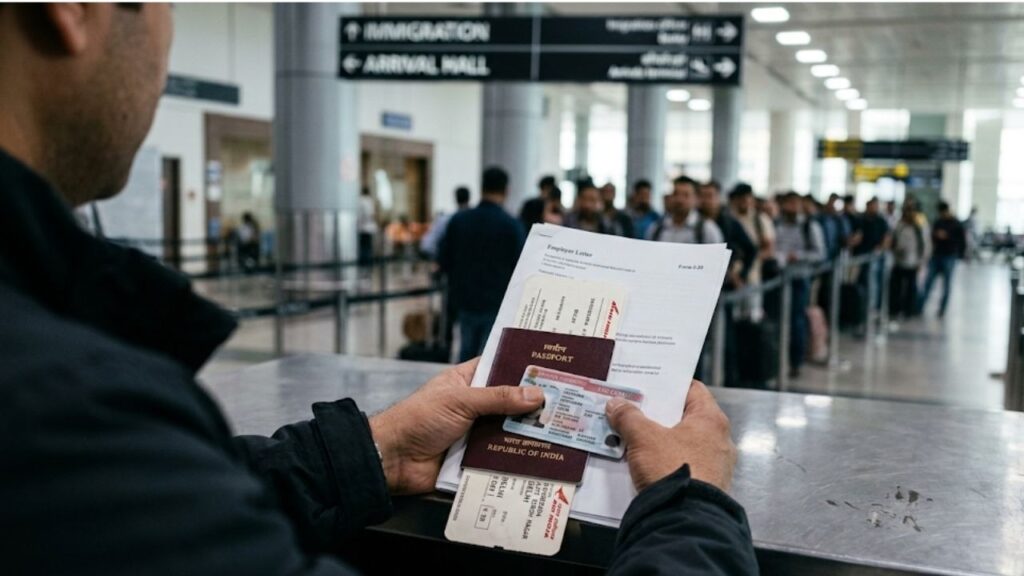
Traveling internationally while on Optional Practical Training (OPT) is possible, but OPT travel rules require careful preparation. Once you graduate and begin OPT, your F-1 immigration status becomes more sensitive to international travel.
To re-enter the United States smoothly, you must carry the correct combination of documents, including your Employment Authorization Document (EAD), a valid visa stamp, employment verification, and a recently endorsed Form I-20.
This guide explains OPT travel risks, visa renewal requirements, and the documents needed for safe re-entry in 2026.
| Key Takeaways 1) 6-Month Rule Your I-20 travel signature is only valid for 6 months while on OPT, unlike the 12-month validity for active students. 2) EAD is Mandatory Do not attempt to re-enter the U.S. after your I-20 program end date without your physical EAD card. 3) Employment Proof Required You should carry a formal job offer letter or employment verification letter. Pay stubs alone are often not sufficient. 4) Travel Warning Due to recent policy changes and travel restrictions, some passport holders without valid visas should avoid international travel until their documentation is secure. 5) Reporting Duty F-1 students must report any change of employer or address within 10 days. |
Is It Safe to Travel? Understanding Your OPT Timeline
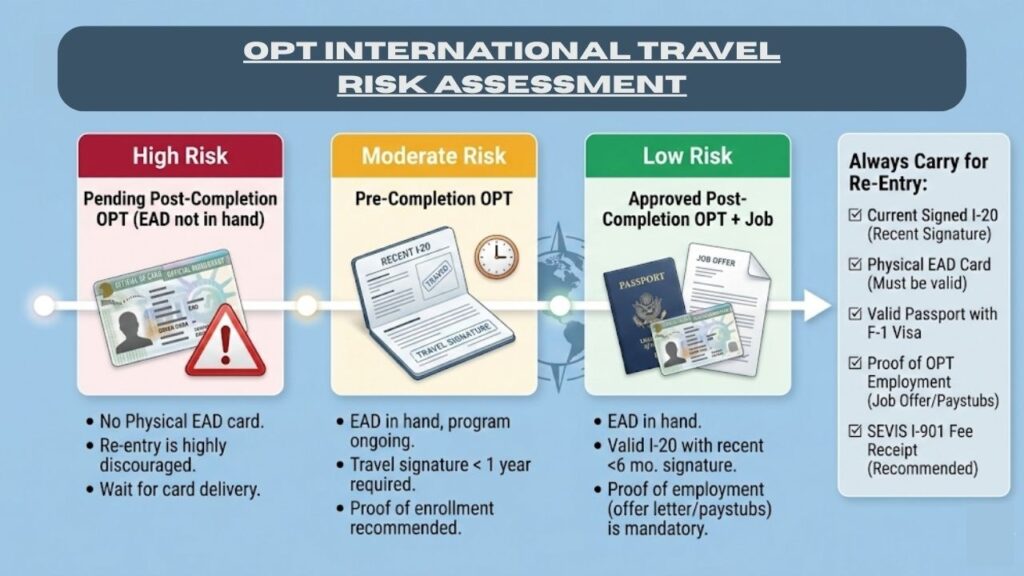
Your risk level depends entirely on where you are in the OPT timeline.
| Your Current Stage | Travel Risk | Key Requirement |
| Pre-Graduation (Pending) | Low / Moderate | Valid I-20 & USCIS Receipt |
| Post-Graduation (Pending) | HIGH | Not Recommended |
| Post-Graduation (Approved) | Low | Physical EAD Card & Job Offer |
Scenario A: Before Your I-20 End Date (OPT Pending)
Status: You are still considered an active student finishing your program.
Travel Risk: Low to moderate.
Required Documents
- Valid passport
- Valid F-1 visa
- I-20 with recent travel signature
- I-797C USCIS receipt notice for OPT
Many students travel during this period without issues, but it is still recommended to confirm your plans with your Designated School Official (DSO) before leaving the United States
Scenario B: After Your I-20 End Date (OPT Pending)
Status: Your academic program has ended, but your OPT work authorization has not yet been approved.
Travel Risk: HIGH
This period is commonly called the “OPT gap.”
If your OPT application is denied while you are outside the United States, you cannot re-enter in F-1 status. Because of this uncertainty, most universities and DSOs strongly advise students not to travel during this period.
Maintaining Status Tip
If your OPT timeline becomes complicated or your employment situation changes, maintaining your F-1 immigration status becomes critical. Some students choose to transfer their SEVIS record to another SEVP-certified school to remain in status while continuing their studies.
Learn more about the programs offered by AF International School of Languages here:
Scenario C: After OPT Is Approved
Status: You have received your EAD card and are working.
Travel Risk: Low — as long as you carry all required documentation.
Critical Requirement
You must have your physical EAD card in hand to re-enter the United States.
Without the physical card, U.S. Customs and Border Protection (CBP) officers may deny entry.
H-1B Cap-Gap Travel Warning
Students in Cap-Gap status should exercise extreme caution when traveling internationally.
The immigration rules change significantly during Cap-Gap periods. If you leave the United States, you may not be able to re-enter until your H-1B petition becomes active.
Before booking travel, consult with your employer’s immigration attorney or your school’s DSO.
Mandatory Documents for Re-Entry While on OPT
When traveling on OPT, border officers expect a complete documentation packet.
Missing documents can result in denied entry or secondary inspection.
You should carry:
Form I-20
Your I-20 must reflect your current employer information, and the travel signature on page two must be less than six months old.
EAD Card
You must present your original, physical Employment Authorization Document. Photocopies are not accepted.
Proof of Employment
Bring a formal employment verification letter or job offer letter printed on company letterhead.
护照
Your passport should be valid for at least six months beyond your re-entry date.
Valid F-1 Visa
Your visa stamp must still be valid unless you qualify for Automatic Visa Revalidation.
| Related Resource: Need a refresher on maintaining your primary student documents? Read our full breakdown on F-1 Visa and I-20 Information. |
F-1 Visa Renewal While on OPT
If your F-1 visa expires while you are inside the United States, you may legally remain in the country to complete OPT.
However, once you leave the U.S., you must obtain a new visa before returning.
Visa renewals during OPT often receive higher scrutiny because your academic coursework has already finished.
Important Visa Renewal Tips
Wait Until OPT Is Approved
Avoid scheduling a visa interview while your OPT application is still pending.
Ensure DS-160 Accuracy
All employment details in your visa application must match your SEVIS record.
Explain Job Relevance
Be prepared to explain how your OPT job directly relates to your field of study.
Prepare for Administrative Processing
Some visa renewals are placed into 221(g) administrative processing, which can delay visa issuance for several weeks.
Always allow extra time before booking return flights.
| Deep Dive: For a step-by-step walkthrough of the consulate interview and DS-160 process, explore The Complete Guide to F-1 Visa Renewals. |
Critical F-1 Travel Rules During OPT
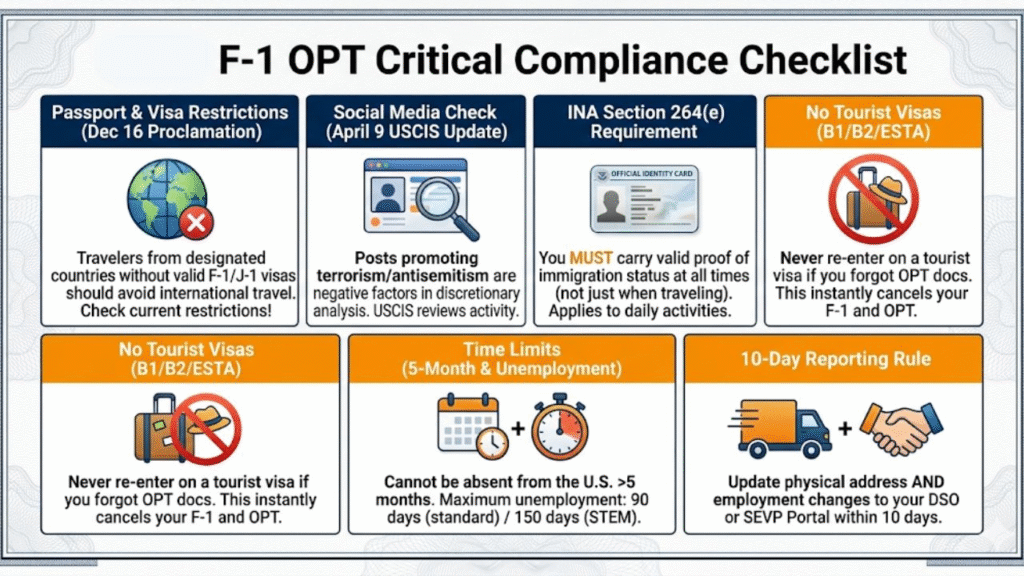
Immigration policies can change quickly, so students should remain aware of the following compliance rules.
Carry Immigration Documents
Under U.S. immigration law, non-citizens age 18 and older must carry proof of legal status.
The Five-Month Rule
You should not remain outside the United States for more than five consecutive months.
Unemployment Limits
OPT students may accumulate a maximum of:
- 90 days of unemployment (standard OPT)
- 150 days total for STEM OPT extensions
10-Day Reporting Requirement
Students must report:
- employer changes
- address changes
within 10 days through either their DSO or the SEVP Portal.
Do Not Enter on a Tourist Visa
Attempting to re-enter the United States on a B-1/B-2 visa or ESTA after OPT approval will terminate your F-1 status.
Official Government Resources
Always verify your plans against official government guidelines. Do not rely on unverified forums.
- U.S. Immigration and Customs Enforcement (ICE) – Travel on OPT
- U.S. Citizenship and Immigration Services (USCIS) – OPT for F-1 Students
- U.S. Department of State – Student Visas
Need Help Maintaining Your F-1 Status?
International students sometimes need a new academic program when OPT ends or when they want to continue improving their English for professional or academic goals.
AF International School of Languages offers small ESL classes designed for international students maintaining F-1 status.
Learn more about our Intensive English Program:
Frequently Asked Questions
Can I travel on OPT without a job?
While technically possible if your OPT is approved, it is strongly discouraged. Re-entering the United States without an employment letter significantly increases your travel risk.
How do I renew my F-1 visa while on OPT?
To renew your visa while on OPT, you should bring:
- physical EAD card
- updated I-20 signed within 6 months
- employment verification letter
- passport and DS-160 confirmation
You must also demonstrate that your job relates to your field of study.
How much does it cost to renew an F-1 visa?
The standard Machine Readable Visa (MRV) fee is currently $185. You typically do not need to pay the SEVIS I-901 fee again if your SEVIS record remains active.
What are the employer requirements for OPT?
Employers must provide a job offer letter describing duties related to your academic major. STEM OPT employers must also participate in E-Verify and complete the Form I-983 training plan.
Where can I find the latest OPT immigration updates?
The best sources include:
- USCIS newsroom
- DHS Study in the States website
- U.S. Department of State
These official sources publish the most current federal immigration updates.
Legal Disclaimer
The information provided on this page is for general informational purposes only and does not constitute legal advice. Immigration rules may change based on updates from the Department of Homeland Security (DHS) and the Student and Exchange Visitor Program (SEVP). Always consult your Designated School Official (DSO) or a qualified immigration attorney regarding your individual situation before traveling internationally.