
A practical guide for learners who know English but still feel off in real conversations. Not another grammar list — a breakdown of what actually goes wrong.
Key Takeaways
- The most disruptive ESL conversation mistakes are not always grammar errors — speaking too fast, over-apologizing mid-sentence, and translating from your first language in real time can break conversations.
- False friends — words that sound correct because they translate directly from your native language — are harder to catch and can lead to misunderstandings.
- Using the wrong register (too formal with friends or too casual in professional settings) can make your English sound socially awkward.
- Forgetting contractions and relying on filler words are fluency habits — and both can be improved with practice.
- Understanding your mistakes is the first step. Practicing real conversations in a structured environment is what truly improves fluency.
You’ve studied English for years. You know grammar and vocabulary, and you can understand written English — but real conversations still feel difficult.
This is a common challenge for students at any ESL school in Los Angeles or Pasadena. Speaking is fast, unpredictable, and requires a different skill set than classroom learning.
At a SEVP-certified ESL school in the USA, many students realize that conversation fluency requires more than grammar — it requires real, practical speaking experience.
Conversation is simply a different skill. It is faster, less structured, and harder to control than written English, which is why even strong students can struggle in real situations.
This guide breaks down what actually goes wrong in live English conversations — and what to do instead.
01.Grammar Mistakes That Actually Disrupt English Conversations
These are the classic errors — covered because readers expect them and Google rewards them. But they do not all matter equally. Some grammar mistakes break comprehension immediately. Others are barely noticed in casual conversation. Here are the ones that actually disrupt understanding when you speak.
Wrong Word Order in Questions
In English, questions require inverting the subject and the verb. When learners keep the statement word order, the sentence reads as a statement — not a question — and the listener has to reprocess it.
- Incorrect: “Where he is going?”
- Correct: “Where is he going?”
- Incorrect: “Why you are late?”
- Correct: “Why are you late?”
Subject-Verb Agreement
The third-person singular “-s” is a small marker that carries real grammatical weight. Missing it is one of the first signals native speakers use to gauge fluency level.
- Incorrect: “She walk to school every day.”
- Correct: “She walks to school every day.”
- Incorrect: “People is coming.”
- Correct: “People are coming.”
Say vs. Tell
These two are treated as interchangeable in many languages, but in English, they behave differently. “Tell” always requires a person as its object. “Say” generally does not.
- Incorrect: “She said me the answer.”
- Correct: “She told me the answer.”
- Incorrect: “He told that he was tired.”
- Correct: “He said that he was tired.”
Bored vs. Boring
One describes how you feel. The other describes what something is like. Mixing them reverses the meaning entirely.
- Incorrect: “This movie is very bored.”
- Correct: “This movie is very boring.”
- Incorrect: “I am so boring today.”
- Correct: “I am so bored today.”
Articles — a, an, the
Articles are among the hardest areas for speakers of Mandarin, Japanese, Korean, Russian, and Hindi — languages with no article system. The most common conversational error is simply dropping the article entirely.
- Incorrect: “I went to store.”
- Correct: “I went to the store.”
- Incorrect: “She is nurse.”
- Correct: “She is a nurse.”
Hidden Preposition Errors
These are errors that sound almost right — which makes them harder to catch and harder to self-correct without feedback.
- Incorrect: “I discussed about the problem.”
- Correct: “I discussed the problem.” (no preposition needed)
- Incorrect: “I recommend you to try it.”
- Correct: “I recommend you try it.” / “I recommend trying it.”
02.How Translating in Your Head Ruins English Fluency
Most grammar errors in spoken English share the same root cause: the learner is thinking in their first language and translating in real time.
The Hidden Cost of Mental Translation
When you do this, you are running two processes at once — forming the idea in your L1 and converting it into English word by word. That takes time. It creates pauses. It produces sentences that are grammatically plausible but semantically off. And it slows you down at exactly the moment when conversation moves fast.
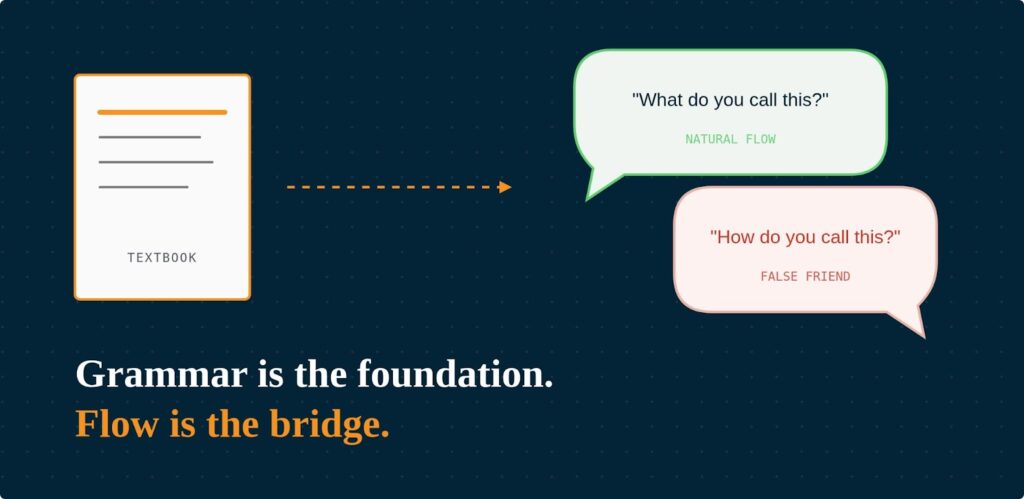
Translating word-for-word slows fluency — thinking in English phrases leads to natural conversation
Building a Phrase Library
The fix is not simply to stop making mistakes. The fix is to stop translating and start thinking in English phrases and chunks instead.
This is a skill, not a switch — it does not happen overnight. But the shift starts with how you study. Instead of memorizing individual words and their translations, learn the phrases they appear in. Instead of “angry = enfadado,” learn “I got angry when…” and “She was angry about…” so you have a ready-made structure to reach for, not a translation task to complete.
Stop translating and start speaking naturally.
Talk to an advisor to build your personalized English learning plan.
👉 Get your I-20 fast and start improving your communication skills today
03. False Friends: English Words That Don’t Mean What You Think
When Direct Translation Fails
These are the mistakes that no one warns you about — because they sound correct. The sentence is grammatically fine, the words exist in English, but the meaning is completely different because the phrase was translated directly from your first language.
What makes false friends particularly difficult is that no one corrects them immediately, because the listener often understands what you mean. The error stays invisible until someone finally mentions it, or until you notice the puzzled look that flashes across someone’s face.
- “I am embarrassed” → should be “I am pregnant.” A Spanish speaker’s direct translation of embarazada. In English, “embarrassed” means ashamed or uncomfortable.
- “Congratulations!” → should be “Happy Birthday!” In several languages, the congratulations equivalent is used for birthdays. In English, it implies an achievement (a job, graduation). Using it for a birthday sounds off.
- “I sent him to the airport” → should be “I took him to the airport.” A direct translation from Mandarin/Japanese where 送 (sòng/okuru) means both “to send an object” and “to accompany a person.”
- “How do you call this?” → should be “What do you call this?” A structural translation that sounds fluent but uses the wrong question word.
- “According to me…” → should be “In my opinion…” “According to” attributes information to an outside source. Using it to introduce your own opinion sounds like you are citing yourself as a third party.
- “I played with my friends” → should be “I hung out with my friends.” Among adults, “played with” sounds like a children’s activity. Adult socializing uses different phrasing entirely.
04. Bad Fluency Habits: Why Your Spoken English Sounds Unnatural
These are not grammar errors. They are habits — ways of speaking that make a conversation feel halting or unnatural even when the words themselves are technically correct.
Related Reading: Struggling to find the right words in real-time? Read our guide on How to Improve Communication Skills in English: 8 Proven Strategies That Actually Work .
Speaking Too Fast When Nervous
Nervousness speeds speech up — that is a natural response. But for ESL learners, speaking faster means less time to find words, more stumbles, and less time for the listener to process. The result is the opposite of what you want: instead of sounding fluent, you sound rushed and unclear. The fix is deliberate: slow down by roughly 20 percent when you feel nervous. A pause between sentences is not a weakness — it reads as composure.
Forgetting Contractions
Native English speakers use contractions constantly in casual conversation. They are not optional — they are expected. Avoiding them makes speech sound formal to the point of being robotic.
- Sounds robotic: “I am going to the store. I will be back in an hour.”
- Sounds natural: “I’m going to the store. I’ll be back in an hour.”
Overusing “Very”
“Very” is a weak intensifier. It is not wrong, but relying on it signals a limited active vocabulary. English has precise words for intensified adjectives — use them.
- very dirty → filthy
- very happy → thrilled / delighted
- very tired → exhausted
- very angry → furious
- very big → enormous / massive
Overusing Filler Words
“Um,” “like,” “you know,” “basically” — every speaker uses fillers. The problem is when they fill every pause and make the speaker seem uncertain. A few are natural; a filler every three words becomes what the listener notices instead of what you are saying. The better habit: pause silently when you need a moment to think.
Over-Apologizing Mid-Sentence
This is a fluency mistake that most guides never identify as one. When learners stop mid-sentence to apologize for a mispronounced word — “Sorry! My English is not good… what I mean is…” — they interrupt the natural flow, draw attention to the error, and lose their place in the thought. What fluent speakers do is correct and continue. No announcement. No apology.
Struggling with real conversations?
👉 Join our English for Communication program in Pasadena
👉 Small groups + real conversation practice
05. Formal vs. Casual English: Why Your Perfect Grammar Sounds Awkward
Register is the level of formality in your language — and using the wrong one is a real conversation mistake, even when the grammar is perfect. ESL learners who studied from textbooks often default to the formal register because that is what textbooks teach.
Deeper Dive: If your main struggle is shifting from casual English to a professional workplace tone, check out From Fluent to Influential: Mastering English for Business Communication .
The Formal Trap
In casual conversation, an overly formal register creates distance where there shouldn’t be any.
- Too formal (to a friend): “I would like to request your assistance with this matter.”
- Natural register: “Can you help me with this?”
The Casual Trap
The reverse happens too — learners who picked up English from social media or informal settings sometimes carry a casual register into professional environments.
- Too casual (in a work meeting): “Yeah, totally — that presentation was fire.”
- Professional register: “Yes, I agree — that was a very effective presentation.”
Neither version is wrong in its correct context. The mistake is using one where the other belongs.
06. Pronunciation and Intonation Mistakes That Change Sentence Meanings
Consonant Sounds: th, ch, j
These sounds do not exist in many languages, making them consistently difficult. The “th” sound has no equivalent in Spanish, French, or most Asian languages — so it often gets replaced with “t,” “d,” or “s.” The goal is not a perfect accent — it is clarity. If the listener has to mentally correct the sound to understand you, the conversation slows down.
Flat Intonation
English is a stress-timed language — not every syllable carries equal weight. Learners who speak with flat intonation can be understood, but sound monotonous and sometimes inadvertently change meaning. Consider what happens when you move the stress across this one sentence:
- I didn’t say she took the money. (Someone else said it.)
- I didn’t say she took the money. (I never said it at all.)
- I didn’t say she took the money. (I implied someone else did.)
- I didn’t say she took the money. (Maybe she borrowed it.)
Misreading Non-Verbal Cues
In English conversation, certain non-verbal signals carry clear meaning: eye contact signals attention, a slight nod means “continue,” and a longer pause at the end of a sentence signals that the speaker is done. Learners who miss these cues may talk over the other person, go silent when the speaker expects a response, or seem disengaged when they are simply concentrating.
07. How to Stop Making Mistakes in English Conversations: 4 Strategies
Actionable Strategies for Fluency
Knowing what the mistakes are is the easier half. Here is what actually changes them:
- Slow down deliberately: Set a conscious pace, especially in high-stakes conversations. Clarity beats speed every time. Native speakers who are confident pause frequently.
- Learn phrases, not just words: If you study vocabulary as isolated words, you will always be translating. Study “I’m looking forward to…” and “What I meant was…” as ready-to-use chunks.
- Practice verb tenses in context: Drill them in sentences that match your real situations — not abstract conjugation tables. “I had already eaten when she called” is more useful than a grammar chart.
- Record yourself speaking: Uncomfortable the first time. Also the fastest way to hear what you actually sound like. Filler words, flat intonation, and missed contractions become immediately clear on a recording.
Why Practice English in Pasadena / Los Angeles Matters
Learning English in a real-world environment makes a significant difference in how quickly you improve. In cities like Pasadena and Los Angeles, students are constantly exposed to natural conversations, different accents, and everyday situations that help build real communication skills.
At an ESL school in Pasadena, you’re not just studying English in a classroom — you’re using it in daily life. Whether ordering food, speaking with locals, or interacting with other international students, every situation becomes part of your learning experience.
At AF International, students benefit from:
- A diverse, international student community
- Real-life conversation practice outside the classroom
- Structured programs designed to improve speaking confidence
If you’re looking for ESL classes in Pasadena, choosing the right environment can accelerate your fluency and help you feel more confident in real conversations.
Frequently Asked Questions
The most common spoken errors include wrong question word order, missing subject-verb agreement, overusing filler words, speaking too quickly when nervous, and forgetting contractions. These disrupt conversation flow more than most grammar mistakes.
“Tell” always takes a person as its object: she told me, he told the class. “Say” does not require one: she said it was fine, he said nothing. You cannot “say someone” something — you tell them.
Articles — a, an, the — do not exist in many of the world’s major languages, including Mandarin, Japanese, Korean, Russian, and Hindi. When your first language has no article system, you have to build an entirely new grammatical category from scratch.
False friends are words or phrases that translate directly from your native language but have a different — sometimes opposite — meaning in English. Embarazada in Spanish looks like “embarrassed” but means “pregnant.”
It is a gradual process. Start by learning language in chunks and phrases rather than individual words. Think of it as building a phrase library, not a vocabulary list. The more ready-made English expressions you have stored, the less real-time translation you need to do.
Intermediate learners have moved past basic grammar errors but often still overuse “very” instead of stronger vocabulary, speak with flat intonation, default to formal register in all situations, translate idioms literally, and over-apologize for small errors.
Recognizing mistakes is step one. Fixing them in live conversation is step two.
The mistakes on this list do not disappear through grammar study alone. They disappear through practice — real, structured, interactive conversation with feedback, such as an Intensive ESL program. At A F International, the English for Communication program is built specifically for this: developing the speaking and listening skills that live conversations actually require, across real situations and different registers.
The mistakes on this list do not disappear through grammar study alone. They disappear through practice — real, structured, interactive conversation with feedback, such as an Intensive ESL program. At A F International, the English for Communication program is built specifically for this: developing the speaking and listening skills that live conversations actually require, across real situations and different registers.

Ready to improve your fluency faster?
👉 Study at a SEVP-certified ESL school in Los Angeles
👉 Start your F-1 transfer or change of status today
📞 Call or Text: (626) 689-9362
💬 WhatsApp: (626) 689-9362
📧 admissions@afint.com