| Key Takeaways 1. F-1 Visa Eligibility: Only SEVP-certified ESL schools can issue the I-20 required for an F-1 visa 2. Real English Skills: Learn how to communicate in real-life situations — not just memorize vocabulary 3. University & Career Prep: Build academic writing, public speaking, and professional English skills 4. Local Support in Pasadena & LA: Get guidance with housing, transportation, and your first 90 days |
Most international students arriving in the United States have already tried apps like Duolingo.
And for vocabulary and basic phrases — they work.
But once you land in Los Angeles or Pasadena, reality hits fast.
Knowing words is not the same as:
- Explaining symptoms to a doctor
- Speaking confidently in class
- Handling your visa status
- Living independently in the U.S.
1. Legal Stability: Your F-1 Visa Starts with the Right School
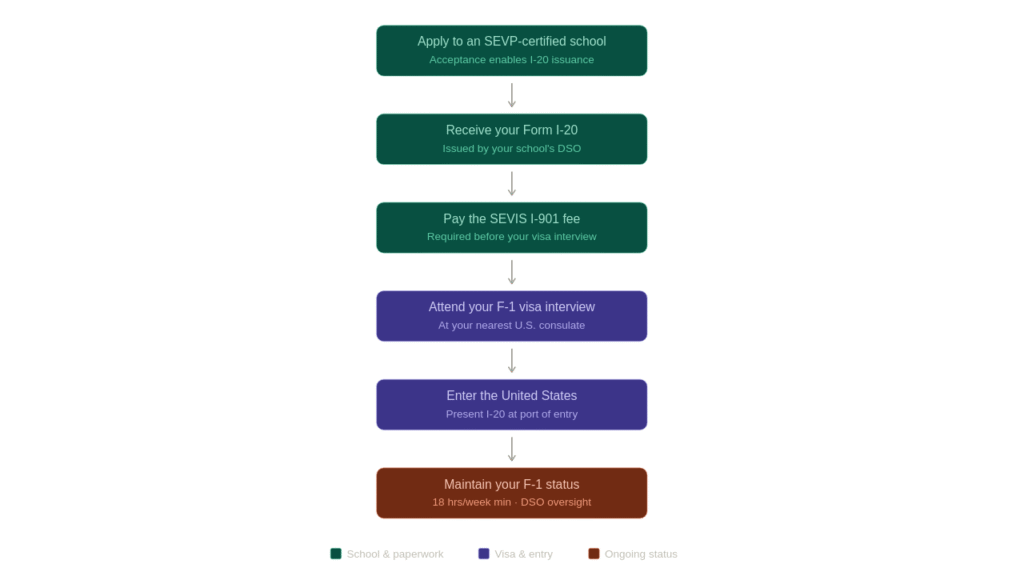
To study in the U.S. on an F-1 student visa, you must:
- Get accepted by a SEVP-certified school
- Receive a Form I-20
- Attend at least 18 hours per week
- Maintain your SEVIS status
Only real ESL institutions — not apps or part-time programs — can provide this.
At AF International School of Languages (Pasadena & Thousand Oaks):
- I-20 issuance is handled directly
- DSOs (Designated School Officials) manage your SEVIS record
- You get real-time visa guidance
This is not optional — it’s required for staying legally in the U.S.
Once enrolled, the student’s legal continuity is managed by a Designated School Official (DSO) — a federally defined role responsible for maintaining the student’s record inside the SEVIS system and ensuring they remain “in status.” That requires a minimum of 18 class hours per week. Fall below that threshold without DSO approval, a student’s legal standing in the country is at risk.
For the official federal guidelines on F-1 status requirements, the DHS Study in the States portal is the authoritative source.
SEVP-certified programs such as AFI International, with campuses in Pasadena and Thousand Oaks, are structured around this from day one. I-20 issuance, SEVIS management, and direct DSO access aren’t add-ons — they’re built into what enrollment means.
Once legal status is secured, the next challenge is one that no visa document prepares a student for.
| For a student preparing for their visa interview, AFI International publishes a step-by-step preparation guide covering exactly what consular officers evaluate. |
2. Why Study ESL in Pasadena or Los Angeles? (LOCAL ADVANTAGE)
Choosing the right location is just as important as choosing the right school.
Pasadena & Los Angeles offer:
- Close proximity to Caltech, JPL, and major universities
- Access to Downtown Los Angeles opportunities
- Safe, academic-focused neighborhoods
- Public transportation and student-friendly lifestyle
- Diverse international student community
Compared to crowded downtown-only schools, Pasadena offers a quieter, more focused learning environment — ideal for serious students.
3. Cultural Fluency: Understanding How English Actually Works in the U.S.
Why do Americans say “How are you?” but keep walking?
Why is eye contact important in interviews — but awkward in other settings?
These are cultural signals.
Most students arrive with correct grammar… but still feel:
- Socially uncomfortable
- Unsure how to respond
- Afraid to speak
Professional ESL programs teach:
- Real-life communication
- Social behavior and tone
- Confidence in everyday interactions
This is what transforms a student from “understanding English” → “living in English.”
4. Academic & Career Readiness (Beyond Conversation)
Being able to hold a conversation in English is not the same as being ready for university or a professional career.
Many students arrive in the U.S. able to communicate in daily situations. But very few are prepared to:
- Write structured academic essays
- Present ideas clearly in front of a class or panel
- Analyze and respond to complex reading materials
These skills require a different level of English — one that must be taught intentionally.
How Professional ESL Programs Close This Gap
For students planning to attend college, graduate school, or build a career in the United States, this transition is critical. It’s where success either begins — or falls apart.
Professional ESL programs bridge this gap through structured training in:
- Academic Writing
Learn how to organize research papers, build strong arguments, and follow proper citation standards used in U.S. universities - Critical Thinking in English
Go beyond describing ideas — develop the ability to analyze, question, and defend your position clearly - Public Speaking & Presentation Skills
Gain confidence speaking in academic and professional settings, reducing the hesitation many students feel due to accent or fear of mistakes - University Pathways
Many SEVP-certified ESL programs offer pathways that allow students to transition into colleges or universities without TOEFL or IELTS, using ESL completion as proof of proficiency
Why This Matters for Your Future
According to U.S. workforce data, communication is one of the most in-demand skills across industries. Strong English ability doesn’t just help you pass classes — it directly impacts your career opportunities and earning potential.
In reality, English fluency becomes a multiplier for your income and career growth.
But reaching that level requires more than self-study or casual practice.
It requires:
- A structured academic environment
- Professional instructors
- Daily immersion and accountability
Only then can students move from basic communication → academic confidence → real career opportunities in the United States.
5. Your First 90 Days in the U.S. (Where Most Students Struggle)
Moving to the United States is not just about learning English — it’s about navigating an entirely new system.
From the moment you arrive, you’re expected to handle everything at once:
- Finding housing
- Opening a bank account
- Understanding transportation
- Managing your visa requirements
All of this happens in a second language, in a city you’ve never lived in.
Why Many International Students Feel Overwhelmed
At large universities, students are often expected to figure this out on their own.
The result?
- Stress and confusion
- Missed visa details
- Slower language progress
When your energy is spent solving daily problems, it becomes much harder to focus on actually improving your English.
AFI International operates on an Open Door policy: a DSO remains accessible throughout the day for immigration questions as they arise, not just during scheduled appointments. Students are also placed into the right ESL course for their proficiency level before they arrive, removing one major source of first-week uncertainty. For students who want daily English immersion outside the classroom, the school facilitates homestay arrangements where language practice happens naturally over shared meals and routines.
The goal is simple: reduce the logistical noise so students can focus on the reason they came.
Looking for ESL Classes in Pasadena or Los Angeles?
For students considering intensive ESL study in Southern California, AFI International’s Intensive ESL Program covers course levels, F-1 eligibility, and the full enrollment process from application through arrival
If your goal is:
- Get an F-1 visa
- Improve English quickly
- Transfer schools or start fresh
AF International School of Languages can help you start immediately
📍 Campuses: Pasadena & Thousand Oaks (Los Angeles Area)
📞 Call / WhatsApp: 626-704-2044
👉 Speak directly with our admissions team before applying — get clear answers and start with confidence
Frequently Asked Questions About ESL Programs in the USA
Yes. The program must be full-time — a minimum of 18 hours per week — at an SEVP-certified institution. Upon acceptance, the school issues an I-20, which the student presents at their visa interview.
If an F-1 student remains outside the U.S. for more than five consecutive months, their SEVIS record is typically terminated. Returning requires a new I-20. Students should consult their DSO before any extended travel.
Some community organizations offer free introductory English programs and those serve a real purpose. However, they are not SEVP-certified and cannot issue I-20s or maintain SEVIS records. Students who require legal student status must enroll in a certified program.
For most students in an intensive program, the range is 6 to 12 months from basic to academic fluency — depending on starting level and consistency of practice outside the classroom.