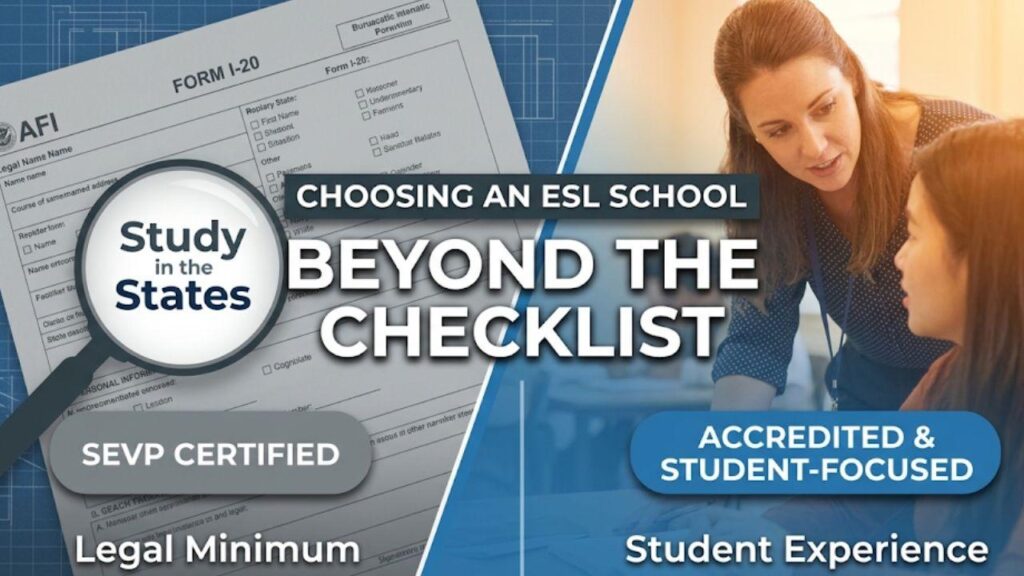
| Key Takeaways SEVP certification is the legal minimum, not a quality guarantee. Any school on the DHS list can enroll F-1 students — that doesn’t mean all of them are worth your time or money. Always check for independent accreditation alongside SEVP status. Bodies like CEA and ACCET audit academic quality separately from DHS. Ask about class size before you enroll. ESL classes with more than 15 students give you significantly less speaking time per session — which is the whole point. Your DSO matters as much as your teacher. The Designated School Official handles your I-20 and SEVIS record. An unresponsive DSO is a serious risk to your visa status. Location affects your learning, not just your lifestyle. Transport access, local community, and campus setting all shape how quickly you settle in and start improving. |
Not sure which ESL program is right for you?
Speak directly with our admissions team and get your I-20 process started today.
📞 Call or text: 626-689-9362
✔ SEVP-certified
✔ Accredited ESL program
✔ Fast I-20 processing
Studying English in the United States is a real commitment, not just financially, but personally. You are planning to move to a new country, build a new routine, and learn a language that is not yet fully yours. It makes sense that you want to choose the right school.
Only a SEVP-certified ESL school in the USA can issue the Form I-20 you need for your F-1 visa, and while the DHS School Search tool shows you hundreds of schools that qualify, it gives you no way to actually compare them.
In this guide, we will cover what SEVP certification actually guarantees, what it doesn’t, and how to evaluate the schools that have it before you make your decision.
What SEVP Certification Actually Means (and What It Doesn’t)
SEVP stands for the Student and Exchange Visitor Program, run by the Department of Homeland Security.
When a school earns SEVP certification, it means DHS has authorized that school to enroll F-1 and M-1 visa students and issue the Form I-20 — the document you need to apply for your student visa.
Schools must apply through Form I-17 and go through a recertification process every two years to maintain their status. You can verify any school’s current certification status using the Study in the States school search map, which shows whether a school is certified for F-1 students, M-1 students, or both.
What SEVP certification does not evaluate or guarantee:
- The quality of teaching
- Class sizes
- Instructor qualifications
- Student support services
- Whether the school is actively enrolling students right now
- The depth or structure of the curriculum
A school that passed its SEVP audit three years ago and a school that genuinely invests in its students will both show up identically on that DHS map. The certification is the starting point. Everything below is how you look beyond it.
| Not sure which ESL program is right for you yet? Before choosing a school, it helps to know what you are looking for. Read our Beginner’s Guide to Choosing the Right ESL Course first. |
SEVP vs. Accreditation — Why You Need Both
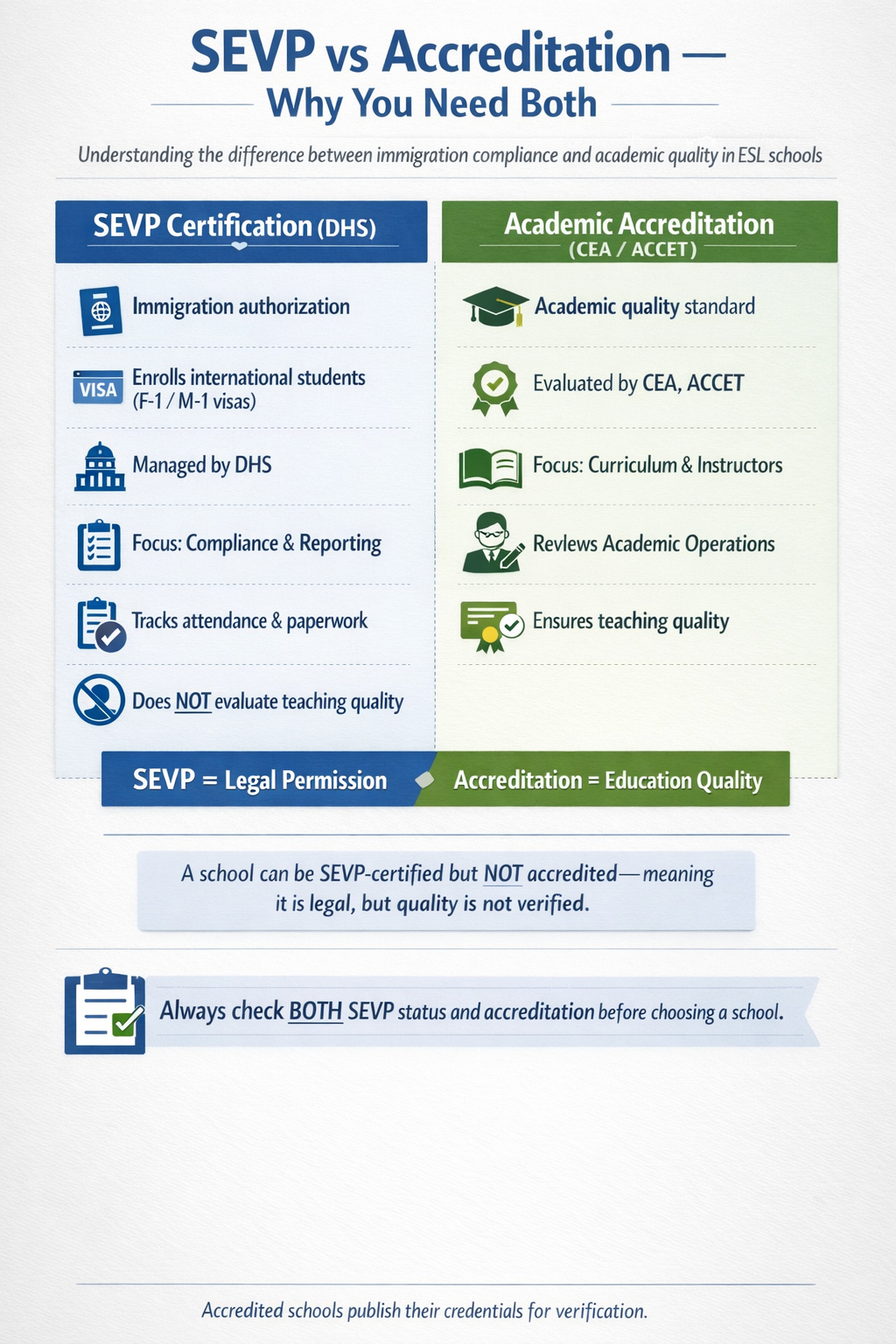
SEVP certification and academic accreditation are two completely separate things, issued by completely different bodies for completely different reasons.
SEVP certification is an immigration authorization. It answers one question: Is this school legally permitted to enroll international students on F-1 or M-1 visas? DHS evaluates whether the school complies with immigration regulations — record-keeping, reporting, and enrollment tracking.
DHS tracks your paperwork and your physical presence in a seat, but that is essentially the extent of their evaluation.
Academic accreditation is a quality standard. For ESL schools in the United States, the two main bodies are:
- CEA — Commission on English Language Program Accreditation. CEA specifically accredits English language programs and evaluates curriculum design, student learning outcomes, instructor credentials, student services, and facilities.
- ACCET — Accrediting Council for Continuing Education and Training. ACCET covers a broader range of vocational and continuing education programs, including English language training.
When an ESL school holds accreditation from CEA or ACCET, it means an independent body has reviewed the actual academic operation of the school — not just whether it files the right immigration paperwork.
A school can be SEVP-certified without holding either of these accreditations. That school is legal. It can issue you an I-20. But you have no independent verification that the teaching is of any standard at all.
When you are shortlisting schools, always check the accreditation page — not just the SEVP status. AF International publishes its accreditation details directly on its website, so students can verify before making any commitment.
The I-20 Process From a Student’s Perspective
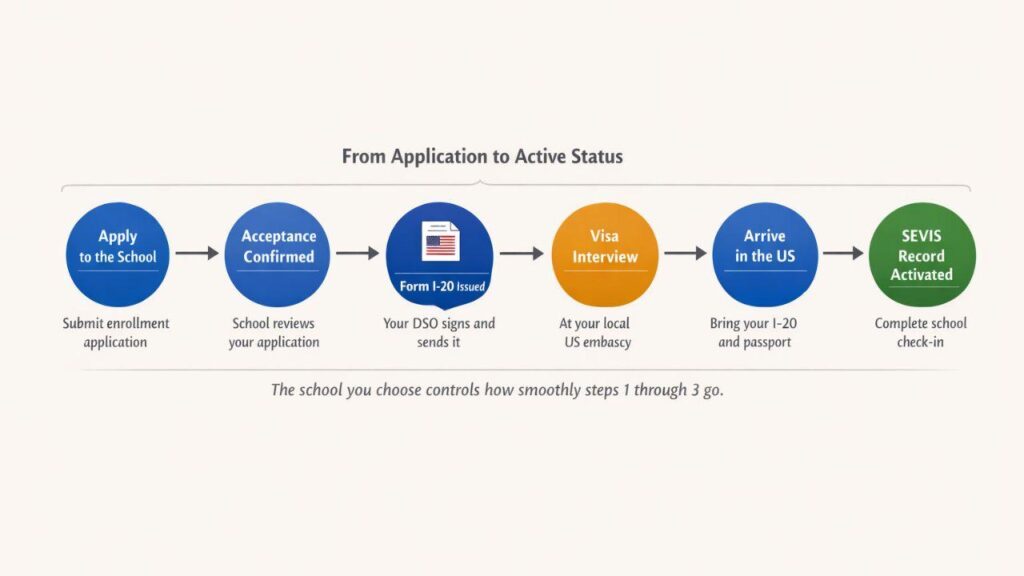
The I-20 is your most important document before you arrive in the US — and the school you choose controls how smoothly you get it.
- You apply to the school and are accepted.
- The school’s DSO (Designated School Official) reviews your application and issues your Form I-20.
- You pay the SEVIS fee — currently $350 — through fmjfee.com. This is a mandatory government fee, separate from your tuition.
- You attend your visa interview at the US embassy or consulate in your country, bringing your I-20 as one of the required documents.
- Upon arrival in the US, you complete your school’s immigration check-in, which activates your SEVIS record and makes your status “Active.”
If you are already studying in the United States, you may be eligible for an F-1 transfer to a new SEVP-certified school without leaving the country.
Where it breaks down is when the school is slow, unresponsive, or makes an error on the I-20, which happens more than students expect. Before you enroll, ask:
- How quickly does the school issue the I-20 after acceptance?
Delays here push back your entire visa timeline. - Is there a dedicated DSO, or does one person manage admissions, records, and student advising simultaneously?
At smaller schools, a single overloaded administrator handling all three roles is a real risk. - What is the process if there is an error on the I-20?
Names misspelled, incorrect program dates, and wrong passport numbers are common. How the school handles corrections tells you a lot about their level of care. - Is the DSO reachable before you enroll?
If it takes a week to get a reply to a pre-enrollment question, that will not improve after you have paid.
Already in the U.S. on an F-1 visa?
Transfer your SEVIS record smoothly and continue your studies without interruption.
📞 Questions? Text us at 626-689-9362
Questions to Ask Any SEVP-Certified ESL School Before You Enroll
Take these to every school on your shortlist. The answers will tell you more than any brochure will.
How many students are in each class?
The meaningful range for ESL instruction is 8 to 15 students. In a class of 10, you realistically get speaking time and individual teacher feedback every single session. In a class of 25, you become a passive participant. Ask for the actual average, not the maximum cap.
What qualifications do the instructors hold?
At a minimum, teachers for beginner through high-intermediate levels should hold a Bachelor’s degree and a CELTA, TESOL, or TEFL certificate. Teachers for advanced levels and test preparation courses should hold an M.A. in TESOL or equivalent.
These are not arbitrary standards — they reflect meaningfully different training in how language acquisition actually works.
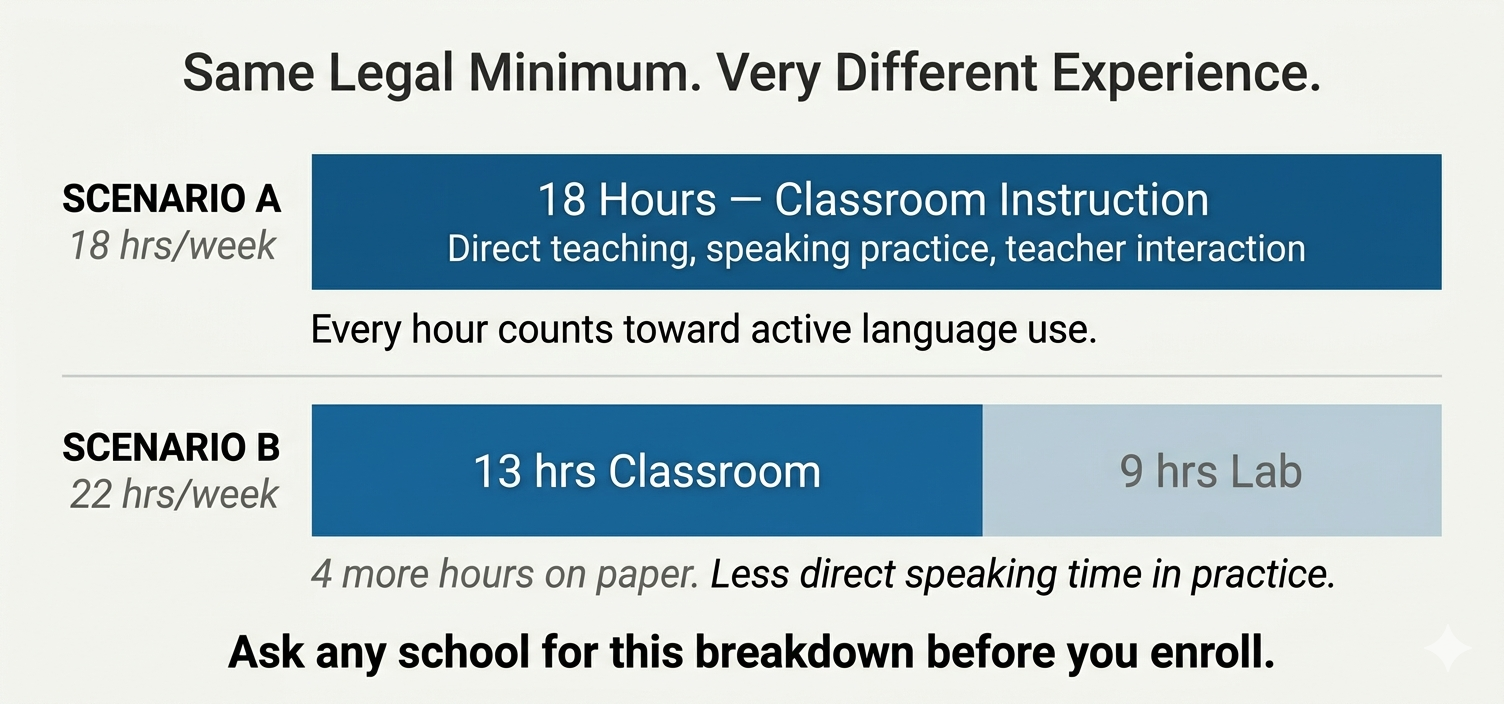
How many classroom hours per week, and what counts toward that number?
Under SEVP rules, English language training programs must provide either 18 clock hours of classroom instruction per week, or 22 hours per week if the majority of instruction is in a language laboratory setting.
These are treated differently because passive lab time and active classroom instruction produce different results. A school that reaches its hour minimum primarily through lab hours is meeting the legal requirement, while giving you less of what actually builds fluency. Ask for the breakdown.
What is the placement process?
A serious school places you based on a diagnostic assessment — a test that evaluates your reading, writing, listening, and speaking before your first class. Schools that assign levels without a placement test are not being careful about your learning. You may end up in a class that is too easy and learn nothing, or too difficult and lose confidence.
Is there a clear progression path through levels?
Ask to see the level structure. A well-designed ESL program runs from beginner through advanced with defined outcomes at each stage — typically aligned to the CEFR framework (A1 through C1/C2). You should be able to see where you start, what it takes to advance, and where the program ends. If the answer is vague, the program probably is too.
What student support services are available?
For someone relocating to a new country, support beyond the classroom matters significantly. Housing assistance, orientation, academic advising, and cultural integration activities directly affect how quickly you settle, how much English you use outside of class, and how long you stay enrolled. Ask specifically what is included and what costs extra.
Is the school actively enrolling students right now?
Some schools maintain SEVP certification while operating at very low capacity or with irregular intake schedules. Ask about current enrollment, current session dates, and how often new students join. A school with a visible, active student body is a school that is genuinely functioning.
Choosing the Right Location for Your ESL Program
For an international ESL student, especially in the first months, where your school sits has practical consequences that go well beyond which city looks appealing on a map.
Transportation access
The majority of new international ESL students do not have a car, at least initially. California, in particular, is a driving culture, and many areas have limited public transit. Before committing to a school, check how accessible the campus is by bus, metro, or rideshare from the areas where student housing is realistically available.
A school that is theoretically in Los Angeles but practically requires a car to reach creates a daily logistical problem.
Local community
Cultural adjustment is a real factor in language learning. Areas with established international communities — where you can navigate daily life with some linguistic support while you build your English — typically ease that adjustment period.
This is not about avoiding English immersion. It is about not being so overwhelmed by daily logistics that you cannot focus on learning.
Why California specifically
Over 14% of all F-1 international students in the US — more than 237,000 people — choose to study in California, making it the largest ESL market in the country by a significant margin.
That concentration matters for two reasons: it means the widest range of options, and it means the widest range in quality. Schools that meet only the bare SEVP minimum exist here alongside some of the most rigorous CEA-accredited programs in the world.
The criteria in this guide apply everywhere, but in California, they are especially worth applying carefully.
California also presents a choice that other US states rarely force on students — you can study within the same metropolitan area and have two completely different learning environments depending on which campus you choose.
Pasadena vs. Thousand Oaks
AFI operates two campuses with meaningfully different characters.
The Pasadena campus sits in a modern high-rise in the heart of Greater LA — urban, accessible, and close to metro connections — making it one of the most accessible ESL schools in Pasadena for students relying on metro or rideshare, with the full social and cultural life of a major city immediately available.
The Thousand Oaks campus in Westlake Village is quieter and suburban — better suited to students who want a more focused, lower-distraction environment while still being within reach of LA.
Neither is objectively better. The right one depends on what kind of environment you learn well in.
| Choosing between Pasadena and Thousand Oaks? We have a full side-by-side breakdown of both campuses — location, environment, transport, and student life. Read the full campus comparison here. |
Study English in Los Angeles with a supportive, accredited ESL program.
Choose the campus that fits your lifestyle — Pasadena or Thousand Oaks.
📞 Contact us: 626-689-9362
Red Flags: How To Spot an SEVP-Certified School That Isn’t Worth Your Time
Choosing the right city matters for your lifestyle, but even the best location can’t save a program with poor standards. Once you’ve picked a campus, you must audit the institution itself for these non-negotiable red flags.
SEVP certification is a legal floor. These are the signs that a school has cleared it and not much else.
No CEFR-aligned level structure.
If the school’s website lists “ESL classes” without a clear level framework — no A1 through C1, no Beginner through Advanced with defined outcomes — the curriculum is probably not structured around how language acquisition actually progresses. You will not have a clear sense of where you are or where you are going.
SEVP-certified but no independent accreditation.
A school with only SEVP certification and no CEA or ACCET accreditation has passed an immigration compliance check. Nothing else has been independently verified.
The DSO is difficult to reach before enrollment
If you send an admissions inquiry and receive a slow, vague, or automated response, that is the school operating at its most motivated — when it wants your enrollment. Post-enrollment support will not be better.
No placement test
Schools that skip diagnostic placement are not taking your learning seriously. They are filling seats.
No sample schedule or curriculum available before payment
A legitimate school will show you what a typical week looks like — when classes run, what subjects are covered, and how instruction time is divided. If that information is unavailable until after you pay a deposit, that is a deliberate lack of transparency.
Vague or absent student reviews
Real schools have real students who talk about their experience. Look for reviews on Google, third-party ESL directories, and the school’s own site. Generic five-star reviews with no specific details are almost as unhelpful as no reviews at all.
School Models: What Type of SEVP-Certified Program Fits Your Goal
SEVP certification and accreditation tell you that a school meets a standard. They do not tell you which model of school suits how you actually learn.
Large chain schools vs. independent schools
SEVP-certified ESL market splits broadly into two models. Large chain schools operate across multiple countries with standardized curriculum and high student volume — the advantage is established infrastructure and brand recognition; the trade-off is that you are one student among hundreds, and administration tends to reflect that scale.
Independent schools run on a different logic. Smaller student bodies mean the teacher knows who you are, the DSO knows your situation, and your experience as an individual actually affects the school’s reputation. AF International operates on this model across both its Pasadena and Thousand Oaks campuses.
Specialization
Not all ESL programs offer the same tracks.
General ESL is widely available. Academic English and test preparation (TOEFL, IELTS) require instructors specifically trained for those courses.
Business and professional English — the highest-value track for working adults — is offered by fewer schools and varies significantly in quality.
AFI’s curriculum covers all three: the Intensive ESL Program runs CEFR-aligned levels 1 through 5, the English for Professionals and Communication course addresses real workplace language needs, and private lessons allow fully customized instruction for students with specific goals.
Both campuses operate within the same metro area, making AFI one of the few accredited ESL schools in Los Angeles with two distinct learning environments to choose from.
The Checklist Before You Commit
Before you pay a deposit to any school, work through this. If a school cannot answer these questions clearly, that is your answer.
| Question | What to Look For |
| Is the school SEVP-certified? | Verify on the DHS School Search tool |
| Is the school independently accredited? | Look for CEA or ACCET certification |
| Is there a clear level structure? | CEFR-aligned levels with defined outcomes |
| Is there a placement test? | Diagnostic assessment before your first class |
| What are instructor qualifications? | CELTA/TESOL minimum; M.A. TESOL for advanced levels |
| What is the average class size? | Under 15 students for meaningful speaking time |
| How are classroom hours counted? | Understand the split between classroom and lab hours |
| How responsive is the DSO? | Test this before you commit — email them a question |
| Is the I-20 process clearly explained? | Timeline, error correction process, DSO availability |
| Does location work practically? | Transport access, housing proximity, campus environment |
| Are there real student reviews? | Specific, detailed, across multiple platforms |
Conclusion
SEVP certification is where your search starts, not where it ends. The DHS list confirms a school is legally authorized to enroll F-1 students.
It does not confirm that the teaching is strong, that the classes are small enough to be useful, that the administration will actually support you, or that the environment will help you improve.
The schools worth your investment are the ones that meet the legal standard and go beyond it — with independent accreditation, qualified instructors, a structured curriculum, and genuine student support.
If you are considering studying ESL in the Los Angeles area, AF International offers ESL classes in Pasadena and Thousand Oaks through SEVP-certified, accredited programs from beginner to advanced levels, with small classes and dedicated student support.
You can explore current course options or reach the admissions team at admissions@afint.com.
Frequently Asked Questions
Yes. If you are currently studying in the United States on an F-1 visa, you can transfer your SEVIS record from your current school to a new SEVP-certified school. This process must be completed before your current program ends or within your grace period. The new school’s DSO will coordinate the transfer and issue a new Form I-20.
After you submit a complete application with all required documents (passport copy, financial proof, and application form), most schools can issue the Form I-20 within a few business days. Delays usually happen when documents are incomplete or corrections are needed.
No. SEVP certification only means the school is authorized to enroll international students and issue I-20s. It does not guarantee teaching quality, class size, or student support. You should also look for accreditation (such as CEA or ACCET), qualified instructors, and a structured curriculum.
Yes, it is possible to apply for a change of status from B1/B2 to F-1 while remaining in the United States. However, approval is handled by USCIS and can take several months. You must maintain valid status during the process and be prepared to study full-time once approved. (This is general information, not legal advice.)
F-1 students must enroll in a full-time program. For ESL programs, this generally means at least 18 hours per week of classroom instruction. Some programs may include additional lab hours, but it is important to understand how those hours are structured.
Look beyond SEVP certification. Check if the school has independent accreditation, small class sizes (typically under 15 students), qualified teachers (TESOL/TEFL or higher), a clear level structure, and responsive student support. Reading real student reviews and asking questions before enrolling are also important steps.
Policies vary by school. Some schools allow you to pay only the application fee to receive your I-20, while others may require partial tuition upfront. Always confirm the payment policy before applying.
Most schools require:
Completed application form
Passport copy
Financial documents (bank statement showing sufficient funds)
If using a sponsor: affidavit of support and sponsor’s bank statement
If transferring: current I-20
Additional documents may be required depending on your situation.
Still have questions? Contact our admissions team directly or start your I-20 application today.
Take the next step toward studying in the United States
Start your application today and receive your Form I-20 as soon as your documents are approved.
Our admissions team will guide you through every step — fast, clear, and reliable.
📞 Call or text now: 626-689-9362
📧 Email: admissions@afint.com
👉 Apply Now
👉 Get My I-20
👉 Contact Admissions