| Key Takeaways: • CPT and OPT allow eligible F-1 students to gain practical work experience in the U.S. • CPT is used before graduation and must be part of your academic program. • OPT generally allows eligible F-1 students to work in jobs related to their major before or after graduation. • CPT requires DSO authorization in SEVIS, while OPT requires a DSO recommendation followed by USCIS authorization. • Completing 12 months or more of full-time CPT makes a student ineligible for post-completion OPT at the same educational level. Part-time CPT does not trigger this restriction. |
If you are an F-1 student planning to study or build a career in the United States, understanding CPT and OPT can help you plan your work opportunities. CPT allows eligible students to gain practical training before graduation as part of their academic program, while OPT provides temporary employment authorization for work related to their major before or after completing their degree.
Although both programs provide valuable professional experience, they differ in timing, eligibility requirements, approval process, and impact on future work authorization. This guide explains the differences between CPT and OPT, who qualifies, how to apply, and what F-1 students should consider before choosing either option.
Can ESL Students Get CPT or OPT Based on an English Program?
No. F-1 students enrolled only in an English-language training program are not eligible for CPT or OPT based on that ESL program. CPT and OPT are generally available to eligible F-1 students studying in qualifying academic programs at colleges, universities, conservatories, or seminaries.
If you are preparing to enter a U.S. college or university, strong academic and professional English can help you participate in classes, prepare for interviews, and communicate confidently in future internships and workplaces. AF International offers small, interactive English classes, personalized placement, experienced instructors, and full-time English programs in Pasadena and Thousand Oaks.
Explore AF International’s Intensive English Program
CPT vs. OPT: Quick Comparison
| Feature | CPT | OPT |
| When used | During your academicprogram, before the programend date. | Before or after completingyour academic program |
| Purpose | Academic practical training | Career-related experience |
| Job offer | Required | Not required to apply |
| Approval | DSO authorization in SEVIS | DSO recommendation and USCIS authorization |
| Work authorization | Form I-20 | EAD card |
Important Note for F-1 Students:
CPT and OPT eligibility depends on factors such as your degree program, school requirements, F-1 status, and current U.S. immigration regulations. While this guide provides general information, students should always confirm their eligibility, timelines, and application requirements with their Designated School Official (DSO).
What Is CPT for F-1 Students?

Curricular Practical Training (CPT) allows eligible F-1 students to gain practical experience before graduation through internships, co-ops, and other approved training opportunities related to their academic program.
Depending on your degree program, CPT may include:
- Internships
- Cooperative education programs
- Clinical placements
- Practicum experiences
- Student teaching
For example: A business student completes a required marketing internship during the summer after receiving CPT authorization from their DSO.
Who Is Eligible for CPT?
Although schools may have additional policies, students may qualify for CPT if they:
- Maintain valid F-1 student status
- Have completed one full academic year, unless enrolled in a qualifying graduate program that requires immediate participation in practical training
- Receive a qualifying internship or job offer before applying
- Work in a position directly related to their major
- Participate in practical training that’s an integral part of their academic program
- Meet any additional academic requirements established by their school
Receiving a job offer alone doesn’t guarantee CPT approval. Your internship or training must also satisfy your institution’s academic policies. If you’re weighing paid vs. unpaid options, it helps to understand the broader picture of legal part-time work options for F-1 students before you accept an offer.
Who Approves CPT?
CPT does not require USCIS approval. Your Designated School Official (DSO) reviews your request and authorizes CPT by issuing an updated Form I-20 with your employment details based on your school’s academic requirements and immigration regulations.
Unlike OPT, CPT does not require an Employment Authorization Document (EAD). Any change to your employment details still needs to be reflected correctly through the SEVIS record update process, so confirm this with your DSO before your start date.
What Is OPT for International Students?

Optional Practical Training (OPT) allows eligible F-1 students to gain practical work experience in jobs directly related to their major. Students may use OPT before completing their degree (pre-completion OPT) or after graduation (post-completion OPT).
- Pre-Completion OPT: Pre-completion OPT allows eligible students to work before completing their degree. It may be useful if you want practical experience that’s related to your major but isn’t part of your academic curriculum.
- Post-Completion OPT: Post-completion OPT allows eligible graduates to participate in qualifying employment directly related to their major. Qualifying employment generally must total at least 20 hours per week.
OPT helps international students apply the knowledge gained during their studies to real-world professional settings while following F-1 work authorization requirements.
Who Is Eligible for OPT?
You may qualify for OPT if you:
- Are enrolled in an eligible academic program at a SEVP-certified college, university, conservatory, or seminary
- Have maintained valid F-1 student status
- Have completed the required period of full-time academic study
- Have not used all available OPT at your current educational level
- Have not completed 12 months or more of full-time CPT at the same educational level
- Receive an OPT recommendation from your Designated School Official
- Submit Form I-765 and receive employment authorization from USCIS
Students enrolled only in English-language training programs are not eligible for OPT based on that ESL program.
Pre-completion and post-completion OPT have different work-hour, employment and reporting requirements. Confirm the rules that apply to your authorization with your DSO before beginning employment.
Who Approves OPT?
OPT requires approval from U.S. Citizenship and Immigration Services (USCIS). Before applying, your Designated School Official (DSO) must recommend OPT through SEVIS and provide an updated Form I-20.
Your school recommends OPT, but USCIS makes the final authorization decision.
For example: A computer science graduate may use post-completion OPT to work as a software engineer in a role related to their degree.
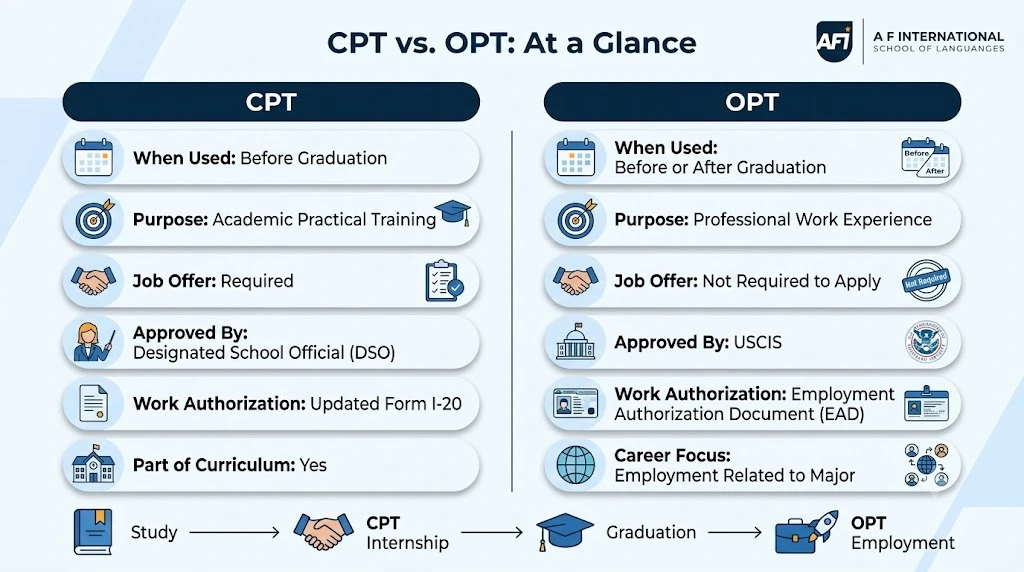
CPT vs. OPT: Detailed Differences
| Feature | CPT | OPT |
| Purpose | Practical training that’s part of your academic program | Professional work experience related to your major |
| When you can use it | Before graduation | Before or after graduation |
| Job offer required to apply | Yes | No |
| Academic credit | Academic credit is not always required, but the training must be an integral part of the established curriculum. | Academic credit is not required. |
| Authorized by | Designated School Official (DSO) | U.S. Citizenship and Immigration Services (USCIS) |
| Employment Authorization Document (EAD) | Not required | Required |
| Employer flexibility | Authorized only for the employer listed on your Form I-20 | Greater flexibility, provided the job relates to your major |
| Duration | Determined by your school’s authorization | Up to 12 months, plus a 24-month STEM OPT extension for eligible students |
Although the programs have different requirements, they’re not competing options. Many international students use CPT to gain practical experience while studying and later apply for OPT to continue building their careers after graduation.
How CPT and OPT Fit Into Your Student Journey
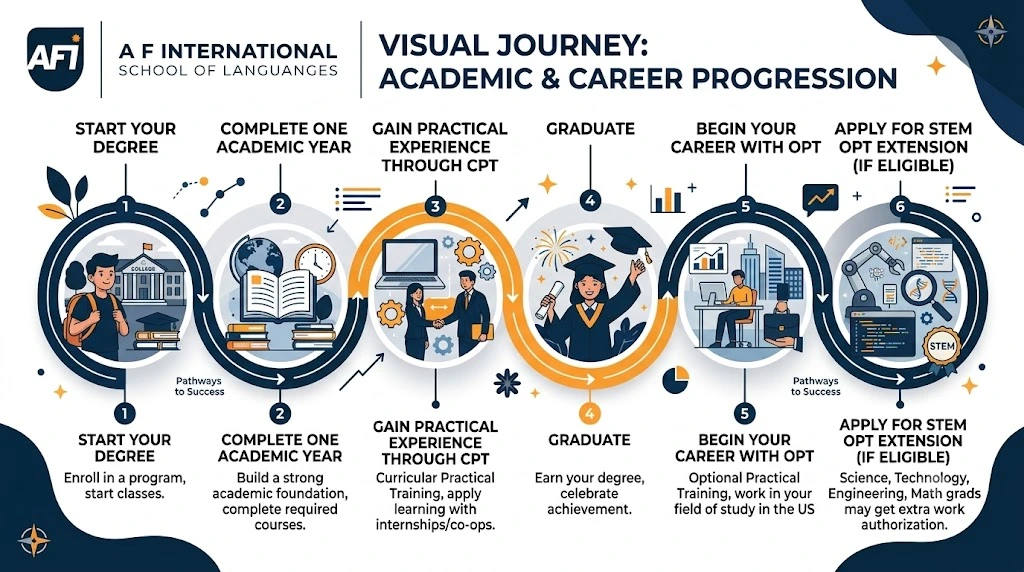
CPT and OPT support different stages of an F-1 student’s academic and career journey. While CPT helps students gain practical experience while they are still completing their studies, OPT allows eligible students to apply their academic knowledge in professional settings before or after graduation.
For many international students, practical training becomes an important part of preparing for a future career in the United States. CPT may provide an opportunity to complete internships, co-ops, or other curriculum-related experiences during a degree program. After completing their studies, eligible students may use OPT to continue building professional skills through employment related to their field of study.
A typical F-1 student journey may look like this:
| Academic Stage | Work Authorization Option | Purpose |
| Starting a U.S. degree program | Full-time study | Build academic knowledge and adjust to the U.S. education system |
| During the program | CPT (if eligible) | Gain practical experience through internships, co-ops, or required training related to your major |
| Near graduation (optional) | Pre-completion OPT | Gain additional work experience related to your field while completing your degree |
| After graduation | Post-completion OPT | Work in a position related to your major and develop professional experience |
| After OPT (if eligible) | STEM OPT Extension | Continue working for an additional 24 months if your degree and employment meet STEM requirements |
Many students use CPT and OPT at different points in their academic journey. Eligible students may use both CPT and OPT during different stages of their education. A common pathway is completing a curriculum-related internship through CPT while studying and later using post-completion OPT after graduation.
However, planning ahead is important because your choice of practical training opportunities can affect your future options. Before accepting any employment opportunity, consult your Designated School Official (DSO) to confirm that you meet all F-1 requirements.
Building career opportunities in the U.S. also requires more than work authorization. Strong English communication skills, academic confidence, and professional readiness can help international students make the most of internship and employment opportunities throughout their journey.
CPT vs. OPT: Which Option Is Right for You?
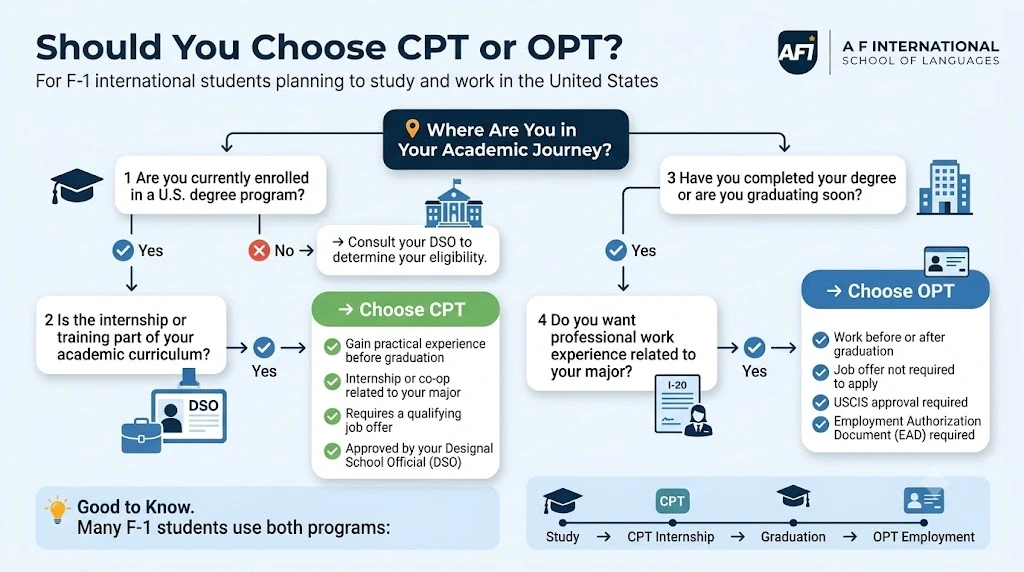
Choosing between CPT and OPT depends on where you are in your academic journey and what type of experience you want to gain. CPT and OPT are not competing options—many students use CPT during their studies and OPT after graduation.
Choose CPT if you:
- Are currently enrolled in a U.S. academic program
- Want to gain practical experience before graduation
- Need an internship, co-op, practicum, or training experience connected to your coursework
- Have an opportunity that meets your school’s CPT requirements
- Need work experience that is part of your academic curriculum
Choose OPT if you:
- Are completing your degree or have recently graduated
- Want to gain professional experience related to your major
- Need flexibility to work with an employer after completing your studies
- Plan to build your career experience in the United States
- May qualify for additional time through the STEM OPT extension
Quick Tip for F-1 Students: Your choice should depend on your academic timeline, career goals, and long-term plans. Before accepting employment opportunities, speak with your Designated School Official (DSO) to confirm that the work authorization option you choose meets F-1 requirements.
Does CPT Affect OPT?
Yes—but only in certain situations.
Many students worry that using CPT will automatically reduce or eliminate their future OPT eligibility. In most cases, that’s not true. The deciding factor is whether your CPT is part-time or full-time, and how long you participate in it.
Full-Time CPT
If you complete 12 months or more of full-time CPT at the same education level, you generally become ineligible for post-completion OPT.
This rule doesn’t mean you should avoid full-time CPT. Instead, understand how much CPT you are using and discuss your long-term plans with your DSO before accepting an extended internship or co-op.
Part-Time CPT
Authorized part-time CPT generally does not reduce your 12-month OPT eligibility.
That’s why many students complete part-time internships during the academic year and still qualify for OPT after graduation.
Common Misconceptions
| Myth | Reality |
| Any CPT removes OPT eligibility. | Only 12 months or more of full-time CPT generally affects post-completion OPT eligibility. |
| Part-time CPT counts toward the 12-month limit. | Part-time CPT doesn’t have the same impact on OPT eligibility. |
| Completing one internship means you can’t apply for OPT later. | Many students complete CPT internships and still qualify for OPT after graduation. |
Planning ahead can help you make the most of both programs while protecting your future work authorization.
| What Is the 24-Month STEM OPT Extension? For many international students, 12 months of post-completion OPT provides valuable professional experience after graduation. However, eligible graduates with qualifying Science, Technology, Engineering, and Mathematics (STEM) degrees may have an opportunity to continue working in the United States for even longer through the 24-Month STEM OPT Extension. Because rules in this area shift, it’s worth staying current on policy updates affecting post-study work options as you plan your timeline. The extension provides eligible graduates with additional time to gain professional experience in their field. Who Is Eligible for the STEM OPT Extension? To qualify for the STEM OPT extension, you generally must:Be in a valid period of post-completion OPTHave an eligible bachelor’s, master’s or doctoral degree with a CIP code on the DHS STEM Designated Degree Program ListHave earned the degree from a qualifying accredited, SEVP-certified institutionWork at least 20 hours per week for each qualifying employerWork for an employer participating in E-VerifyComplete Form I-983 with a qualifying employerMaintain a bona fide employer-employee relationship and meet all reporting requirementsBecause immigration regulations can change, it’s important to review the latest USCIS guidance and consult your Designated School Official (DSO) before applying. Benefits of the STEM OPT Extension For eligible graduates, the STEM OPT extension offers several advantages, including:Up to 24 additional months of work authorizationMore time to gain industry-specific experienceContinued professional development in your fieldAdditional opportunities to pursue long-term employment, including employer-sponsored work visas When Should You Apply? Planning ahead is essential.Rather than waiting until your initial OPT period is about to end, begin discussing the extension with your DSO well in advance. Applying within the appropriate timeframe can help prevent interruptions to your employment authorization. Good to Know: Not every degree qualifies for the STEM OPT Extension. If you’re unsure whether your program is STEM-designated, ask your DSO before making long-term career plans. |
How Students Typically Prepare for CPT and OPT
Preparing for CPT and OPT involves more than understanding work authorization requirements. Many international students start building the skills and experience they need well before applying for practical training opportunities.
Common preparation steps include:
1. Strengthen English Communication Skills
Strong English skills can help students participate confidently in classes, communicate with professors and classmates, prepare for interviews, and succeed in professional environments.
2. Build Academic Confidence
Understanding U.S. classroom expectations, improving study skills, and adapting to academic communication styles can make the transition to U.S. education smoother.
3. Prepare Professional Documents
Students often begin preparing for future opportunities by creating resumes, practicing interview skills, and learning how to present their academic background and experience to potential employers.
4. Understand Workplace Expectations
Learning professional communication, workplace etiquette, and industry expectations can help international students transition more confidently into internships and professional roles.
5. Plan Early With Your School
Students should discuss their academic plans, internship opportunities, and work authorization options with their Designated School Official (DSO) to understand eligibility requirements and important timelines.
Building these skills early can help international students feel more prepared when pursuing opportunities such as CPT and OPT. AF International School of Languages supports students in developing English communication skills and academic confidence needed for success in U.S. education and professional environments.
How to Apply for Curricular Practical Training (CPT)
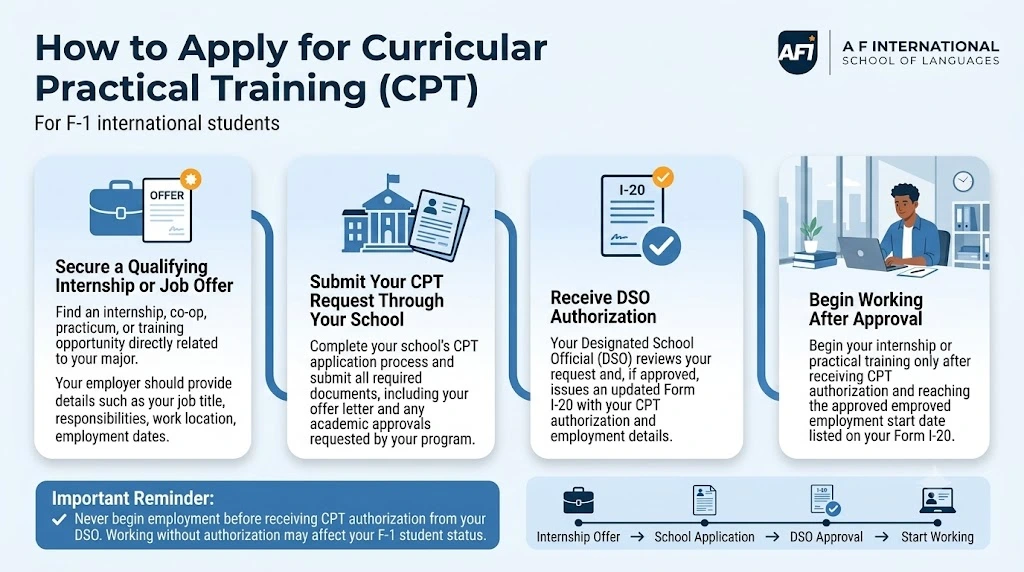
The CPT application process is managed through your school. While requirements vary by institution, most students follow these steps:
Step 1: Secure a Qualifying Internship or Job Offer
Find an internship or training opportunity related to your major. Your employer may need to provide details such as your job title, responsibilities, location, and employment dates.
Step 2: Submit a CPT Request Through Your School
Complete your school’s CPT application and provide required documents, such as your offer letter and any academic approvals required by your program.
Step 3: Receive CPT Authorization
If approved, your DSO will update your Form I-20 with CPT authorization. Review the details carefully before beginning employment.
Step 4: Start Working After Approval
You can begin your internship or training only after receiving CPT authorization and reaching your approved start date.
How to Apply for Optional Practical Training (OPT)
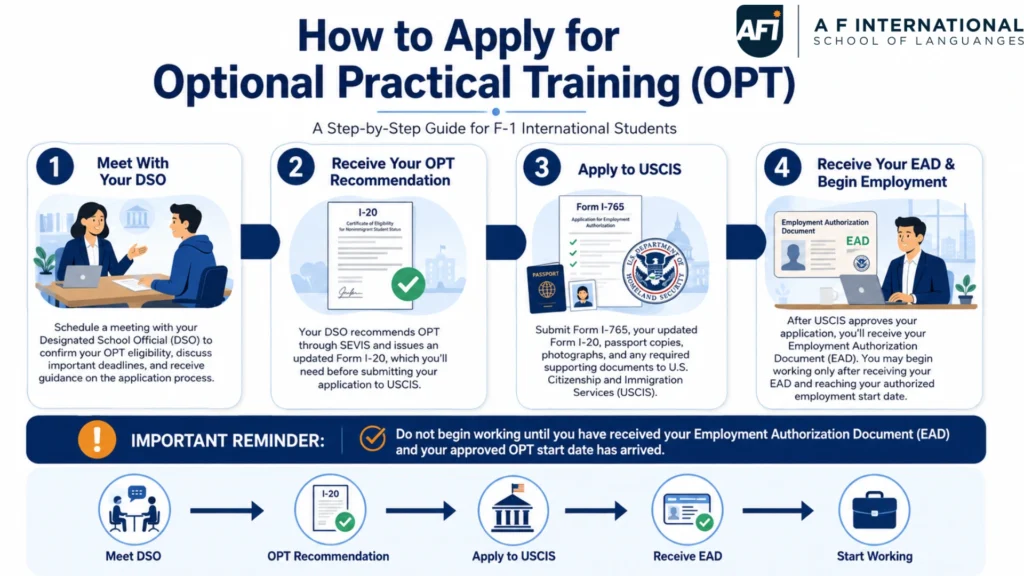
OPT requires approval from USCIS, so students should begin planning early. The process generally includes:
Step 1: Meet With Your DSO
Your DSO will review your academic and SEVIS record, determine whether to recommend OPT in SEVIS, and provide an updated Form I-20. USCIS makes the final eligibility and authorization decision.
Step 2: Submit Your Application to USCIS
Submit Form I-765 along with your updated Form I-20 and required supporting documents.
Filing windows are strict. For post-completion OPT, USCIS currently permits filing up to 90 days before and no later than 60 days after the program end date. The application must also be filed no more than 30 days after the DSO enters the OPT recommendation in SEVIS. Always verify the current filing window before submitting.
Step 3: Receive Your EAD Card
If USCIS approves your application, you will receive an Employment Authorization Document (EAD) confirming your work authorization.
Step 4: Begin Employment After Authorization
You may begin working only after receiving approval, your EAD card, and reaching your authorized start date.
Common Mistakes International Students Should Avoid
Applying for CPT or OPT involves more than submitting paperwork. Small mistakes can delay your work authorization or even affect your F-1 student status.
Understanding the most common pitfalls can help you prepare a stronger application and avoid unnecessary complications.
| Common Mistake | How to Avoid It |
| Waiting until the last minute to apply | Start planning early and keep track of important deadlines. |
| Beginning work before receiving authorization | Wait until you’ve received the required approval and reached your authorized employment start date. |
| Accepting a position unrelated to your major | Make sure your job directly relates to your field of study before accepting employment. |
| Assuming all internships qualify for CPT | Confirm that your internship meets your school’s academic requirements before applying. |
| Misunderstanding CPT rules | Review how your CPT participation may affect future OPT eligibility. |
| Submitting incomplete or inaccurate applications | Carefully review all forms and supporting documents before submitting them. |
| Relying on outdated immigration information | Always consult your DSO and review the latest USCIS guidance before making decisions. |
Before You Apply, Ask Yourself
Use this quick checklist before applying for CPT or OPT:
✓ Do I meet the eligibility requirements?
✓ Is my employment directly related to my major?
✓ Have I completed all required application steps?
✓ Do I have the necessary authorization before starting work?
✓ Have I discussed my plans with my Designated School Official (DSO)?
Taking a few extra minutes to review these questions can help you avoid delays and stay compliant with F-1 student regulations.
Prepare for U.S. Academic and Professional Communication
Work authorization is only one part of professional success. International students also need the English skills to participate in classes, explain their qualifications, complete interviews, collaborate with colleagues, and communicate professionally.
AF International helps international students build academic and professional English through small classes, experienced instructors, personalized placement, and practical communication activities. Programs are available at our Pasadena and Thousand Oaks campuses for students preparing for university, career advancement, or greater confidence in the United States.
CPT and OPT are not available through AF International’s English-language programs. However, AFI can help you develop the communication skills needed for your future academic and professional goals.
Explore our Intensive English Program or speak with an admissions advisor.
Conclusion
CPT and OPT serve different purposes for eligible F-1 degree students. CPT provides curriculum-related training during an academic program, while OPT provides temporary employment authorization for work related to a student’s major. Because eligibility, timing and authorization requirements vary, students should speak with the DSO at the school that controls their SEVIS record before accepting employment.
Build the English Skills for Your Next Step
Preparing for a U.S. college, university or professional environment? AF International can help you strengthen the academic and workplace English needed for classes, interviews and future career opportunities.
Our students benefit from:
- Small, interactive English classes
- Experienced instructors
- Personalized placement and feedback
- Academic and professional communication practice
- Pasadena and Thousand Oaks campus options
- Full-time English programs for eligible F-1 students
Explore the Intensive English Program
Contact AF International Admissions
Additional Resources for F-1 Students
For the most up-to-date information about CPT, OPT, and STEM OPT requirements, students should review official guidance from:
- U.S. Citizenship and Immigration Services (USCIS)
- Study in the States (Department of Homeland Security)
- Their school’s Designated School Official (DSO)
Frequently Asked Questions
Yes. Completing 12 months or more of full-time CPT at the same education level generally makes students ineligible for post-completion OPT. Part-time CPT typically does not have the same impact.
No. CPT authorization is documented on your updated Form I-20, so an EAD isn’t required.
Remote or hybrid employment may be possible when the position otherwise satisfies OPT requirements, is directly related to the student’s major and is properly reported. STEM OPT has additional employer, supervision, worksite and Form I-983 requirements. Students should confirm a remote or hybrid arrangement with their DSO before beginning or changing employment.
Travel may be possible during OPT, but the required documents depend on whether your application is pending or approved. Before making travel plans, consult your DSO and review current USCIS guidance.
OPT may be authorized for up to 12 months at an eligible educational level. Time used for pre-completion OPT reduces the post-completion OPT available at the same educational level. Eligible students with qualifying STEM degrees and employment may receive an additional 24-month STEM OPT extension. Employment authorization length is different from how long a student may remain in F-1 status.
OPT doesn’t automatically lead to an H-1B visa. However, many graduates use OPT to gain experience with employers who later choose to sponsor them for H-1B status.
The cap-gap extension may automatically extend F-1 status—and, for certain students, OPT employment authorization—when a qualifying, cap-subject H-1B petition requesting change of status is timely filed. A petition does not need to be approved before the cap-gap period begins. Students whose OPT has already ended may receive an extension of status without an extension of employment authorization. Confirm individual eligibility with your DSO and current USCIS guidance.
CPT requires a qualifying internship or job offer before authorization. OPT does not require a job offer to apply, but any employment must relate to your major.