
Can You Transfer Schools After OPT?
Yes. Eligible F-1 students may be able to transfer their SEVIS record to another SEVP-certified school after post-completion OPT, including during the applicable grace period.
If your OPT is ending and you want to continue full-time study, it is important to plan early. You may need time to receive admission, coordinate your SEVIS transfer-release date with your current DSO, and begin your new program within the applicable timeline.
Interested in continuing your studies at AFI Pasadena? Tell us your OPT end date, current school, and preferred start date, and our admissions team can explain AFI’s transfer-in requirements and available program dates.
USCIS currently states that during the 60-day grace period following authorized post-completion OPT, an eligible F-1 student may transfer to another SEVP-certified school.


SEVP-Certified School

CEA-Accredited

F-1 Transfer-In Support

Pasadena, California
If your post-completion OPT is ending and you want to continue studying in the United States, timing matters.
You may need to choose your next program, receive admission, coordinate a SEVIS transfer-release date with your current school, and begin your new program within the applicable F-1 transfer timeline.
AF International School of Languages (AFI) in Pasadena welcomes eligible international students into its full-time Intensive English Program and provides support with AFI’s F-1 transfer-in process.
This guide explains what happens when OPT ends, how a SEVIS transfer after OPT works, which dates you should pay attention to, and how AFI Pasadena can help with the transfer-in process.
What Happens When Your OPT Ends?
Your OPT end date is the last day of the post-completion OPT employment authorization shown on your Employment Authorization Document (EAD).
When your authorized OPT period ends, your OPT employment authorization generally ends as well.
There is another date that can be just as important if you are transferring schools: your SEVIS transfer-release date.
If your SEVIS record is released to another school while your OPT is still active, your existing OPT authorization ends on the transfer-release date. If you are still working, discuss the timing carefully with your current DSO before choosing that date.
What Is the 60-Day Grace Period After OPT?
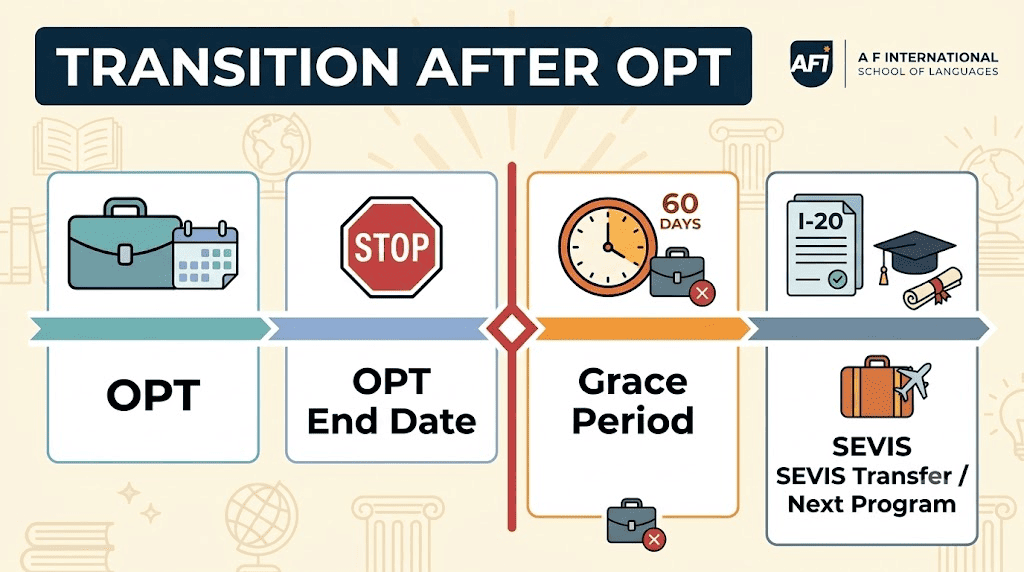
Eligible F-1 students who complete authorized post-completion OPT generally have a 60-day grace period following the end of OPT.
During this transition period, eligible students may take certain next steps, including transferring to another SEVP-certified school.
The grace period does not extend your OPT employment authorization. You should not assume you can continue working simply because you are still within the grace period.
If you plan to continue studying, do not treat Day 60 as the day to begin looking for another school. Admission, documentation, SEVIS transfer processing, the transfer-release date, and your new program start date all require coordination.
Is Your OPT Already Ending Soon?
USCIS currently recognizes school transfer as one of the options during the post-completion OPT grace period, while ICE states that the grace period itself does not provide additional employment authorization.
Can You Transfer Your SEVIS Record After OPT?
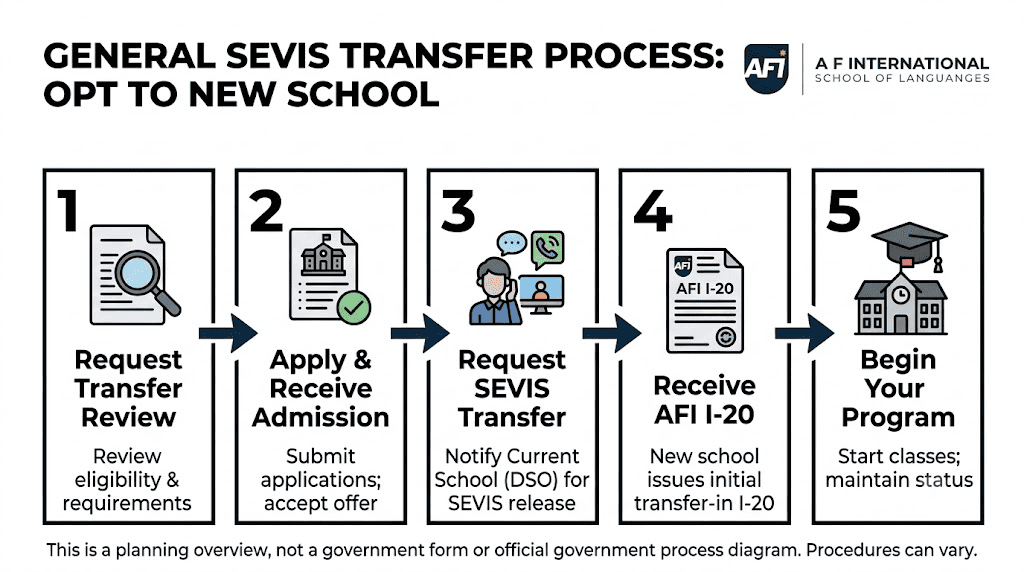
Yes. Eligible F-1 students may be able to transfer their SEVIS record after OPT to another SEVP-certified school. For the full process, see our guide on how to transfer between U.S. schools on an F-1 visa.
The transfer is not automatic. You generally need to be accepted by the transfer-in school and work with your current Designated School Official (DSO) to establish a SEVIS transfer-release date.
Your new program start date also matters. SEVP guidance requires transfer students to begin their new program by the applicable next available session/five-month transfer timeframe.
Because the dates depend on the student’s individual situation, coordinate the transfer-release date with your current DSO and confirm the available program start date with your new school before completing the transfer.
Study in the States says an F student transferring between schools generally must begin at the next available session or within the applicable five-month period, whichever comes earlier.
SEVIS Transfer After OPT: Your Timeline at a Glance
Before Your OPT Ends
Research your next program and contact the transfer-in school whenever possible.
Receive Admission
Complete the school’s admission requirements before your current school transfers your SEVIS record.
Choose Your Transfer-Release Date
Work with your current DSO. If you are still using OPT employment authorization, remember that the transfer-release date can end the remaining OPT authorization.
Transfer Your SEVIS Record
Your current school releases the record to the new school on the agreed transfer-release date.
Receive Your New I-20
The transfer-in school completes the applicable transfer-in process.
Begin Your New Program
Start by the applicable program-start deadline and complete the school’s reporting and enrollment requirements.
Want to Continue With AFI Pasadena?
Why Continue Your Studies at AFI Pasadena After OPT?
If your next educational goal is to strengthen your English through structured, full-time study, AFI Pasadena offers an Intensive English Program for eligible international students.
At AFI, students develop English skills including speaking, listening, reading, writing, grammar, pronunciation, communication, and fluency across multiple proficiency levels.
AFI Pasadena also provides support with the school’s transfer-in process, including admission requirements, AFI documentation, available program dates, and school check-in requirements.
Our Pasadena campus gives international students the opportunity to study English in a smaller, supportive learning environment while living in one of Southern California’s most recognized educational and cultural communities.
SEVP-Certified School
CEA-Accredited
F-1 Transfer-In Support
Pasadena, California
OPT Ending Soon? Let Us Review Your AFI Transfer Timeline
Intensive English Program
AFI’s intensive ESL program offers instruction across multiple English proficiency levels, from beginner through advanced. Coursework focuses on areas such as grammar, reading, writing, listening, pronunciation, communication, and fluency.
For students who want to strengthen their English before pursuing another academic or professional goal, an intensive English program may provide a structured next step.
F-1 and I-20 Support
AFI is authorized to enroll eligible F-1 students in qualifying full-time study and issue Form I-20s to eligible admitted students.
AFI’s admissions and DSO team can explain the school’s current transfer-in requirements, required documents, available program dates, and AFI’s portion of the SEVIS transfer process.
Admission or issuance of a Form I-20 does not by itself guarantee immigration status or eligibility. Students should continue coordinating their individual timeline with their current DSO.
Personalized Transfer-In Support
Transferring schools involves several dates and documents, but you do not have to guess what AFI needs from you.
Once you contact AFI, our team can explain the school’s admission requirements, provide the school information your current institution may request, confirm available AFI start dates, and guide you through AFI’s transfer-in and check-in procedures.
The earlier you contact us, the more time you have to coordinate the appropriate transfer date with your current DSO.
Pasadena Location and Program Availability
AFI’s Pasadena campus is located near Downtown Pasadena.
Students can study in a walkable Southern California city with access to restaurants, cafés, shopping, public transportation, and the greater Los Angeles area.
If Pasadena is where you want to continue your studies, contact AFI before your transfer is completed so you can confirm the school’s available program dates and admission requirements.
Who May Consider AFI Pasadena After OPT?
AFI Pasadena may fit students whose genuine next educational goal is to improve their English through structured, full-time study.
Students may choose intensive English to strengthen communication for future university study, academic success, professional communication, or greater everyday English fluency.
If your goal is primarily continued employment rather than full-time English study, remember that transferring your SEVIS record is different from continuing OPT. A SEVIS transfer can end remaining OPT employment authorization, so coordinate the timing with your current DSO before choosing a transfer-release date.
SEVIS Transfer vs. F-1 Visa Transfer: What’s the Difference?
Students sometimes call the school-change process an “F-1 visa transfer.” Technically, when an F-1 student changes schools in the United States, the school-to-school process generally involves transferring the student’s SEVIS record, not transferring the visa itself. If you want a closer look at how SEVIS records get updated in general, see our step-by-step guide to the SEVIS record update process.
Your F-1 visa and SEVIS record serve different purposes:
|
F-1 Visa |
SEVIS Record |
|
Used when seeking admission to the U.S. in F-1 classification |
Contains your F-1 student record |
|
Issued through a U.S. embassy or consulate |
Managed through SEVIS and your school |
|
Is not transferred from school to school |
Can be transferred between eligible schools |
|
Particularly relevant for international travel/re-entry |
Used in the school-transfer process |
When Should You Start Your SEVIS Transfer After OPT?
Start before your OPT end date whenever possible.
You may need time to compare programs, complete admission requirements, submit financial and immigration documents, receive acceptance, coordinate your transfer-release date, and confirm an appropriate program start date.
If your OPT is already ending soon, do not assume you are too late. Contact AFI Pasadena so our team can explain the school’s current admission requirements, available program dates, and transfer-in process.
Starting early is especially important if your preferred school has specific admission requirements or limited start dates. You can also review our update on proposed F-1 transfer and post-study guidelines for additional background on possible policy changes.
What Should You Prepare for an AFI F-1 Transfer Review?
Transfer and admission requirements vary by student, but documents commonly needed during the process may include your valid passport, current Form I-20, OPT EAD if applicable, financial documentation, and AFI application materials.
Additional documents may be requested depending on your situation.
You do not need to wait until every document is ready to contact AFI. If your OPT is ending soon, you can first tell us your OPT end date, current school, and preferred start date.
How to Transfer Your SEVIS Record to AFI Pasadena
Step 1: Contact an Advisor
Tell us your OPT end date, current school, and preferred AFI Pasadena start date.
Our admissions team can explain AFI’s current admission requirements, available program dates, and transfer-in steps before you complete the full application.
Step 2: Apply and Receive Admission to AFI
If you decide to continue with AFI, complete the application and submit the required admission and financial documents.
Step 3: Coordinate Your SEVIS Transfer With Your Current DSO
After admission, work with your current DSO to arrange the transfer of your SEVIS record to AFI and establish the appropriate transfer-release date.
If you are still working under OPT, discuss how the selected release date will affect your remaining employment authorization before the transfer takes effect.
Step 4: Receive Your AFI Transfer I-20
After your SEVIS record is released to AFI and AFI has access to the record, the school can complete the applicable transfer-in I-20 process.
Step 5: Check In and Begin Classes at AFI
Follow AFI’s reporting, registration, document, and attendance requirements and begin your program by the required start date.
5 F-1 Transfer Mistakes to Avoid When OPT Is Ending
When your OPT is ending, small timing mistakes can create unnecessary problems with your next program and SEVIS transfer. If you plan to continue studying in the United States, avoid these common mistakes.
1. Waiting Until the End of Your Grace Period
Do not wait until the final days of your 60-day grace period to start looking for your next school.
You may still need time to choose a program, complete admission requirements, submit financial and immigration documents, receive acceptance, and coordinate your SEVIS transfer with your current DSO.
Starting earlier gives you more time to plan your transfer and confirm that your new program start date works with your timeline.
If your OPT is already ending soon, you can contact AFI Pasadena to learn about current admission requirements and available program start dates.
2. Choosing a SEVIS Transfer-Release Date Without Considering Your OPT
Your SEVIS transfer-release date can affect your remaining OPT employment authorization.
If your OPT is still active, transferring your SEVIS record to your new school may end your current OPT authorization on the transfer-release date.
Before selecting a release date, talk with your current DSO and make sure you understand how the timing may affect your employment and transition to your new program.
3. Assuming Admission Automatically Transfers Your SEVIS Record
Being accepted by a new school does not automatically transfer your SEVIS record.
Admission and SEVIS transfer are separate steps. After you are accepted, you generally need to work with your current DSO to request the transfer of your SEVIS record to the new school.
Make sure you have completed both the admission process and the SEVIS transfer process before assuming your transfer is finished.
4. Ignoring Your New Program Start Date
Your new program start date is an important part of your F-1 transfer timeline.
Transfer students generally need to begin the new program within the applicable transfer timeframe, including the next available session and five-month requirements that may apply to their situation.
Before completing your SEVIS transfer, confirm the available start date with your new school and discuss the timing with your current DSO.
If you are considering AFI Pasadena, our admissions team can explain the available Intensive English Program start dates before you complete your transfer.
5. Confusing Your F-1 Visa With Your F-1 Status and SEVIS Record
Changing schools does not mean that your F-1 visa is being transferred from one school to another.
The school-to-school transfer process involves your SEVIS record. Your visa, SEVIS record, and F-1 status serve different purposes.
Understanding the difference is especially important if you are planning international travel or making decisions about your next program.
Not Sure Which Dates Apply to Your AFI Transfer?
If your OPT is ending and you are considering full-time English study at AFI Pasadena, you do not need to figure out the process alone.
Tell us your OPT end date, current school, and preferred start date, and our admissions team can explain AFI’s transfer-in requirements and available program dates.
Frequently Asked Questions
Eligible F-1 students may be able to transfer their SEVIS record to another SEVP-certified school during the applicable grace period after authorized post-completion OPT. The transfer should be coordinated with the current DSO and transfer-in school.
A transfer may be possible before the EAD end date, but the SEVIS transfer-release date can end the student’s remaining OPT employment authorization. Students who are still working should coordinate the date carefully with their current DSO.
F-1 transfer timing depends on the applicable dates. SEVP guidance generally requires the student to begin at the next available session or within the applicable five-month transfer period, whichever requirement applies earlier.
Eligible F-1 students may be able to transfer into a qualifying full-time English language program. AFI Pasadena offers intensive English study for eligible international students.
Eligible students may be able to transfer their SEVIS record to AFI Pasadena if they meet the applicable requirements and AFI admission requirements. You can begin by requesting an F-1 transfer review from AFI.
The school-to-school transfer process concerns the student’s SEVIS record rather than transferring the visa itself. Visa validity is especially relevant when seeking admission to the United States after international travel.
The post-OPT grace period itself does not provide additional OPT employment authorization.
Start with your OPT end date, current school, preferred start date, and basic contact information. AFI can then tell you which additional admission documents are required.
Conclusion
If your post-completion OPT is ending and your next educational goal is full-time English study, starting early gives you more time to coordinate admission, your SEVIS transfer-release date, and your next program start date.
AFI Pasadena can explain the school’s current admission requirements, available Intensive English Program dates, and AFI’s transfer-in process.
You do not need to have every document ready before contacting us.
Start by telling us your OPT end date, current school, and preferred start date.