
| Key Takeaways Know your level: Take a quick CEFR-based test, so you avoid classes that are too easy or too hard. Match course to goal: Choose General, Academic, or Business ESL based on whether you need daily life English, university admission, or career growth. Check accreditation: Pick schools approved by bodies like CEA, ACCET, or the British Council to avoid low‑quality or scam programs. Align with your lifestyle: Decide between online flexibility and in‑person immersion based on your time, budget, and energy. Ask smart questions before paying: Confirm visa suitability, placement tests, clear pathways, and hidden costs so the course truly moves you toward your next step. |
Learning English is an investment. It costs money, and more importantly, it costs your time.
If you type “learn English” into Google, you will see millions of results. Some are expensive universities, and some are cheap apps. Some promise you will be fluent in 30 days (which is a lie), and others look very serious and difficult.
How do you choose?
If you pick a course that is too hard, you will quit. If you pick one that is too easy, you will get bored. This guide is your map. We will break down exactly how to find the right English as a Second Language (ESL) course for your specific goals, budget, and learning style.
What Exactly is ESL?
First, let’s look at the basics. ESL stands for English as a Second Language.
An ESL student refers to people who live in an English-speaking country but grew up speaking a different language at home. However, many people now use the term “ELL” (English Language Learner) or “EFL” (English as a Foreign Language) because many learners use English as a global tool for business or travel, not just for survival in an English-speaking country.
Why Bother Learning?
- The Career Boost: Recruitment statistics show that bilingual employees can earn between 5% and 20% more per hour than their monolingual counterparts. In the global market, English is the “language of business.”
- Brain Health: When you learn a second language, your brain actually changes its shape and how it works. Scientific studies published by the NIH show that even in adults, the brain is flexible enough to grow new connections. This is called neural plasticity.
- Social Connection: It allows you to make friends from every corner of the world, not just your home country.
However, knowing why you want to learn is the easy part. The hard part is knowing what to learn.
But “I want to learn English” is a bad goal. It is too big. You need a specific path.
A doctor needs different English than a tourist. A university student needs different English than a grandmother wanting to talk to her grandkids.
To succeed, you must stop “just learning” and start “training” for a specific result.
Understanding Language Levels (The CEFR)
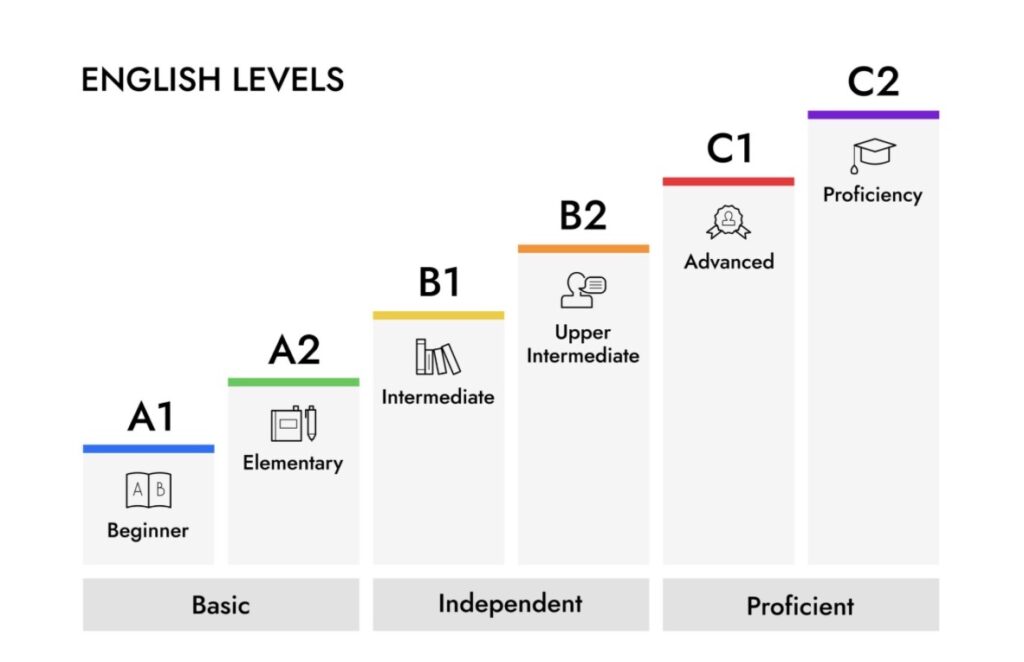
Most high-quality schools categorize their classes using these six lBefore you buy a course, you need to know where you stand. The world uses a standard system called the CEFR (Common European Framework of Reference for Languages). Think of this as a ruler that measures your ability.
Levels:
Milestone Exams: Many courses are designed to get you from one level to the next. If you finish a B2 course, schools will often ask you to take a certificate exam (like the Cambridge B2 First) to prove you actually reached that level.
| Level | Name | Description |
| A1 | Beginner | 1. Can understand and use familiar everyday expressions and very basic phrases. 2. Can introduce him/herself and ask simple questions about personal details. |
| A2 | Elementary | 1. Can understand sentences related to immediate relevance (e.g., shopping, local geography, employment). 2. Can communicate in simple and routine tasks. |
| B1 | Intermediate | 1. Can understand the main points of clear input on familiar matters (work, school). 2. Can describe experiences, events, dreams, and ambitions. |
| B2 | Upper Intermediate | 1. Can understand complex text on both concrete and abstract topics. 2. Can interact with a degree of fluency that makes regular interaction with native speakers possible without strain. |
| C1 | Advanced | 1. Can understand a wide range of demanding, longer texts. 2. Can use language flexibly and effectively for social, academic, and professional purposes. |
| C2 | Mastery / Proficiency | 1. Can understand with ease virtually everything heard or read. 2. The speaker has the precision and understanding of a highly educated native speaker. |
Milestone Exams: Many courses are designed to get you from one level to the next. If you finish a B2 course, schools will often ask you to take a certificate exam (like the Cambridge B2 First) to prove you actually reached that level.
The Assessment: Finding Your Starting Point
One of the biggest mistakes students make is joining a class that is too easy (you get bored) or too hard (you get frustrated). This is called Level Mismatch.
How to Check Your Level
- Professional Tools: If you want an official result, look at tests from the British Council or Cambridge English.
- Use Free Online Diagnostics: For casual learners, websites like EF Standard English Test (EF SET) offer a free, quick check of your reading and listening.
- The 4-Pillar Check: Real fluency is not just reading. You must assess four separate skills:
- Reading: Can you read a news article?
- Writing: Can you write an email to your boss?
- Listening: Can you understand a podcast?
- Speaking: Can you tell a story to a friend?
Note: It is normal to be B2 in Reading but only A2 in Speaking. Look for a course that helps your weakest pillar.
The “Big Three” Course Types
Not all English is the same. You must pick the “flavor” of English that matches your goal.
Type A: General English
This is for daily life. You will learn how to talk to neighbors, go to the doctor, and travel. Most General English courses focus on Communicative Language Teaching (CLT)—this means the teacher makes you speak in class rather than just staring at a grammar book.
Type B: Academic English (Exam Prep)
This is for University students and scholarships. These are serious, rigorous courses, such as the Intensive ESL Program at AF International, designed to help you pass a specific test required by universities.
- IELTS: Most popular in the UK, Canada, and Australia.
- TOEFL: The standard for the USA and academic research.
- The Pathway Concept: Some courses act as a “bridge.” If you pass a specific school’s Academic English program, you might be allowed to enter a university without taking the TOEFL.
Type C: Business/Professional English
This is for Managers, corporate employees, and career-switchers who need specialized training in English for Professionals. You will not talk about your “summer holiday.” You will learn how to write reports, give presentations, negotiate contracts, and understand industry-specific vocabulary.
Goal Alignment: Why Are You Here?
Motivation is the fuel that keeps you going when the grammar gets hard.
A one-size-fits-all approach to English instruction is ineffective because a learner’s goal dictates the necessary focus, course type, and learning intensity. This segmentation ensures learners invest their time in the most relevant material, leading to higher success rates and stronger engagement.
| Profile | Core Goal | Key Needs & Focus | Recommended Course Type |
| The Student(Academic Track) | University Admission: High scores on TOEFL, IELTS, SAT, GMAT. | Test Mastery: Strategies, academic vocabulary, complex essays, and endurance under pressure. | Intensive Preparation Course(High Level)Focus on timed practice, skimming/scanning, and heavy homework load. |
| The Job Seeker(Career Entry) | Employability: Getting a recognized certificate to pass HR filters. | Practicality: Workplace foundations, writing formal emails, and interview prep. | Certified Business English(Intermediate to Advanced)Focus on professional etiquette and a globally recognized certificate. |
| The Professional(Career Advancement) | Promotion & Leadership: Confidence in presentations, negotiations, and client management. | Soft Skills: Nuance, influence, cross-cultural communication, and fluency. | 1-on-1 Executive Coaching(Advanced / Proficiency)Highly customized, high-stakes dialogue practice. Certificate is secondary to results. |
| The New Resident(Survival & Integration) | Independence: Navigating daily life, forms, and administrative processes. | Functionality: “Survival English” for doctors, rent, and transport. Low-stress environment. | Community Conversational Class(Beginner to Intermediate)Task-oriented oral communication for real-world scenarios. |
Practical Logistics: Money, Time, and Quality
Now we get to the practical part. How do you choose your learning path and school?
Online vs. In-Person

- Online: Great flexibility and lower cost. However, it requires high self-discipline.
- In-Person: Total immersion. You practice English during the break, at lunch, and after class. This is the fastest way to learn.
The “18-Hour Rule” (For F1 Visa)
In the U.S., most SEVP-certified ESL programs require full-time enrollment (typically around 18 hours of class per week). This is considered “Full Time.” Anything less is “Part Time” and usually does not qualify for a visa.
| If you need help understanding the requirements, you can review our guide on F-1 Visa and I-20 information for international students. |
Accreditation: The Quality Check
This is the most important tip in this article. Just because a school has “English” in the name does not mean it is good. Scams exist.
Check if the school is accredited by a government-recognized body:
- In the USA: Look for ACCET (Accrediting Council for Continuing Education and Training) or CEA (Commission on English Language Program Accreditation).
- In the UK: Look for the British Council logo.
- Global: Look for IALC or Eaquals.
For example, at AF International, we are transparent about our status; you can view our accreditation details here.
The Teacher
Do not just accept “native speaker.” Always ask to meet the teachers or check their credentials before signing up.
- Certification: Does the teacher have a CELTA, TESOL, or TEFL certificate?
- Feedback: Do they correct your mistakes? A teacher who just smiles and nods is not helping you improve.
Learning Style
- Visual: Look for courses with videos, slides, and clear textbooks.
- Auditory: Look for courses with listening labs and accent training.
- Social: Look for courses with “breakout rooms” (for Zoom) or group projects.
Where to Look: A Quick Comparison
Here is a breakdown of where you can find these courses:
| Category | Key Examples | Best For… |
| Global Schools | British Council, Cambridge English, IDP, EF (Education First) | High-quality, standardized learning and recognized certificates. Safe and reliable. |
| International Schools | Kaplan, International House (IH), EC English | Immersive experiences. They have schools in many countries and often mix travel with study. |
| University Programs | State Universities, Community Colleges, Oxford University Press | Serious students who want an academic environment and campus life. |
| Specialized Coaching | Wall Street English, Berlitz | Professionals and career-switchers who need “Business English” specifically. |
| Online Marketplaces | Preply, iTalki, Cambly | 1-on-1 practice with tutors. You choose the price and the time. Good for speaking practice. |
| Local Community | Libraries, YMCA, Religious Centers | Beginners on a tight budget. Great for meeting local people in your new city. |
How AF International Fits These Paths
You don’t always have to choose between a “serious” university program and a “fun” vacation course. The best schools offer a mix of both under one roof.
At AF International, we designed our curriculum to match the specific profiles we listed above. Instead of forcing you into a single box, we offer specialized tracks that align with your real-world goals.
Here is how our specific programs match the goals we discussed:
- For the “Job Seeker” & “Professional”: We offer English for Professionals (customized for your career) and English for Communication, focusing on the speaking skills needed for the workplace.
- For the “Academic Student”: We provide rigorous Cambridge FCE & CAE Preparation courses and an Intensive ESL Program aligned with CEFR levels (A1-C2) to get you university-ready.
- For the “Tourist” & “Social Learner”: Our English Plus Fun program combines morning study with afternoon trips to Hollywood and Venice Beach. We also offer Short-term ESL for visitors on a brief stay.
- For the Mature Learner: Learning doesn’t stop at 25. Our 50+ English course allows mature students to improve their skills while enjoying Californian culture with peers.
You can view the full breakdown of these programs and explore our current course options here. If you’re comparing accredited ESL programs in California, explore our Intensive ESL and Professional English tracks to see which fits your goal
The “Before You Pay” Checklist
Before you hand over your credit card, ask these questions. If the school cannot answer them, walk away.
- Is it Accredited? (Check for CEA, ACCET, or British Council).
- Can they issue an I-20? (If you are applying for a US Student Visa, this is mandatory.)
- Is the “Social Program” included? Some schools charge extra for city tours and movie nights.
- Is there a free placement test? Never let a school “guess” your level.
- What is the Pathway? Is this course a dead-end? Or does it lead to a university degree or a job qualification?
- Are there hidden costs? You usually have to pay extra for textbooks and registration. Always download the official school catalog to see the full breakdown of fees.
Warning on Burnout: Be realistic. An “Intensive” course (20+ hours a week) is great for rapid growth, but it is exhausting. A “Part-time” course (4 hours a week) is slower but easier to manage if you have a job. Don’t start strong and quit after two weeks because you are tired.
Conclusion: Your Next 3 Steps
- Take a 15-minute level test. Search for “Free EF SET test” or “Cambridge English Level Test” right now.
- Define your “One Big Goal.” Write it down. (Example: “I want to pass the IELTS with a score of 6.5 by December.”)
- Book a trial lesson. Most online teachers and many local schools offer a free or cheap trial lesson. Try one this week.
Learning English is a journey, but you don’t have to walk it blind. Choose the right map, pack the right gear, and start walking.
Frequently Asked Questions (FAQ)
How long does it take to advance one CEFR level?
It generally takes about 200 hours of guided study to move up one full level (e.g., from B1 to B2). In an “Intensive” program (20+ hours/week), this takes about 10–12 weeks. In a part-time course, it can take a year.
Can I work while studying in the USA on an F-1 Visa?
Generally, no. F-1 students in language training programs rarely have off-campus work authorization. Do not plan on using a US salary to pay your tuition; immigration officials will deny your visa if you cannot prove you already have the funds.
What is the ideal class size?
Look for classes with 10 to 15 students. This is the “Goldilocks” zone—small enough that the teacher hears you speak every day, but large enough to have diverse partners for group activities. Avoid lecture halls with 30+ students.
What if my speaking is much weaker than my reading and writing?
Choose a course that clearly includes conversation practice, small groups, and teacher correction; if possible, add 1‑on‑1 speaking sessions or language exchange specifically to target your weaker skills.
What is the difference between a ‘Certificate’ and an ‘Official Exam’?
A school’s Certificate of Completion proves you attended the class. An Official Exam (like IELTS or Cambridge) proves your actual skill level to the world. If you need a credential for a job or university, you must take the Official Exam, not just finish the course.