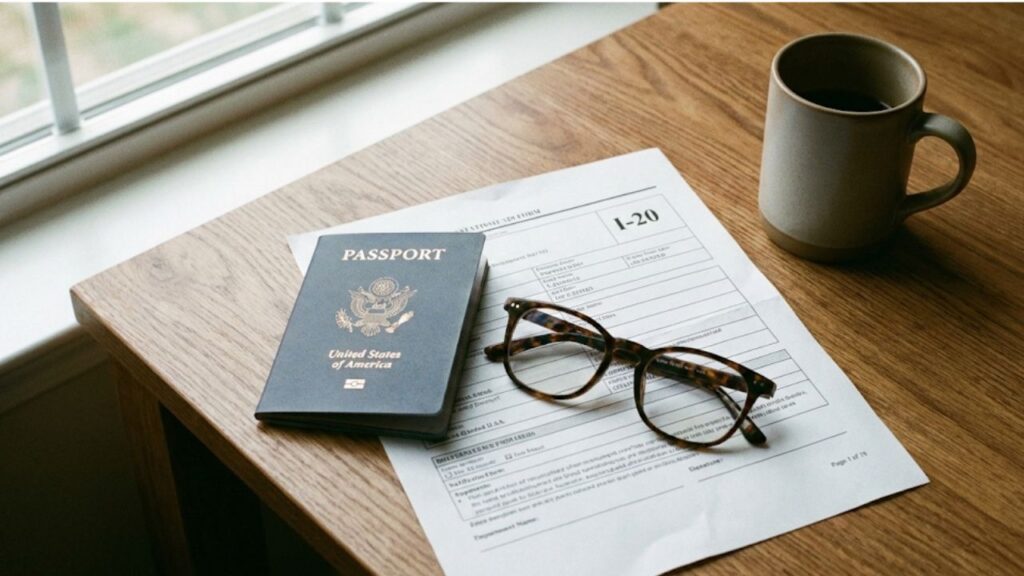
| At a Glance: F-1 Visa Interview Success Checklist ✔ Know your school, program, and financial details without looking at notes ✔ Organize your I-20, SEVIS receipt, and passport in a clear folder ✔ Dress professionally (business casual) ✔ Bring printed documents only (no electronics allowed) ✔ Answer confidently, clearly, and honestly |
You have your admission letter, your finances are finalized, and your forms are finished. Now, there is only one step left: The F-1 Visa Interview.
For many students, this is often the most stressful part of the process. Because, while knowing the right answers is important (check out our guide on [Top 12 F-1 Visa Interview Questions & Answers] for that!), how you present yourself matters just as much as what you say.
Why? Because a visa interview is very fast. An officer often makes a decision in the first two minutes of interaction. During that time, they aren’t just checking your facts—they are looking to see if you are a confident and honest student.
And so, to make those two minutes count, you need a plan that goes beyond just memorizing lines. Use these five tips to get organized, stay calm, and walk into the embassy feeling ready.
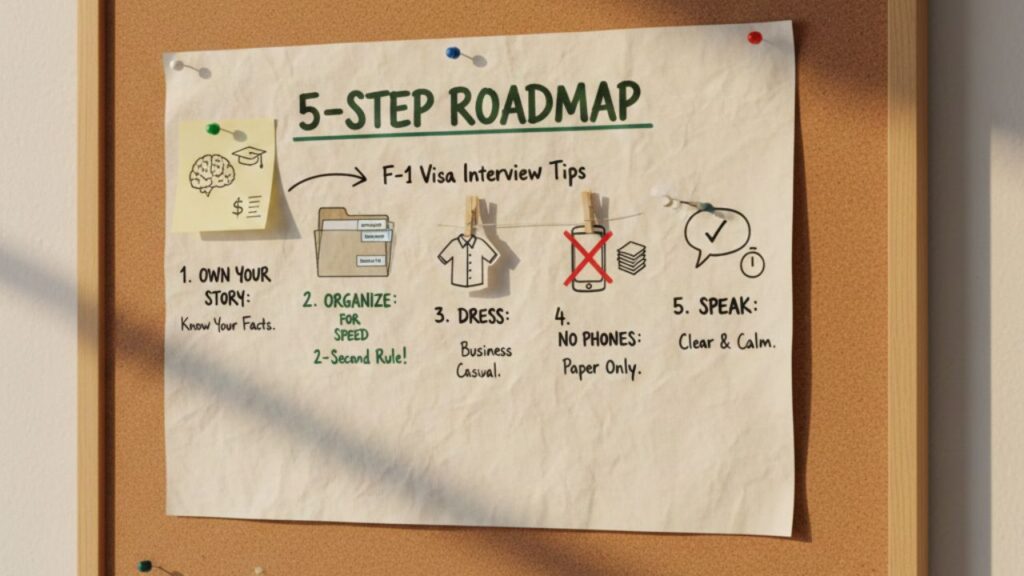
1. Know Your Application and School Details by Heart
The visa interview is a solo mission.
Parents, agents, and friends are not allowed inside the interview window (unless you are a minor).
You must speak for yourself.
What You Must Know:
- School name and campus location
- Your program (ESL, Intensive English, etc.)
- Tuition cost per term
- Who is sponsoring you
- Your sponsor’s annual income and savings
- Your long-term career plan
If your answer sounds like:
“My agent handled everything.”
That is a red flag.
If your answer sounds like:
“I chose this ESL program because I need advanced academic English before transferring into a U.S. university.”
That shows purpose.
🎯 Pro Tip: Officers are trained to detect rehearsed scripts. Speak naturally.
2. Keeping Your Papers Ready and Organized
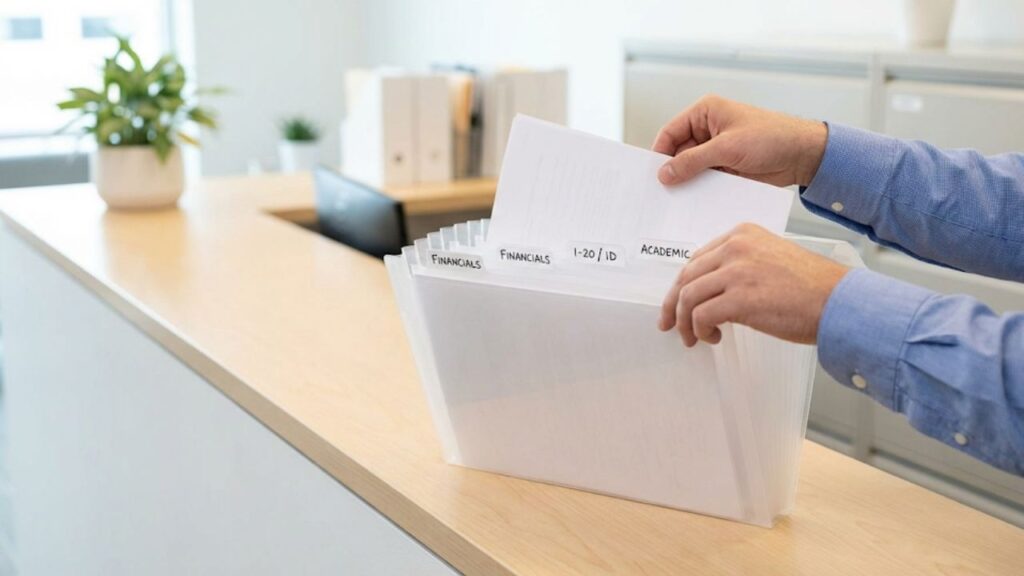
An organized student looks like a serious student. Nothing causes panic faster than an officer asking for your “bank statements” while you spend 30 seconds digging through a messy bag.
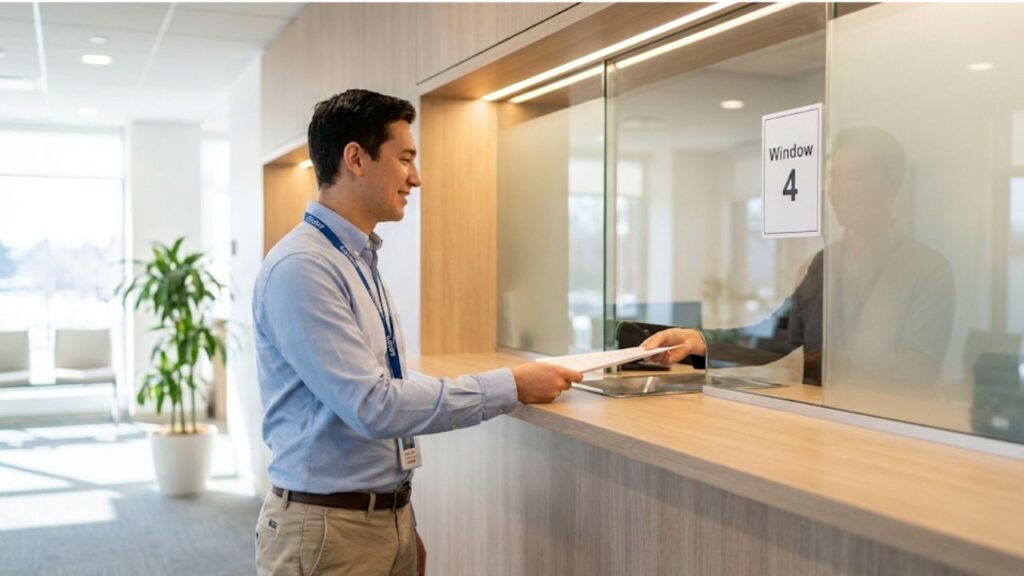
Remember, you will likely be standing at a small counter with a glass window between you and the officer. Because space is limited and you cannot bring large bags inside, you need to be able to find your documents quickly.
The Strategy:
- Use a Clear Folder: Organize your documents in a transparent folder with labeled tabs or dividers.
- Put Important Pages First: Keep your mandatory documents (Passport, I-20, SEVIS receipt, DS-160 confirmation) at the very front. Keep supporting documents (Bank statements, transcripts, affidavits) behind them.
- Find Documents Fast: You should be able to produce any document the officer asks for within two seconds. This smooth handling demonstrates that you are prepared, organized, and hiding nothing.
3. Dress Like a Serious Student
There is no official dress code.
But appearance affects perception.
Visa officers are making rapid judgments under time pressure.
Avoid:
❌ Gym clothes
❌ Flip flops
❌ Graphic t-shirts
❌ Overly casual attire
Aim for:
✔ Collared shirt or blouse
✔ Clean trousers or professional skirt
✔ Closed shoes
✔ Minimal accessories
You do NOT need luxury clothing.
You need to look respectful and focused.
Think: University presentation, not vacation.
4. Understand Security Rules Before You Arrive
Most U.S. consulates do not allow:
- Phones
- Smart watches
- USB drives
- Headphones
- Electronic keys
Bring printed copies only.
Do not say:
“It’s on my phone.”
You will not be allowed to access it.
Arrive early. Stay calm. Use waiting time to breathe and mentally review your goals.
5. Speaking Clearly, Honestly, and Calmly

It is completely normal to feel nervous. In fact, most officers expect it! However, extreme anxiety can sometimes be mistaken for dishonesty.
The interview is usually short often lasting only 2 to 5 minutes. The officer has a heavy caseload and wants to get through the interview efficiently.
The Strategy:
- Listen to the Question: Listen carefully to the question asked. If you didn’t hear it, politely ask, “Could you please repeat that?” It is better to ask than to give an irrelevant answer.
- Look at the Officer: Maintain polite eye contact. Looking down or away constantly can make you appear evasive.
- Keep it Concise: Because time is short, get to the point.
- Bad: “Well, ever since I was a child, I liked computers and my uncle gave me a laptop…”
- Good: “I chose this program because it offers a specialization in Cloud Computing, which aligns with my career goal of becoming a Solution Architect.”
- Be Honest: If you don’t know an answer (e.g., a specific detail about the U.S. city), admit it honestly rather than guessing. Honesty is valued above perfection.
What If Your F-1 Visa Is Denied?
A denial is not the end.
But you cannot simply reapply with the same answers.
You must:
✔ Identify the weakness
✔ Strengthen financial or home ties evidence
✔ Improve clarity of academic goals
Many students are approved on the second attempt when they prepare correctly.
Frequently Asked Questions About the F-1 Visa Interview
1. How long does the F-1 visa interview actually take?
Most F-1 visa interviews last between 90 seconds and 3 minutes. In some cases, it may be slightly longer, but decisions are often made very quickly.
Visa officers review your DS-160, SEVIS record, and I-20 before you even approach the window. The interview is primarily to confirm:
- Your academic intent
- Your financial readiness
- Your ties to your home country
Because the interview is short, your answers must be clear, direct, and confident. Long stories or unrelated details can weaken your case.
2. What are the biggest behavioral red flags to avoid?
Visa officers are trained to identify inconsistencies and scripted responses. The most common red flags include:
- Arguing or debating with the officer
- Giving memorized, robotic answers
- Providing vague or one-word responses
- Contradicting information listed on your DS-160
- Saying you plan to “stay in the U.S. permanently”
- Not knowing basic details about your school or sponsor
Even small inconsistencies between your spoken answers and your DS-160 form can trigger concern.
Stay calm. Stay honest. Stay consistent.
3. What happens if my F-1 visa is denied?
If your F-1 visa is denied, the officer will typically cite Section 214(b). This means they were not convinced you demonstrated strong non-immigrant intent — in other words, sufficient ties to your home country.
A denial does not permanently prevent you from reapplying.
However, you should not reapply immediately without strengthening your case. You must:
- Identify the weakness in your previous interview
- Improve documentation (financial proof or home ties)
- Clarify your academic and career goals
- Ensure all DS-160 information is accurate and consistent
Many students are approved on their second attempt after proper preparation.