
| Key Takeaways: • Most international ESL students do not need an ITIN or Social Security Number (SSN) just to study in the United States. • Most F-1 students qualify for an SSN only after they have eligible, authorized employment. Limited non-work exceptions may apply when a federal, state, or local law requires an SSN for a specific benefit. • An ITIN is used for tax reporting if you’re not eligible for an SSN but have certain U.S. tax filing requirements. • If you’re studying English full-time and have no job or taxable U.S. income, you may not need either number. • An ITIN does not give you permission to work, and an SSN is not automatically issued to every international student. • Understanding the difference can help you avoid applying for the wrong identification number and make tax season less confusing. |
Introduction
If you’re planning to study English in the United States on an F-1 visa, you may have come across two important identification numbers: the Social Security Number (SSN) and the Individual Taxpayer Identification Number (ITIN). Because both are associated with taxes and government records, it’s easy to assume every international student needs one.
In reality, these numbers serve different purposes and are issued under different circumstances. Whether you need an SSN, an ITIN, or neither depends on factors such as your employment authorization and tax filing responsibilities—not simply your student status.
This guide explains the differences between an SSN and an ITIN, who qualifies for each, and how to determine which identification number, if any, applies to your situation.
Quick Answer: Do You Need an SSN or ITIN?
Most F-1 ESL students do not need an SSN or ITIN just to study in the United States. An SSN may be available to students with authorized employment, while an ITIN is used for specific tax reporting situations when an SSN is not available.
| Your Situation | Do You Need an SSN? | Do You Need an ITIN? |
|---|---|---|
| You’re only studying English and have no job or taxable U.S. income | No | No |
| You have an authorized on-campus job | Yes | No |
| You’re approved for eligible work authorization related to your F-1 status | Yes | No |
| You have taxable U.S. income but aren’t eligible for an SSN | No | Yes |
| You’re only required to file Form 8843 and have no taxable income | No | Usually No* |
What Is a Social Security Number (SSN)?
A Social Security Number (SSN) is a nine-digit identification number issued by the U.S. Social Security Administration (SSA). It is primarily used to report employment earnings, process payroll, and meet U.S. tax reporting requirements.
International ESL students on an F-1 visa do not automatically receive an SSN. Most F-1 students may apply for an SSN after becoming eligible for authorized employment, such as qualifying on-campus employment. Very limited non-work exceptions may apply when an SSN is legally required for a specific government benefit or service.
Important for ESL students: F-1 students enrolled in English-language training programs are not eligible for Curricular Practical Training (CPT) or Optional Practical Training (OPT). Other limited employment options may be available, but students must speak with their Designated School Official (DSO) and obtain any required authorization before working.
Can an F-1 Student Get an SSN Without a Job?
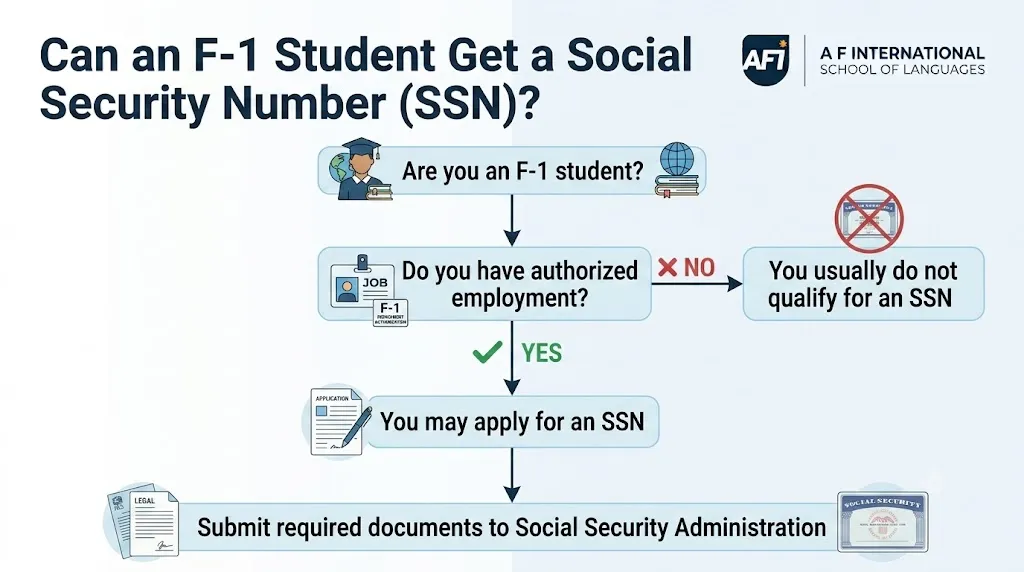
Generally, no. Most F-1 students become eligible for an SSN after obtaining qualifying, authorized employment. Limited non-work exceptions exist, but enrolling in an English-language program or entering the United States does not, by itself, make a student eligible for an SSN.
If you later secure eligible on-campus employment or another form of authorized work under your F-1 status, you can begin the SSN application process through the Social Security Administration (SSA). Until then, there’s usually no need to apply for an SSN.
Note: Receiving an SSN does not give you permission to work in the United States. You must first obtain valid work authorization before applying for an SSN.
What Is an Individual Taxpayer Identification Number (ITIN)?
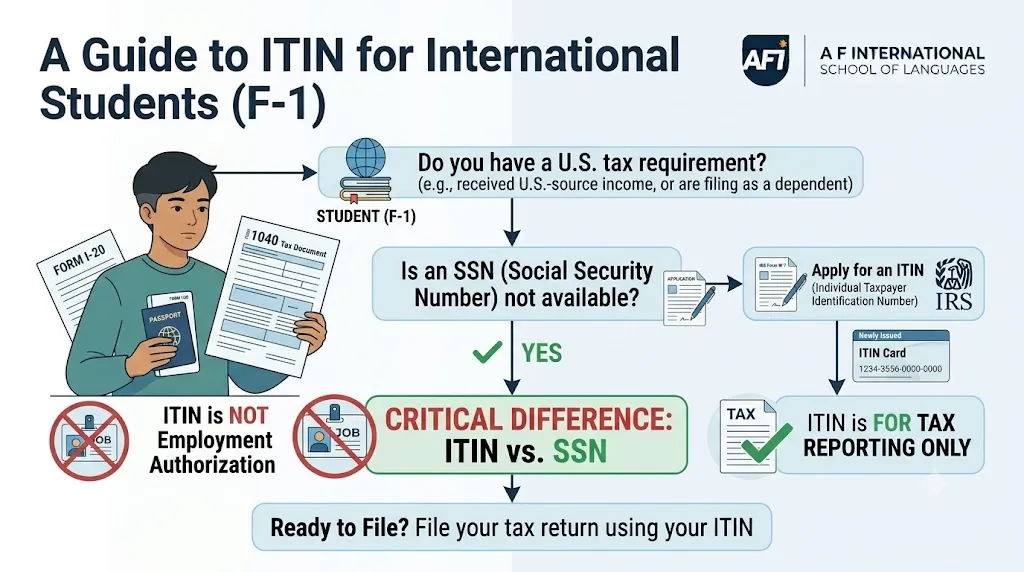
An Individual Taxpayer Identification Number (ITIN) is a tax identification number issued by the Internal Revenue Service (IRS) for individuals who have U.S. tax filing or reporting obligations but aren’t eligible for a Social Security Number (SSN).
An ITIN is only needed when you have a qualifying U.S. tax reporting requirement but are not eligible for an SSN, such as receiving certain taxable U.S.-source income.
Note: An ITIN is only used for tax purposes. It doesn’t authorize you to work in the United States, replace an SSN, or affect your immigration status.
For example: An F-1 ESL student receives a taxable scholarship but doesn’t have authorized employment and therefore isn’t eligible for an SSN. In this situation, the student may need an ITIN to meet IRS tax filing requirements.
Now that you understand what each identification number is, let’s compare them side by side to see how they differ in terms of eligibility, purpose, work authorization, and tax reporting.
SSN vs. ITIN: What’s the Difference?
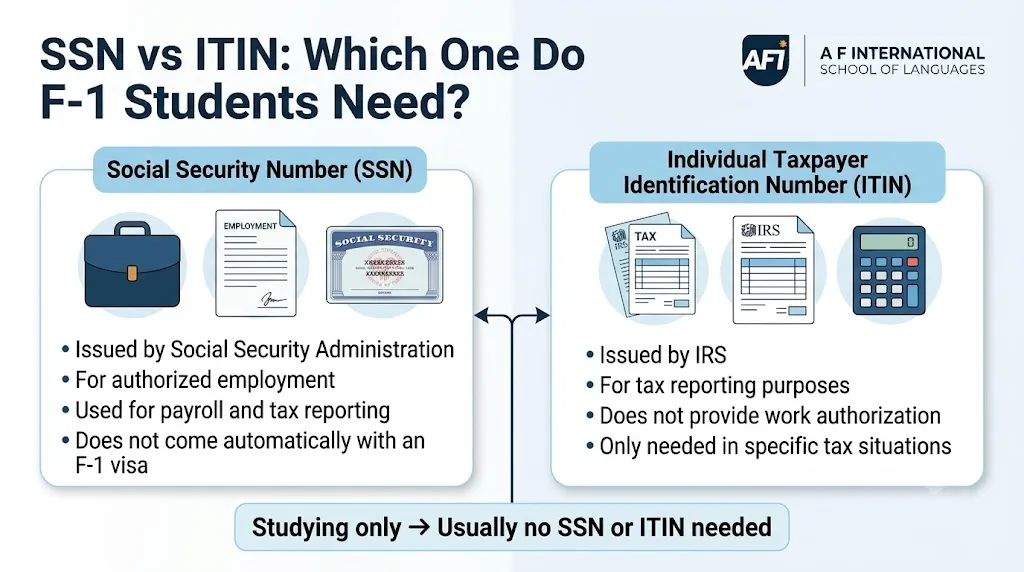
Although both an SSN and an ITIN are taxpayer identification numbers, they serve different purposes. The biggest difference is that an SSN is tied to authorized employment, while an ITIN is used only for tax reporting when someone isn’t eligible for an SSN.
For international ESL students, understanding this distinction can help you avoid applying for the wrong identification number.
| Feature | Social Security Number (SSN) | Individual Taxpayer Identification Number (ITIN) |
| Issued by | Social Security Administration (SSA) | Internal Revenue Service (IRS) |
| Primary purpose | Employment, payroll reporting, and tax identification | Tax reporting for individuals who aren’t eligible for an SSN |
| Who can apply? | Generally, noncitizens with DHS-authorized employment; limited non-work exceptions may apply. | Individuals with U.S. tax reporting obligations who don’t qualify for an SSN |
| Can international ESL students get one? | Generally, yes, after obtaining qualifying authorized employment. | Yes, but only if they have a qualifying tax filing requirement and aren’t eligible for an SSN |
| Can it be used to work? | An SSN does not authorize employment. It is used for wage and tax reporting after employment is authorized. | An ITIN does not authorize employment. It is used only for federal tax purposes. |
| Can it replace the other? | No | No |
| Used for filing taxes? | Yes | Yes |
| Required just to study in the U.S.? | No | No |
| Issued automatically with an F-1 visa? | No | No |
Which One Should an F-1 ESL Student Apply For?
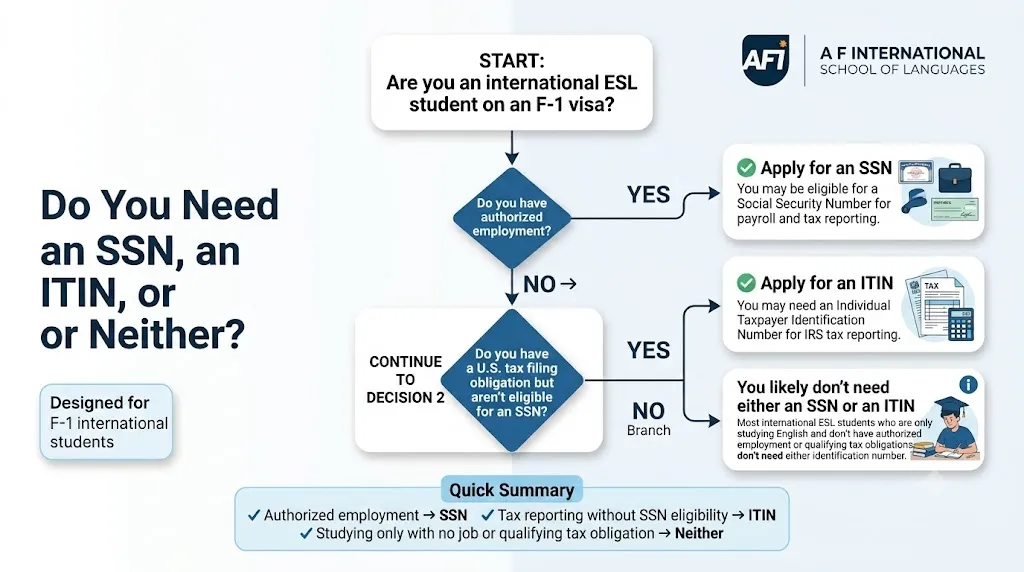
Your situation determines which number you need:
- Only studying English: You likely do not need an SSN or ITIN.
- Authorized employment: You may qualify for an SSN.
- Tax filing requirement without SSN eligibility: You may need an ITIN.
What If You Don’t Need an SSN or ITIN?
If you don’t qualify for an SSN or ITIN, you can usually continue your studies using other accepted identification documents. Your passport, visa, and Form I-20 are commonly used for many student-related activities, although requirements vary by organization.
In most cases, you can still:
- Attend classes and maintain your F-1 student status.
- Open a bank account, rent housing, and access everyday services using documents such as your passport, F-1 visa, and Form I-20 (requirements vary by organization).
If a company or organization requests an SSN or ITIN, ask whether they accept alternative forms of identification for international students. Many institutions accept alternative forms of identification, although their documentation requirements may vary.
How to Apply for an SSN or ITIN
The application process depends on your eligibility. Before applying, confirm whether you qualify for a Social Security Number (SSN) or need an Individual Taxpayer Identification Number (ITIN).
Applying for a Social Security Number (SSN)
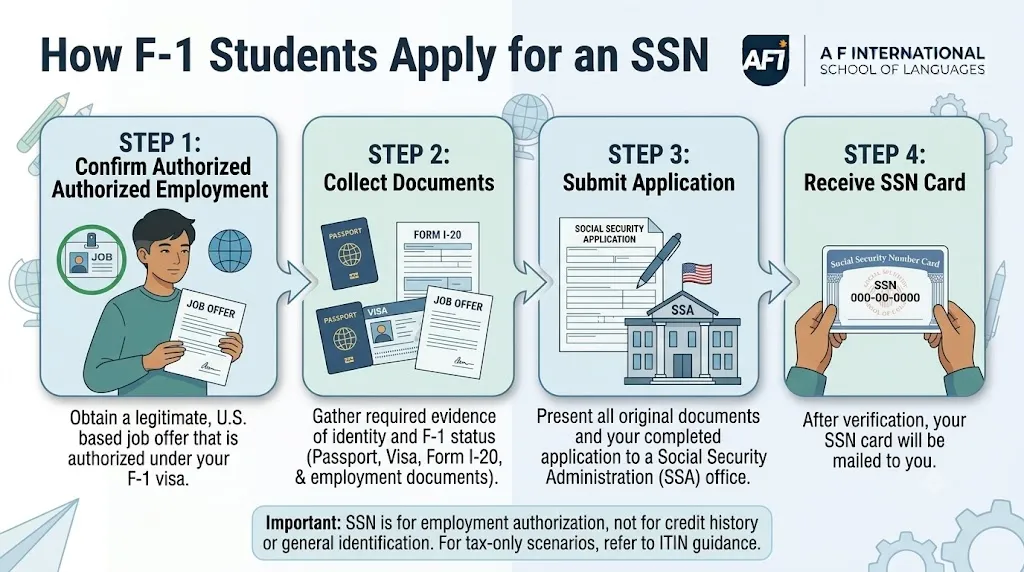
If you have authorized employment under your F-1 status, you can apply for an SSN through the Social Security Administration (SSA).
Step 1: Confirm your eligibility. Make sure you have approved employment authorization, such as an eligible on-campus job or other authorized work under your F-1 status.
Step 2: Gather the required documents. You’ll typically need your passport, F-1 visa, Form I-20, and employment-related documents required by the SSA.
Step 3: Submit your application. Start your SSN application online through the Social Security Administration. Then, follow SSA instructions to visit a Social Security office with the required original documents. If approved, your Social Security card will be mailed to you.
Applying for an Individual Taxpayer Identification Number (ITIN)
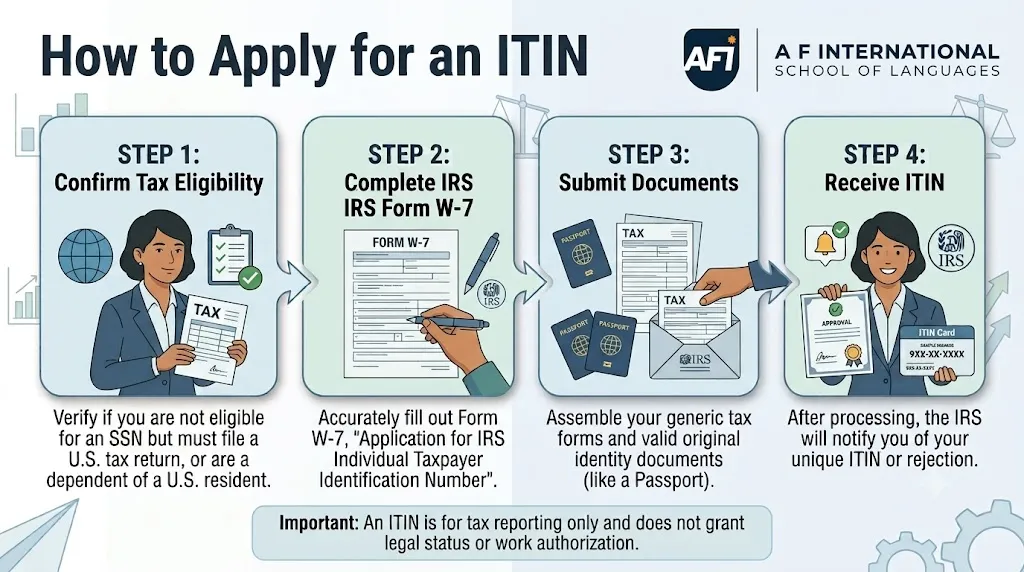
If you aren’t eligible for an SSN but have a qualifying U.S. tax filing requirement, you can apply for an ITIN through the Internal Revenue Service (IRS).
Step 1: Confirm your eligibility. Make sure you meet IRS requirements for obtaining an ITIN before submitting your application.
Step 2: Complete Form W-7 and prepare your documents. Gather the required identity and foreign status documents listed in the IRS instructions.
Step 3: Submit your application. In most cases, you must submit Form W-7 with a signed federal tax return and the required identity and foreign-status documents. Limited exceptions apply. Follow the current IRS instructions or obtain assistance from an authorized Certifying Acceptance Agent or IRS Taxpayer Assistance Center.
Tip: If you’re unsure which identification number applies to your situation, check with your school’s international student office before submitting an application.
What Documents Do You Usually Need?
While the exact requirements depend on your situation, these are the documents most international students commonly need during the application process.
| Identification Number | Common Documents |
| Social Security Number (SSN) | Passport, F-1 visa, Form I-20, employment authorization or employer documentation, and any additional documents requested by the SSA. |
| Individual Taxpayer Identification Number (ITIN) | IRS Form W-7, proof of identity and foreign status (such as a passport), and supporting tax documents required by the IRS. |
Before applying, always check the latest document requirements with the appropriate government agency, as application procedures may change.
Does an ITIN Expire?
An ITIN generally expires at the end of the third consecutive tax year in which it was not used on a federal tax return. If an expired ITIN is needed for a future tax return, it must be renewed.
Where to Find Reliable Guidance
Understanding U.S. tax and employment requirements can be confusing, especially if you’re receiving advice from multiple sources. Because every international student’s situation is unique, it’s important to rely on official guidance before applying for an SSN or ITIN.
If you are studying at AF International, our DSO team can answer general, school-specific questions about F-1 enrollment, Form I-20, SEVIS, and employment eligibility. AF International does not provide legal or tax advice, but we can direct students to the appropriate official government resources.
For questions about eligibility, tax filing, or employment authorization, consider these trusted resources:
| Resource | How They Can Help |
| Your School’s International Student Office | Explains F-1 student requirements, employment eligibility, and tax-related guidance based on your situation. |
| Social Security Administration (SSA) | Provides official information about SSN eligibility, required documents, and the application process. |
| Internal Revenue Service (IRS) | Offers guidance on ITIN eligibility, Form W-7, and U.S. tax filing requirements. |
| U.S. Department of Homeland Security (DHS) | Shares official information about F-1 student status and authorized employment. |
When in doubt, verify information with official sources before submitting an application. Taking a few extra minutes to confirm your eligibility can help you avoid unnecessary paperwork and ensure you’re following the correct process.
Final Thoughts
Understanding the difference between an SSN and an ITIN can save you time, prevent unnecessary applications, and help you meet your tax responsibilities when required. If your employment or tax situation changes during your studies, check with your school’s international student office before applying so you can follow the correct process.
Frequently Asked Questions
If Form 8843 is the only form you are required to file and you are not required to submit a federal tax return, you generally do not need an SSN or ITIN. Check current IRS guidance because individual tax circumstances vary.
An eligible F-1 student may apply for an SSN after obtaining qualifying on-campus employment. The Social Security Administration generally requires Form I-20, evidence of employment, and a letter from the student’s Designated School Official (DSO).
No. F-1 students enrolled in English-language training programs are not eligible for Curricular Practical Training (CPT) or Optional Practical Training (OPT). Other limited employment options may be available, but students must speak with their DSO and receive any required authorization before working.
The Social Security Administration does not require an employee to have an SSN before beginning properly authorized work. However, the employer will need the SSN for wage and tax reporting, so eligible students should apply promptly and follow their employer’s instructions.
Contact your DSO for school-specific questions about F-1 status, SEVIS, Form I-20, and employment eligibility. Contact the Social Security Administration about SSN requirements. For ITIN or tax-filing questions, consult the IRS or a qualified tax professional.
Planning to study English full time in California? AF International’s admissions team can explain our Intensive English Program, admission requirements, and Form I-20 eligibility. Email admissions@afint.com or call/text 626-689-9362.
Explore AF International’s Intensive English Program or speak with our admissions team.