
At AFINT, we see this pattern across both our Pasadena and Thousand Oaks campuses: students who arrive with strong grammar, tested vocabulary, and years of academic English — and who still find their first U.S. workplace deeply confusing. Not because their English failed them. Because no one taught them that U.S. professional communication often follows very different expectations and communication styles: direct, low-context, and built around visible participation.
That gap is not a language problem. It is a communication system problem — and it is exactly what this guide addresses.
Key Takeaways
- Language fluency and professional communication are not the same skill. In U.S. workplaces, knowing what to say matters less than knowing how to position it — and that is a cultural competency, not a grammar problem.
- In most U.S. professional settings, competence is demonstrated as much as it is possessed. A colleague who never hears you articulate your work will not know what you are capable of, regardless of your actual output.
- In the U.S. workplace, remaining silent during meetings is frequently read by managers as disengagement or a lack of initiative — not the attentiveness or respect it signals in many other cultures. This is one of the most common and costly miscalibrations for international professionals.
- Workplace communication in a second language is a learnable system. From protecting F-1 status to building toward OPT career opportunities, the professionals who invest in this skill early tend to advance faster and advocate more effectively for themselves.
What Does Workplace Communication and Business English Actually Mean?
Most people think of communication as talking. In a professional setting, it is far more layered than that.
Workplace communication is the full range of methods you use to exchange information, ideas, and feedback with colleagues, managers, and clients. The way you communicate directly determines how competent, trustworthy, and capable others perceive you to be.
Understanding the four types of communication gives you a framework for identifying where your strengths are and where you have room to grow.
| Type | What It Looks Like at Work | Why It Matters for ESL Learners |
|---|---|---|
| Verbal | Speaking in meetings, giving presentations, joining conversations | U.S. workplaces expect active participation — silence is often read as disengagement, not respect |
| Nonverbal | Body language, eye contact, facial expressions, and posture | Direct eye contact signals confidence in the U.S.; norms differ significantly across cultures |
| Written | Emails, Slack messages, reports, project updates | Clarity and tone in writing directly affect how professional you appear to managers |
| Listening | Active attention in meetings, asking clarifying questions, remembering details | Strong listeners build trust — remembering what someone shared in a previous conversation signals genuine engagement |
Each of these types requires a slightly different skill set. The good news is that all four can be learned and practiced, which is exactly what structured English for professionals programs are designed to help with.
7 Reasons Strong Communication Skills Directly Impact Your Career
Understanding why communication matters in theory is one thing. Seeing how it changes concrete career outcomes is another. These five reasons are drawn from real workplace dynamics — the kind that affect promotions, projects, and professional reputations.
1. It Determines How Others Perceive Your Competence
In a U.S. workplace, competence is demonstrated as much as it is possessed. A manager who does not hear you speak clearly in meetings will not know what you are capable of. An email full of vague language will make a straightforward request feel uncertain.
Your actual skill level is invisible to your colleagues unless you can communicate it effectively. This is especially true for international employees, who may already feel pressure to prove themselves in a new cultural environment.
2. It Builds the Professional Relationships That Open Doors
Careers are built on relationships — and relationships are built on communication. The colleague who learns your name, the manager who keeps you in mind for new projects, the senior professional who introduces you to someone useful: all of these connections begin with a conversation.
Networking in the U.S. context is direct and relationship-first, which can feel unfamiliar if you come from a culture where professional relationships build slowly and formally. Practicing small talk, confident introductions, and follow-up communication makes these connections possible.
3. It Reduces Costly Misunderstandings on Teams
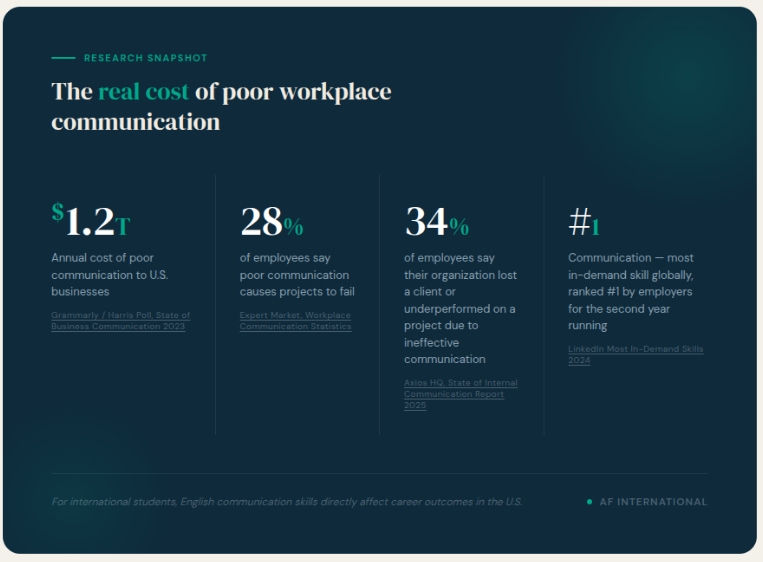
A survey conducted by Expert Market found that 28 percent of employees identified poor communication as the primary reason their projects failed to finish on time.
Across U.S. businesses, ineffective communication practices cost an estimated $1.2 trillion annually, according to the Grammarly and Harris Poll State of Business Communication report.
At the individual level, being the person who communicates clearly — who writes precise emails, confirms deadlines, and flags problems early — makes you a reliable teammate. That reputation has direct career value.
4. It Signals Leadership Potential to Employers
Managers and HR professionals consistently rate communication as one of the top indicators of leadership potential. This is not about being the loudest voice in the room. It is about being the person who can explain a complex idea simply, facilitate a difficult conversation calmly, and represent a team’s work clearly to a senior audience.
For F-1 students working toward career goals in the U.S., developing this capacity in English — not just fluency, but professional precision — is a direct investment in long-term advancement.
5. It Helps You Advocate for Yourself
Salary negotiations, performance reviews, disagreements with a colleague, requests for accommodations or flexibility — all of these require you to advocate clearly for your own needs and contributions.
This is one of the communication skills that international students find hardest, because many home cultures treat self-advocacy as impolite or presumptuous.
In most U.S. professional environments, the opposite is true: being able to articulate your value, express a boundary, or make a direct request is expected and respected.
6. It Protects Your Professional Standing During High-Stakes Transitions
For F-1 students navigating OPT, CPT, or employer sponsorship conversations, miscommunication carries consequences that go beyond missed promotions.
Being able to ask precise questions about employment terms, clarify expectations with a DSO or HR representative, and document conversations in writing is not just a career skill — it is a form of protection.
International professionals who communicate clearly in these moments reduce their exposure to misunderstandings that can affect visa status, employment authorization, and legal standing.
7. It Shortens the Time Between Starting and Belonging
The professional isolation that many international employees experience in their first U.S. workplace role is rarely about language fluency alone. It is about the invisible participation norms — when to speak, how to push back, what small talk signals, how to read silence — that take years to learn without deliberate practice.
Strong communication skills compress that learning curve. The professionals who invest in this early build team integration, informal trust, and career visibility close the gap faster than those who rely on time alone.
Improve Your Professional English With Confidence
Strong workplace communication is not just about speaking English fluently — it is about knowing how to participate confidently in U.S. professional and academic environments.
At AF International School of Languages, our English for Professionals and Intensive ESL programs are designed specifically for international students, working professionals, and F-1 visa students who want to strengthen real-world communication skills for the classroom, workplace, and everyday life in the United States.
✔ Small interactive classes
✔ Professional communication focus
✔ F-1 visa & I-20 support
✔ Pasadena & Thousand Oaks campuses
✔ Supportive international learning environment
Whether your goal is university preparation, workplace communication, OPT readiness, or long-term professional growth, our team is here to help you build confidence step by step.
👉 Schedule a Placement Assessment or Speak With Admissions Today
What Strong vs. Weak Workplace Communication Actually Looks Like
Strong workplace communication relies on clarity, active listening, and direct confirmation. Below are four common workplace scenarios highlighting the difference between weak, indirect responses and strong, professional execution.
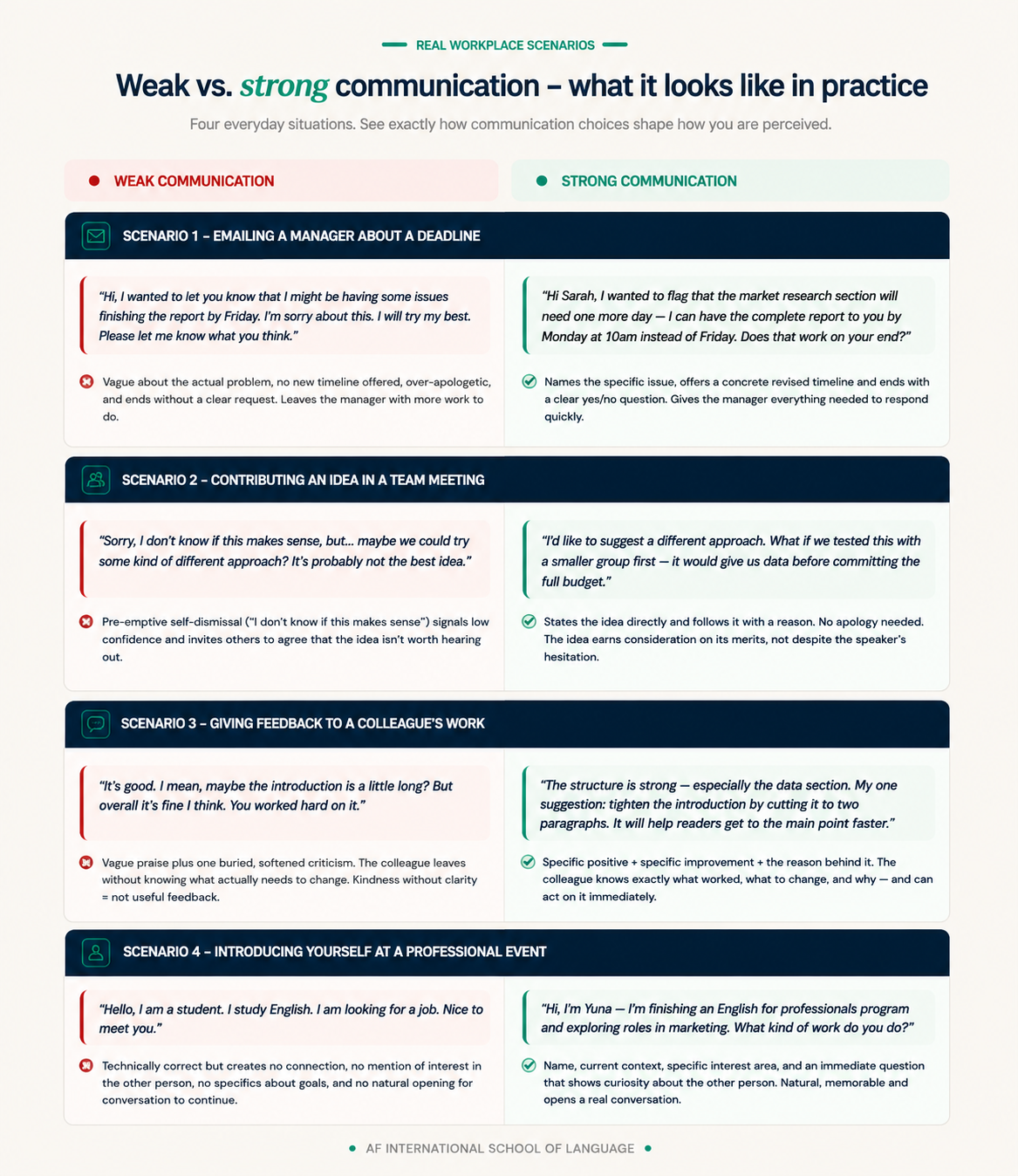
Scenario: Responding to feedback from a manager
Weak response: “OK, I understand. I will try to do better.”
Strong response: “Thank you — that’s helpful. To make sure I’m clear, you’d like me to send the weekly update by Thursday instead of Friday, and keep it to the three main project points rather than a full summary. I’ll adjust starting this week.”
The difference is not about English level. It is about showing that you listened, confirming your understanding, and giving your manager confidence that the change will actually happen. That is a learned skill, and it is one of the most valuable things you can practice as a professional communicator.
The Cultural Gap: Why U.S. Workplace Communication Feels Different
U.S. workplace communication feels different because it relies on “low-context” norms, meaning expectations are stated explicitly and directly, rather than relying on assumed cultural hierarchy. If you have ever felt confused by American workplace communication—too casual, too direct, or unexpectedly blunt—you are not misreading the situation.
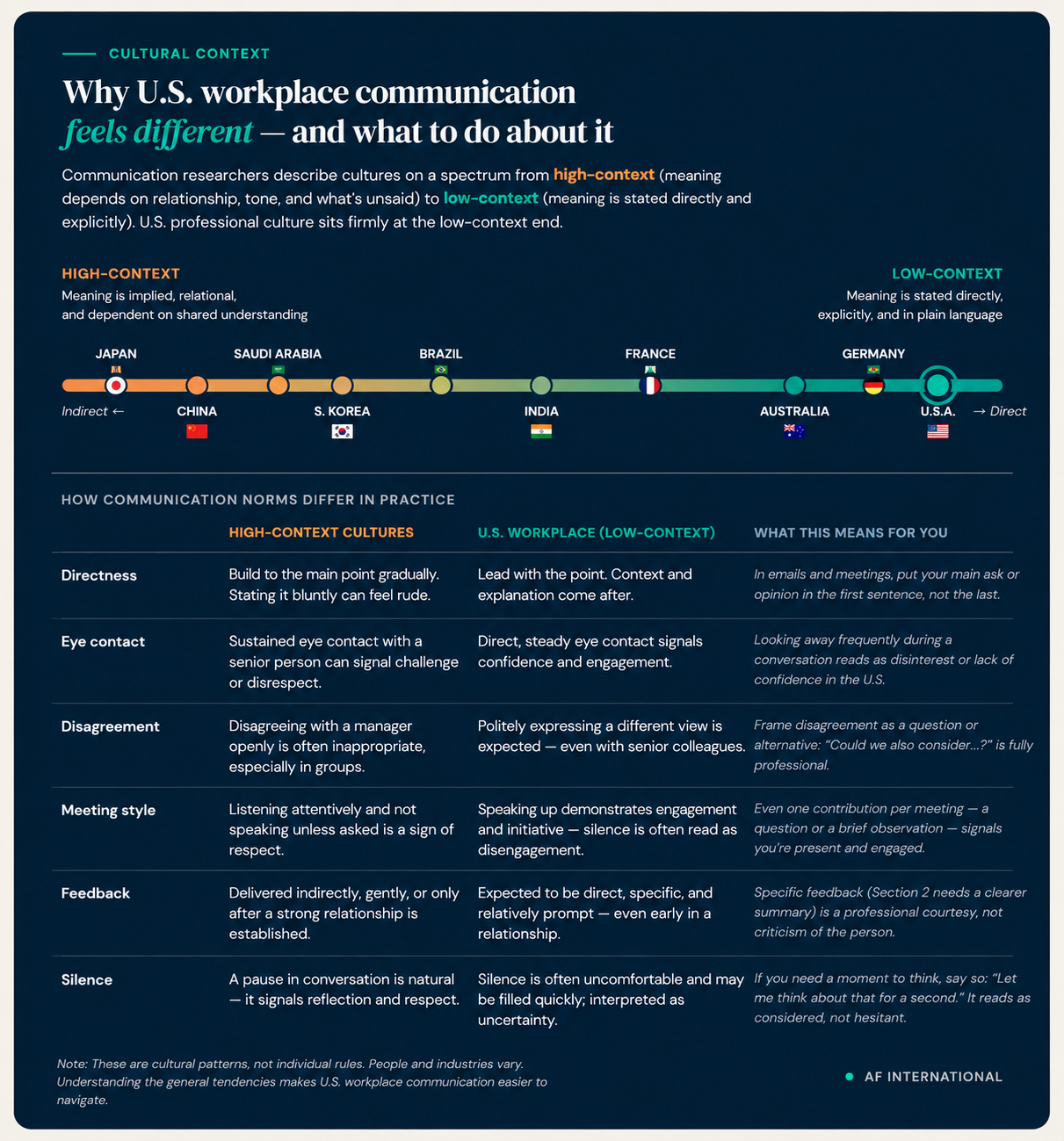
| Communication Norm | U.S. Workplace Expectation | Common Contrast in Other Cultures |
|---|---|---|
| Directness | Say what you mean clearly and early in a conversation | Many cultures build to the point gradually, especially in formal settings |
| Eye contact | Sustained eye contact signals confidence and engagement | In some Asian and Middle Eastern cultures, sustained eye contact can signal disrespect or challenge |
| Disagreement | Politely expressing a different view is expected, even with seniors | In hierarchical cultures, openly disagreeing with a manager may be considered inappropriate |
| Meeting participation | Speaking up in meetings demonstrates engagement and initiative | Remaining quiet is often a sign of listening and respect in high-context cultures |
| Feedback | Direct, specific, and relatively quick | May be delivered indirectly, gently, or only after a strong relationship is established |
This table is not a set of rules — it is a set of patterns. Individuals vary. Industries vary. But understanding these general tendencies helps you decode situations that might otherwise feel confusing or discouraging.
Adapting to U.S. communication norms does not mean abandoning your own culture. It means adding a new professional register to your existing skills.
For a deeper look at how business English specifically works in U.S. professional contexts, see our guide: From Fluent to Influential: Mastering English for Business Communication.
5 Strategies to Improve Business English Communication as an ESL Professional
Reading about communication skills is one thing. Having a system to actually practice them is another. These five strategies are built specifically for ESL professionals in U.S. workplaces — not generic tips, but approaches that target the specific gaps between language fluency and professional effectiveness.
1. Practice The One-Sentence Position Statement
Before every meeting, write one sentence that captures the single most important thing you need the other person to understand. U.S. workplace culture rewards directness — starting with your conclusion, not building toward it. This single habit retrains the instinct to contextualize before concluding.
2. Mirror And Confirm Feedback In Writing
After receiving verbal feedback from a manager, follow up with a short email: “To confirm what we discussed — you’d like X by Y date. Let me know if I’ve understood correctly.” This does three things simultaneously: it confirms your comprehension, it creates a written record, and it signals professional accountability — a quality U.S. managers respond to strongly.
3. Study The Register, Not Just The Vocabulary
U.S. workplaces use dramatically different registers across contexts: Slack messages are casual; client emails are formal; all-hands meetings are direct and brief. The mistake most ESL professionals make is applying one register uniformly. Pay attention to how your colleagues shift tone across channels and practice matching it deliberately.
4. Use Meetings As Listening Labs, Not Performance Anxiety Triggers
If speaking up in meetings feels high-pressure, start by practicing one specific move: ask a clarifying question. “Can you say more about X?” or “What’s the timeline on that?” These are low-stakes contributions that signal engagement without requiring you to lead the conversation. Build from there.
5. Debrief Difficult Conversations In Writing Afterwards
After any conversation that felt confusing — where the meaning was unclear, or the cultural subtext was lost — write a brief note to yourself: What did they say? What do you think they meant? What would you do differently? Over time, this builds the cultural pattern recognition that formal language instruction rarely provides.
How AFINT Builds Professional Business English & Workplace Communication Skills

Improving workplace communication as an ESL learner requires more than vocabulary drills. It requires practice in the kinds of real-world situations — negotiations, presentations, feedback conversations, professional emails — that actually come up at work. That is the focus of AFINT’s structured English programs in Pasadena and Thousand Oaks.
The English for Professionals & Communication program is built specifically for learners who already have English fluency and want to develop the professional precision that workplace success requires. It covers business writing, presentation skills, professional conversation, and the cultural communication norms that textbooks rarely address.
For learners who want to build a stronger foundation first, the Intensive ESL Programs — Levels 1 to 5 at both campuses provide a structured progression from essential communication skills through advanced professional English.
Frequently Asked Questions
For ESL professionals, communication gaps in U.S. workplaces are systemic, not stylistic.
A native speaker’s gaps are usually about tone or word choice. An international professional is navigating cultural norms, register differences, and participation expectations that no language course teaches directly.
Strong communication skills make your competence visible, your relationships possible, and your self-advocacy effective.
What are the 7 key communication skills in the workplace?
The seven most important workplace communication skills are:
1. Active listening: Processing and retaining information.
2. Verbal expression: Speaking clearly and concisely.
3. Written communication: Drafting professional emails and reports.
4. Nonverbal awareness: Managing body language and eye contact.
5. Feedback management: Giving and receiving critique professionally.
6. Register adaptability: Tailoring communication styles for specific audiences.
7. Instructional clarity: Seeking confirmation and clarifying ambiguous directions
For F-1 students pursuing U.S. careers through OPT or CPT, professional communication is not a soft skill — it is a credentialing challenge. Employers evaluate it from the first email through onboarding. Candidates who communicate with cultural fluency are consistently more competitive in hiring decisions, independent of their technical qualifications.
The four main types of workplace communication are:
1. Verbal: Spoken language in meetings and conversations.
2. Nonverbal: Body language, facial expressions, and posture.
3. Written: Emails, reports, and Slack messages.
4. Listening: Active attention and engagement.
The most effective approach combines structured language instruction with real-world corporate practice. This means participating in mock negotiations, studying U.S. workplace cultural norms, and seeking feedback from instructors who understand both linguistics and corporate environments.
Mastering these skills triggers a compounding effect on your career. The top ten benefits include:
1. Stronger professional relationships
2. Faster conflict resolution
3. Higher team productivity
4. Reduced errors and misunderstandings
5. Better project outcomes
6. Stronger leadership visibility
7. Improved employee morale
8. More effective collaboration
9. Faster career advancement
10. A stronger, more trustworthy professional reputation
In a professional setting, communication serves five core functions — and understanding which one applies in a given moment is a skill in itself:
Coordinate work: Aligning on tasks, deadlines, and responsibilities.
1. Build relationships: Creating trust and rapport among colleagues.
2. Share ideas: Contributing expertise and proposing actionable solutions.
3. Advocate for needs: Requesting resources and communicating professional value.
4. Navigate culture: Adapting to workplace norms and audience expectations.
Related reading:
- How to Improve Communication Skills in English: 8 Proven Strategies That Actually Work
- Common ESL Communication Mistakes in Conversations And What to Do Instead
- From Fluent to Influential: Mastering English for Business Communication
Build the Communication Skills That Open Doors
Fluent English alone is not always enough to succeed in U.S. academic and professional environments. The ability to communicate clearly, participate confidently, and navigate workplace expectations can directly influence your opportunities, professional relationships, and long-term career growth.
At AF International School of Languages, we help international students and professionals develop practical business English communication skills for real-world success — from classroom participation and presentations to workplace conversations, networking, and professional communication in the United States.
Whether you are preparing for university study, improving your workplace English skills, transferring your F-1 status, or building confidence for future OPT opportunities, our team is here to support your next step.
Why Students Choose AFINT
✔ Small interactive classes
✔ Professional business English and workplace communication focus
✔ Supportive instructors and personalized learning environment
✔ F-1 visa & I-20 support for eligible students
✔ Pasadena & Thousand Oaks campus locations
✔ Guidance designed specifically for international students
Take the next step toward stronger communication, greater confidence, and new opportunities in the United States.
WeChat QR Code

→ Contact Admissions to Learn More