
Quick Answer
For an F-1 student in a classroom-dominant English language training program, a full course of study normally means at least 18 clock hours of attendance each week. If the dominant part of the program is laboratory work, the minimum is 22 clock hours per week.
The 12-credit rule used by many undergraduate programs does not apply to English language training. Online or distance-education classes also cannot count toward an ESL student’s required full course of study.
Before reducing your schedule, you must receive authorization from your Designated School Official (DSO).
What Is a “Full Course of Study” for F-1 ESL Students?
For F-1 students enrolled in English language training, a full course of study is measured by weekly clock hours of attendance—not college credits.
Under federal regulations, a classroom-dominant English language program generally requires at least 18 clock hours of attendance per week. A program consisting primarily of laboratory work requires at least 22 clock hours per week.
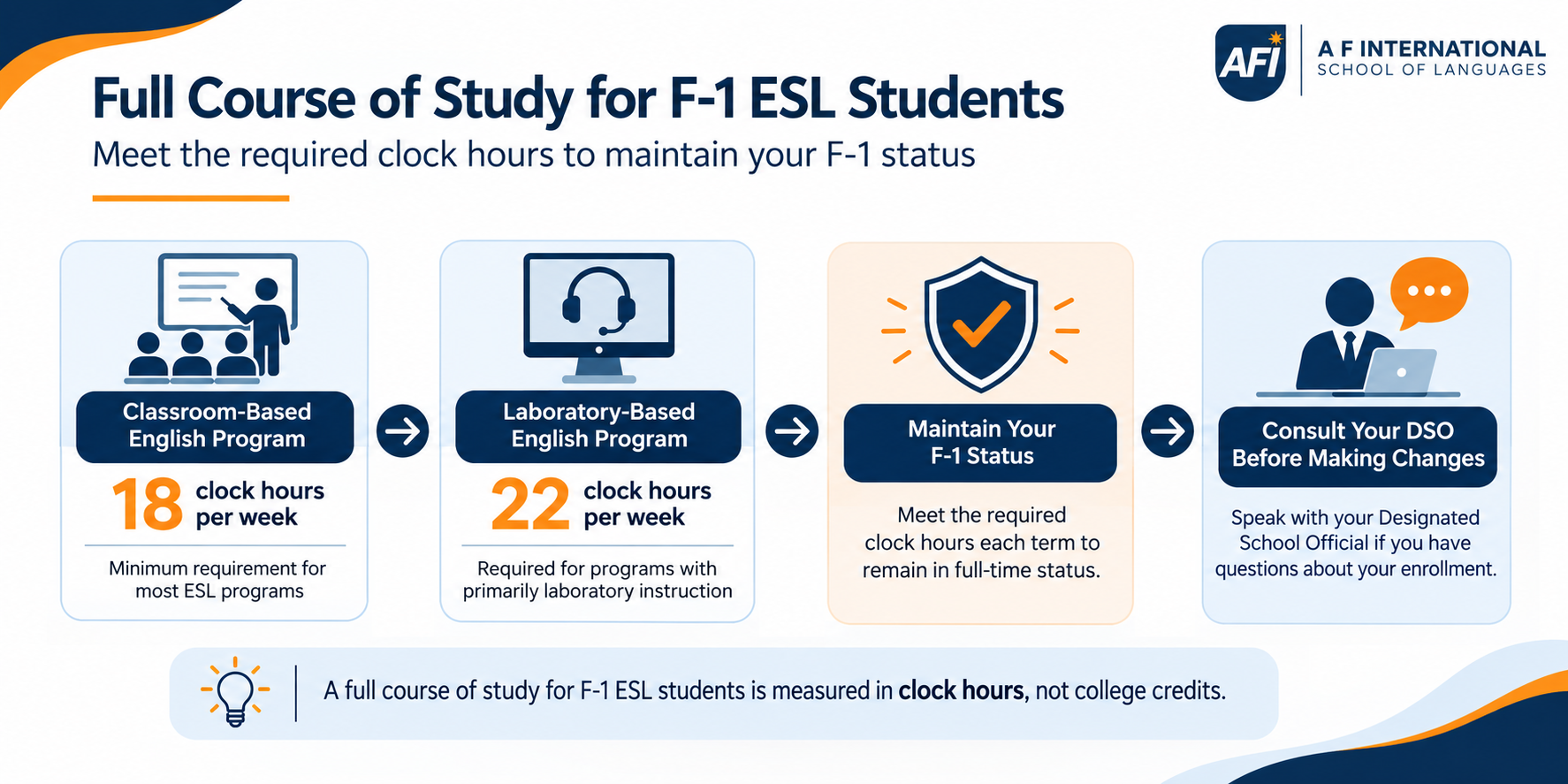
| Program Format | Minimum Weekly Requirement |
| Classroom-based English language program | 18 clock hours per week |
| Laboratory-based English language program | 22 clock hours per week |
Does the 12-Credit Rule Apply to ESL Students?
The short answer is no. The 12-credit rule does not apply to F-1 students enrolled in English language training programs.
This is one of the most common points of confusion for international students. Many colleges and universities require undergraduate students to enroll in at least 12 credit hours per semester to maintain full-time status. However, ESL programs follow a different federal standard.
Instead of credit hours, English language training programs measure full-time enrollment using clock hours, which represent the actual time you spend in class each week. That’s why F-1 ESL students must meet the minimum 18 or 22 clock-hour requirement, depending on how their program is delivered.
Clock hours measure scheduled instructional time and attendance, while credit hours measure the academic value of college coursework.
The table below highlights the difference:
| Undergraduate F-1 Students | F-1 ESL Students |
| Full-time enrollment is measured in credit hours | Full-time enrollment is measured in clock hours |
| Typically need at least 12 credit hours per academic term | Must attend at least 18 or 22 clock hours per week, depending on the program format |
| Enrolled in degree or certificate programs | Enrolled in English language training programs |
| Limited online coursework may count toward full-time enrollment (subject to federal rules) | Online or distance education does not count toward the required full course of study |
If you’re unsure whether your schedule qualifies as full-time, ask your school before making any schedule changes.
What Happens If You Don’t Maintain a Full Course of Study?
Maintaining a full course of study is one of the key responsibilities of studying in the U.S. on an F-1 visa. If you drop below the required number of clock hours without prior authorization, you may no longer meet the enrollment requirements for your F-1 status.
Depending on your situation, failing to maintain a full course of study could lead to:
- Loss of F-1 status if you’re no longer considered a full-time student.
- Changes to your SEVIS record, which your school is required to maintain and report.
- Complications with future immigration benefits, such as transferring schools or applying for other F-1 benefits.
If your SEVIS record is affected because you did not maintain a full course of study, you may need to work with your school and follow additional immigration procedures before you can continue your studies or receive certain F-1 benefits. That’s why it’s important to discuss your situation with your school before making any enrollment changes.
Never reduce your course load without prior authorization. Unauthorized enrollment changes can affect your F-1 status and SEVIS record. If you’re facing a medical condition, academic challenge, or another situation that affects your ability to study full-time, discuss your situation with your school’s designated official before reducing your course load.
In some cases, students may qualify for an authorized Reduced Course Load (RCL). However, approval must be granted in advance, and eligibility is limited to specific circumstances allowed under federal regulations.
The safest approach is to communicate with your school early. At AF International, your Designated School Official (DSO) can explain your options before any enrollment changes are made.
Can an F-1 ESL Student Study Fewer Hours?
Only in limited circumstances and with advance DSO authorization. Federal regulations allow a Reduced Course Load for certain initial academic difficulties, a documented temporary illness or medical condition, or a final session in which fewer hours are needed to complete the program.
The DSO must authorize the reduction and update SEVIS before the student drops below a full course of study. A student who reduces their schedule first and requests permission later may be considered out of status.
Medical requests require documentation from an eligible licensed medical professional. Personal, work, financial, or scheduling difficulties do not automatically qualify.
Full-Time English Study at AF International
AF International’s Intensive English Program provides 18 clock hours of in-person instruction each week. Classes are held Monday through Thursday from 9:00 a.m. to 1:30 p.m. at our Pasadena and Thousand Oaks campuses.
AF International has served English learners since 1995 and is CEA-accredited and SEVP-certified. Prospective students can contact our Admissions team for information about class schedules, tuition, application documents, and enrollment steps. Current F-1 students should contact their Designated School Official (DSO) before changing or reducing their class schedule.
Serving Students Since 1995 • CEA-Accredited • SEVP-Certified • Pasadena & Thousand Oaks
Considering Full-Time English Study in California?
Learn about AF International’s 18-hour-per-week Intensive English Program and the steps required to enroll.
View the Intensive English Program
Email: admissions@afint.com
| Note: This article is intended for general informational purposes. For the most current federal requirements, consult your Designated School Official (DSO) and the U.S. Department of Homeland Security’s Study in the States guidance. |
Frequently Asked Questions
A classroom-dominant English language training program generally requires at least 18 clock hours of attendance per week. A laboratory-dominant program requires at least 22 clock hours per week.
No. The 12-credit rule generally applies to undergraduate college or university programs. English language training programs use weekly clock hours instead of college credits.
No. Online and distance-education classes cannot count toward the required full course of study for an F-1 student enrolled in an English language training program.
Only in limited circumstances allowed by federal regulations. The DSO must authorize the Reduced Course Load and update SEVIS before the student reduces their hours.
F-1 students are expected to attend their classes and follow their school’s attendance policy. Repeated or extended absences may affect a student’s ability to maintain status. Students experiencing attendance problems should contact their DSO promptly
Contact AF International Admissions for information about schedules, tuition, application documents, and enrollment steps.
Email: admissions@afint.com
Call or text: (626) 689-9362
Official Sources