Updated October 26, 2026
Short Answer
If you complete your F-1 program or authorized post-completion OPT while maintaining status, the rules currently in effect generally provide a 60-day grace period.
But 60 days is not your only transfer timing requirement. Your SEVIS transfer release date, new program start date, and the applicable five-month rule can also affect your timeline. Current SEVP transfer guidance explains that F-1 transfer students generally must begin at the transfer-in school by the next available session start date or within the applicable five-month period.
Already in the United States and considering full-time English study in Pasadena? AFI Admissions can review your current school, important dates, and AFI admission requirements for a possible transfer.
Request an F-1 Transfer Review
Tell us about your current school and important dates. AFI Admissions will review your information and contact you about available program dates, admission requirements, and the school-side next steps for a possible AFI transfer.
Deadline approaching? Call or WhatsApp 626-689-9362

Serving English Learners Since 1995

CEA-Accredited

Authorized to Enroll F-1 Students

Pasadena
September 2026 F-1 Rule Update
You may have seen recent information saying the F-1 post-completion period was changing from 60 days to 30 days.
DHS published a new fixed-period-of-admission rule that was scheduled to take effect September 15, 2026. On September 14, a federal court issued a preliminary injunction postponing implementation. The existing Duration of Status (D/S) framework therefore remains in effect for now.
Because the litigation is ongoing, students should check current guidance before making an important immigration or travel decision.
Is the F-1 SEVIS Transfer Deadline 60 Days?
The 60-day grace period is an important part of the timeline for eligible students after program completion or authorized post-completion OPT, but it is not a universal deadline for completing every step of a school transfer.
A transfer can also depend on:
- your program or OPT end date;
- acceptance by the transfer-in school;
- your SEVIS transfer release date; and
- when the new program begins.
Current SEVP guidance explains that a transfer student must begin the new program at the next available session start date, or within five months of the transfer-out date or previous program completion date, whichever is earlier.
That is why you should review your complete timeline—not simply count 60 days.
Want to understand the complete process? Read our step-by-step guide on how to transfer between U.S. schools on an F-1 visa.
How Does the 60-Day Grace Period Affect Your SEVIS Transfer?
Under the rules currently in effect, eligible F-1 students generally receive a 60-day period after completing their program or authorized post-completion OPT.
If you plan to continue studying, use that period carefully. Waiting until the final days can leave less time for admission documents, school procedures, and coordination of your SEVIS release date.
The 60-day period does not automatically transfer your SEVIS record.
If Your Grace Period Has Already Started
Begin contacting prospective schools and your current DSO as early as possible.
Your current school controls the SEVIS record until the transfer release date. On the release date, control transfers to the transfer-in school.
Considering AFI Pasadena? Request a transfer review so Admissions can check AFI admission requirements and available program dates.
SEVIS Transfer vs. 60-Day Grace Period
|
SEVIS Transfer |
60-Day Grace Period |
|
Moves your SEVIS record to another eligible school |
A post-completion period for eligible F-1 students |
|
Includes a transfer release date |
Does not automatically transfer SEVIS |
|
Requires coordination between schools |
Does not replace transfer timing requirements |
|
Leads to enrollment at the transfer-in school |
Is only one part of the overall timeline |
Bottom line: Think of the 60-day grace period as one piece of your transfer timeline—not the whole timeline.
What Is the Five-Month Rule for an F-1 SEVIS Transfer?
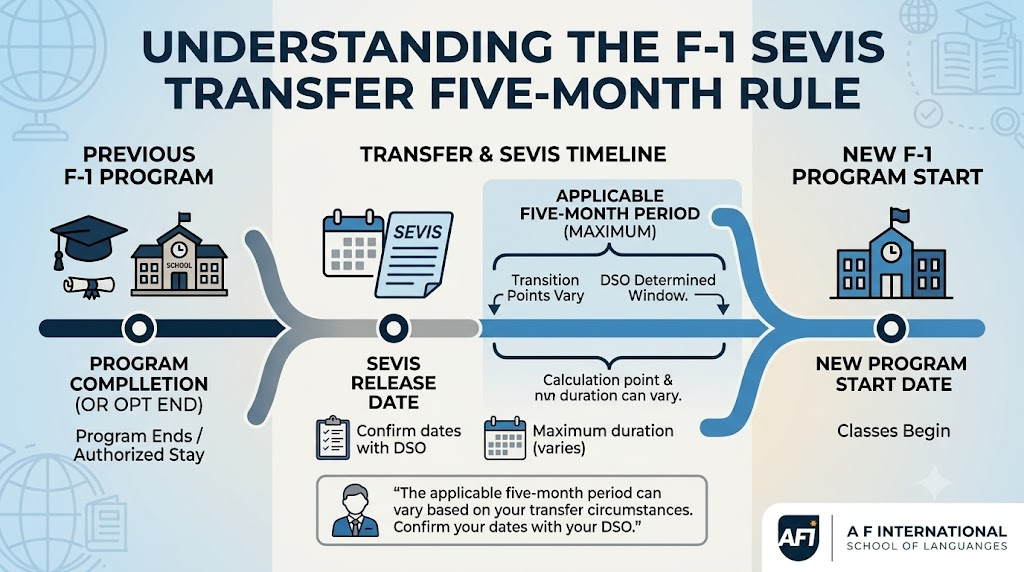
The five-month requirement answers a different question from the 60-day grace period.
Under current SEVP transfer guidance, a transfer student must begin the new program at the next available session start date, or within five months of the transfer-out date or previous program completion date, whichever is earlier.
Students transferring after OPT also need to review how their OPT dates, transfer release date, and next program start date fit together.
In simple terms:
Current Program / OPT → Admission → SEVIS Release → New Program Start
This is why “I have 60 days” is not enough information to determine your complete transfer timeline.
Which Dates Matter for Your SEVIS Transfer?
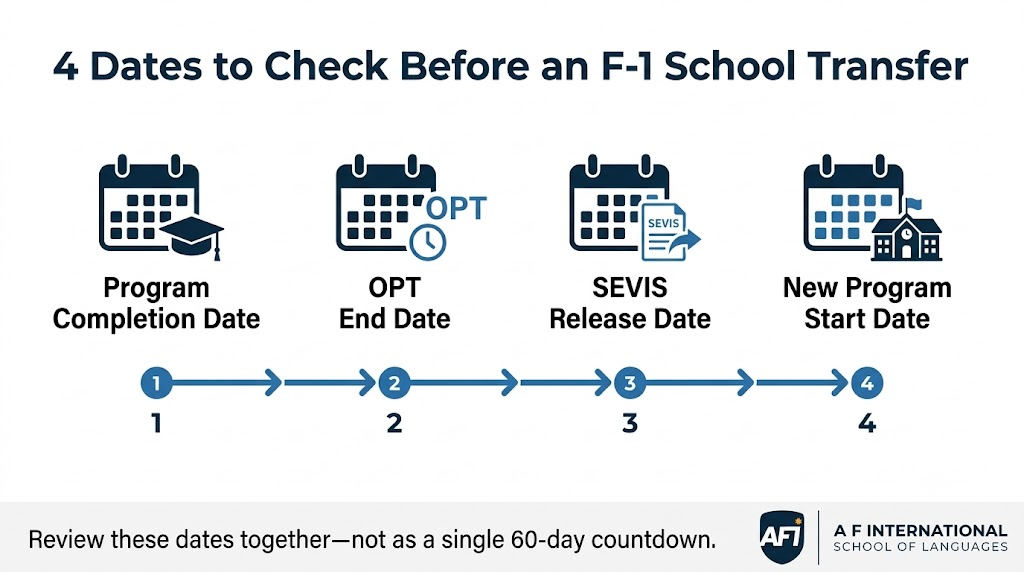
Four Dates to Check Before You Request a SEVIS Transfer
- Program Completion Date
Check the program end date on your current Form I-20 and ask your current DSO if you have questions about your official completion date. - OPT End Date
If you are on post-completion OPT or STEM OPT, check the expiration date on your EAD. If you are still working, coordinate your SEVIS release date carefully. Your employment authorization may be affected when your SEVIS record is transferred. - SEVIS Transfer Release Date
Your transfer-out school controls your SEVIS record until the release date. On that date, the transfer-in school receives control of the record. Not sure what happens to your SEVIS record during a transfer? Read our Step-by-step SEVIS record update guide. - New Program Start Date
Confirm the transfer-in school’s next available start date before requesting your release.
Check these dates together. A single 60-day countdown does not tell you whether your entire transfer timeline works.
Not sure whether your dates work for a transfer to AFI Pasadena?
AFI Admissions can review your current school, important dates, and available program start dates.
Which F-1 Transfer Situation Applies to You?
You Are Still Studying
You can begin researching and applying to another SEVP-certified school while you are still enrolled and maintaining status.
After acceptance, coordinate the release date and new program start date with the appropriate DSOs.
You Recently Completed Your Program
Check your official completion date, grace period, proposed transfer release date, and the new school’s next available session.
Starting early gives both schools more time to complete their procedures.
Your OPT Is Ending
Check your EAD end date first. Then review the proposed transfer date and the transfer-in school’s next available start date.
If you are still working, be especially careful about the release date because transferring can end your existing OPT-related employment authorization. If you’re weighing an ESL program as your next step after OPT, our guide on maintaining F-1 status after OPT and an ESL transfer walks through this exact scenario in more depth.
Planning to Continue With English Study in Pasadena?
AFI Admissions can review your current school, program or OPT end date, and AFI’s available program dates.
Prefer to talk first? Call or WhatsApp 626-689-9362.
Example: Your OPT Ends June 30
Suppose your authorized post-completion OPT ends on June 30.
Do not simply count forward 60 days and assume that date is your complete transfer deadline.
Instead, check:
June 30 OPT End → Admission → SEVIS Release → New Program Start
You also need to make sure the new program meets the applicable transfer timing requirements.
If your OPT is ending soon, beginning the admission process before your grace period becomes tight gives you more time to coordinate the transfer.
How Does an F-1 School Transfer Work?
- Apply to the Transfer-In School
Complete the school’s admission requirements. - Confirm Your Program Start Date
Make sure the available start date works with your transfer timeline. - Follow Your Current School’s Transfer-Out Procedure
Your current school may ask for an acceptance letter or transfer form. - Coordinate Your SEVIS Release Date
Your transfer-out DSO enters the new school and release date into SEVIS. - Complete Enrollment With the New School
After the release date, follow the transfer-in school’s instructions for your transfer-pending Form I-20, registration, orientation, and reporting.
Want the full process? Read our guide: How to Transfer Your F-1 SEVIS Record to Another School.
When Should You Start an F-1 Transfer?
As soon as you know that you may want to change schools.
Starting early gives you more time to complete admission requirements, confirm the new program start date, and coordinate your SEVIS release.
If your program or OPT has already ended, do not intentionally wait until the final days of your grace period to begin contacting schools.
What Happens If You Miss the SEVIS Transfer Deadline?
Missing an applicable SEVIS transfer deadline can create problems for your F-1 status. You should not assume that you can simply request a transfer after the deadline and continue as normal.
If your deadline is approaching, contact your DSO immediately if:
- Your grace period is ending soon.
- Your new program starts later than expected.
- Your SEVIS release hasn’t been processed.
- You aren’t sure which date controls your timeline.
- You have already passed an important date.
Don’t withdraw, leave the U.S., or make a status decision based solely on a generic online deadline. Ask your DSO to review your specific SEVIS record.
Considering AFI Pasadena and your timeline is close?
Four Common F-1 Transfer Mistakes
- Assuming the 60-Day Grace Period Is the Only Deadline
Your new start date and transfer release date matter too. - Waiting Until the Last Few Days
School admission and transfer procedures require time. - Choosing a Release Date Before Confirming Your New Start Date
Check both schools before finalizing the release date. - Assuming Admission Automatically Transfers SEVIS
Acceptance and SEVIS transfer are separate steps.
Considering an F-1 Transfer to an English Program in Pasadena?
If you are already in the United States and want to continue full-time English study, AF International offers its Intensive English Program for eligible F-1 students at our Pasadena campus.
AFI Admissions can help prospective transfer students understand:
- AFI admission requirements
- available program start dates
- required application documents
- school-side SEVIS transfer procedures
- enrollment steps
Not Sure Whether AFI Pasadena Fits Your Transfer Timeline?
Tell us about your current school and important dates. AFI Admissions will review your information and contact you about admission requirements, available start dates, and the school-side next steps for a possible transfer.
Prefer to talk first? Call or WhatsApp 626-689-9362.
Serving English Learners Since 1995
CEA-Accredited
Pasadena
Frequently Asked Questions
Not at this time. DHS published a rule that was scheduled to change the F-1 framework beginning September 15, 2026, but a federal court issued a preliminary injunction postponing implementation. The existing D/S framework remains in effect while the litigation continues.
Under the current framework, eligible students generally have a 60-day post-completion period after authorized OPT. However, the transfer release date and new school’s start date also matter. Current SEVP guidance explains that a transfer student must begin the new program at the next available session start date, or within five months of the transfer-out date or previous program completion date, whichever is earlier.
Eligible students can request a transfer during the applicable post-completion period, but the other transfer timing requirements still need to be met. ICE specifically notes that eligible students can request a transfer through the end of the 60-day period following post-completion OPT, subject to the applicable new-program timing requirements.
Current ICE guidance says off-campus employment authorization associated with the transfer-out school ends when the student transfers. If you are still working, discuss your planned release date with your DSO before transferring.
No. Admission and SEVIS transfer are separate steps. Your current DSO must complete the transfer-out action and specify the transfer-in school and release date.
Thinking About Transferring to AFI Pasadena?
If you are already in the United States, send us your current school and important dates. AFI Admissions will review your information and let you know what AFI needs from you for admission and a possible school transfer.