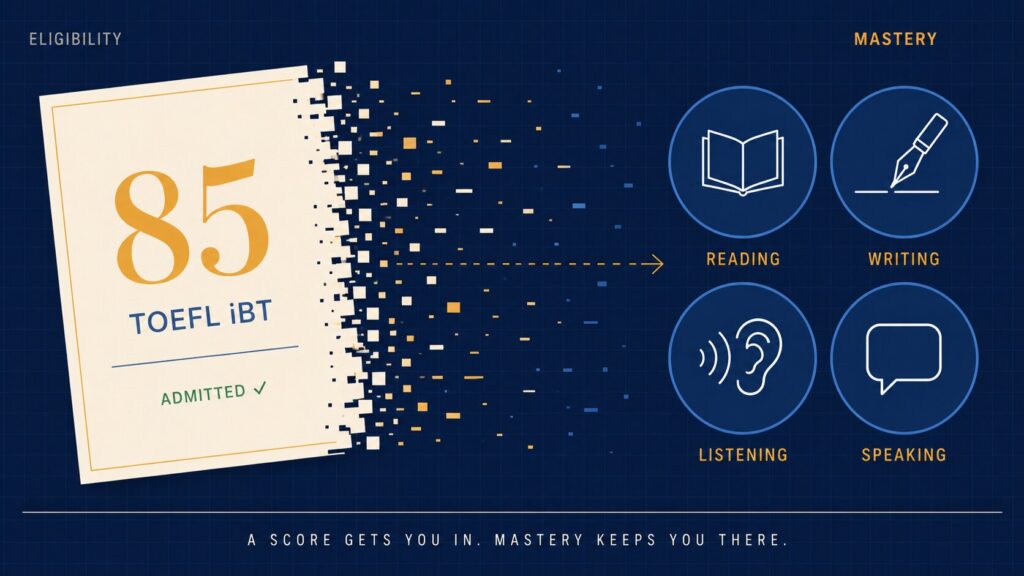
Many international students arrive in the USA with a passing TOEFL score and still struggle. They understand the material. They did the work. But in the lecture hall, during group projects, or when an assignment asks them to argue a position in writing, something slips.
This is not a test score problem. It is an English mastery problem, and the right ESL program is designed to solve it.
This guide explains what English mastery means for an international student, why it affects outcomes beyond the classroom, and what building real mastery actually requires.
Regulatory Notice (2026): In August 2025, DHS published a proposed rule that would cap F-1 student enrollment in language training programs at a lifetime total of 24 months. If finalized, this rule would affect how long students can stay in ESL programs before moving to a degree program. This guide reflects current regulations. Monitor updates at ice.gov/sevis and consult your DSO before making enrollment decisions.
Key Takeaways
- Understand What Mastery Actually Is: English mastery is not a TOEFL score. It is the ability to read, write, listen, and speak well across academic and professional situations, under pressure, in real time.
- Know the Academic Stakes: Multiple studies confirm that English proficiency is among the strongest predictors of academic success for international students in English-medium programs. Students who struggle to communicate cannot ask for help and fall behind.
- Recognize the Professional Consequences: Workplace English is different from classroom English. Students who reach OPT or CPT eligibility without strong professional communication skills face a real disadvantage in the U.S. job market. OPT and CPT are only available to F-1 students enrolled in degree programs, not to ESL-only students.
- Learn the Four Skills That Matter: Academic reading, formal writing, lecture comprehension, and real-time speaking are the four areas that determine whether an international student succeeds or stalls.
- See How an ESL Program Bridges the Gap: A SEVP-certified, accredited intensive English program is not just a path to F-1 status. It is where real mastery is built before the pressure of degree coursework begins.
What English Mastery Actually Means
Most students think of English proficiency in terms of a score. TOEFL 80. IELTS 6.5. Admitted.
That is not mastery. That is eligibility.
Mastery is what happens after admission. It is the ability to:
- Read academic journal articles and identify the core argument
- Write persuasive essays with clear theses under tight deadlines
- Follow fast-paced lectures on unfamiliar topics without losing the thread
- Participate in seminars and ask questions during office hours
- Explain your thinking to professors who push back on your ideas
These four areas, academic reading, formal writing, lecture comprehension, and real-time speaking, form the core of what English mastery means in practice.
There is also a key distinction that most test preparation programs skip. Researchers distinguish between conversational English and academic English. Conversational English can be picked up in roughly two years. Academic English, the level required for university study, typically takes five to seven years to develop without structured instruction, based on Jim Cummins’ research on second-language academic proficiency (CALP). A structured intensive ESL program with qualified instructors shortens that timeline significantly compared to unstructured immersion alone.
For more on what the F-1 program requires in terms of language and enrollment standards, see our F-1 visa and I-20 information page.
| Test-Level English | Mastery-Level English |
|---|---|
| Passes TOEFL or IELTS threshold | Works across all four language areas in real contexts |
| Sufficient for admission | Required for academic survival and professional performance |
| Shows isolated skill on timed tasks | Shows sustained fluency under real-world pressure |
| Used once to gain entry | Applied every day in class, meetings, and conversations |
| Can be built through test prep alone | Requires structured immersion and classroom feedback |
Why It Matters Academically
The research on this question is consistent. A study cited by IELTS found English proficiency to be the strongest predictor of academic success for students in an English-Medium Instruction program. Multiple studies confirm that higher IELTS scores correlate with stronger academic outcomes for international students. A peer-reviewed systematic review in PMC adds consistent evidence: insufficient English proficiency measurably hinders performance in English-medium degree programs. Students who lack it cannot follow course content, join class discussions, or keep up with peers who have stronger language skills.
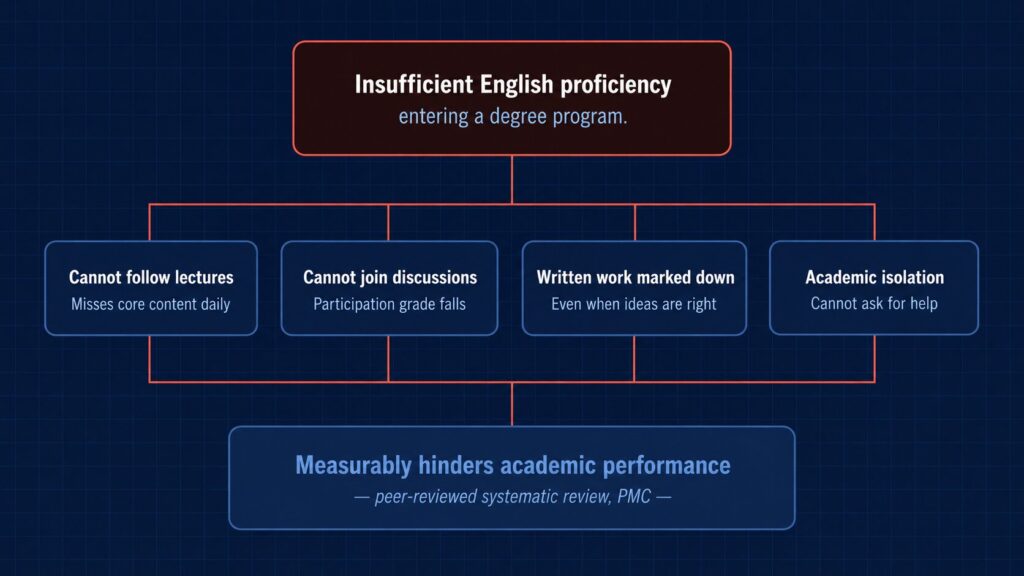
The consequences go deeper than grades. Students who cannot communicate well in English face a specific set of problems:
- They cannot ask for help from professors or peers when confused
- They spend too much time studying alone to cover what they missed in class
- They experience frustration, embarrassment, and academic isolation
- Their written work is marked down even when they understand the subject
This pattern is well-documented and common. It is also entirely preventable.
The students who avoid it are the ones who arrive at their degree program ready to work in academic English, not just pass a test. That is the outcome a well-run intensive ESL program is built to produce.
Want to know if you’re ready for college-level English?
AF International offers English placement testing for international students who want to improve academic English, prepare for university study, or transfer to a U.S. college or university.
Schedule your placement test today.
Why It Matters Professionally
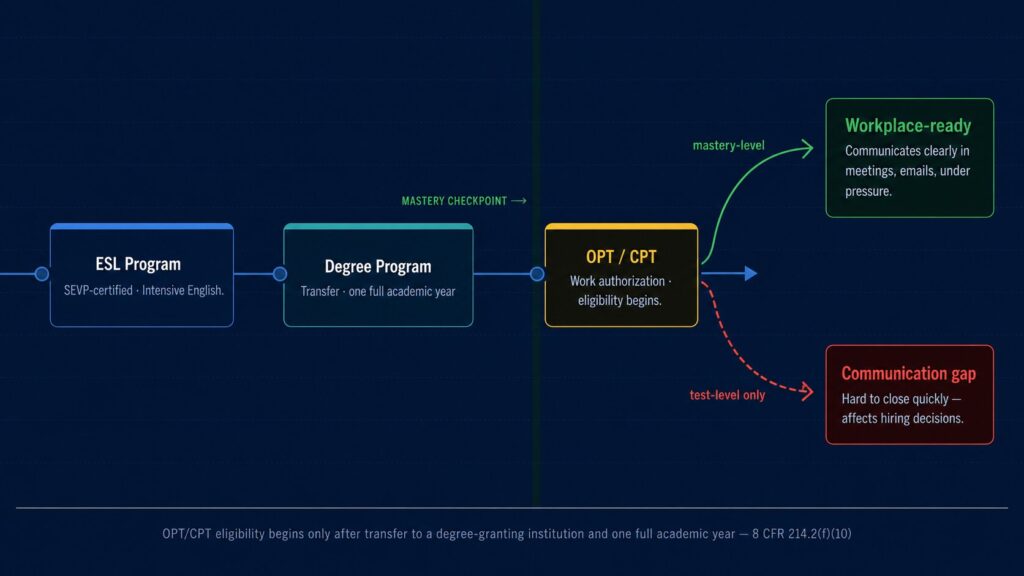
For many F-1 students, the goal of studying in the USA goes beyond the degree. They want to work here through Optional Practical Training (OPT) or Curricular Practical Training (CPT). These are the two federal work authorization paths available to F-1 degree students.
Important: Under 8 CFR 214.2(f)(10), F-1 students in English language training programs only are not eligible for OPT or CPT. Work authorization eligibility begins only after you transfer to a degree-granting institution and complete one full academic year there. Staying in an ESL program longer than necessary delays this eligibility.
OPT and CPT require a kind of English mastery that is different from what academic study demands. Workplace English is about presenting ideas clearly in a meeting, writing emails that do not cause confusion, joining fast group discussions, and being understood by colleagues.
Students who build genuine mastery during their ESL and early degree years arrive at the workplace ready. Students who treated English as a hurdle to clear arrive at OPT eligibility with a gap that is hard to close quickly. This affects hiring decisions, internship performance, and long-term competitiveness in the U.S. job market.
Mastery-level English is the professional asset that outlasts the visa category.
The TOEFL Gap: What Tests Cannot Measure
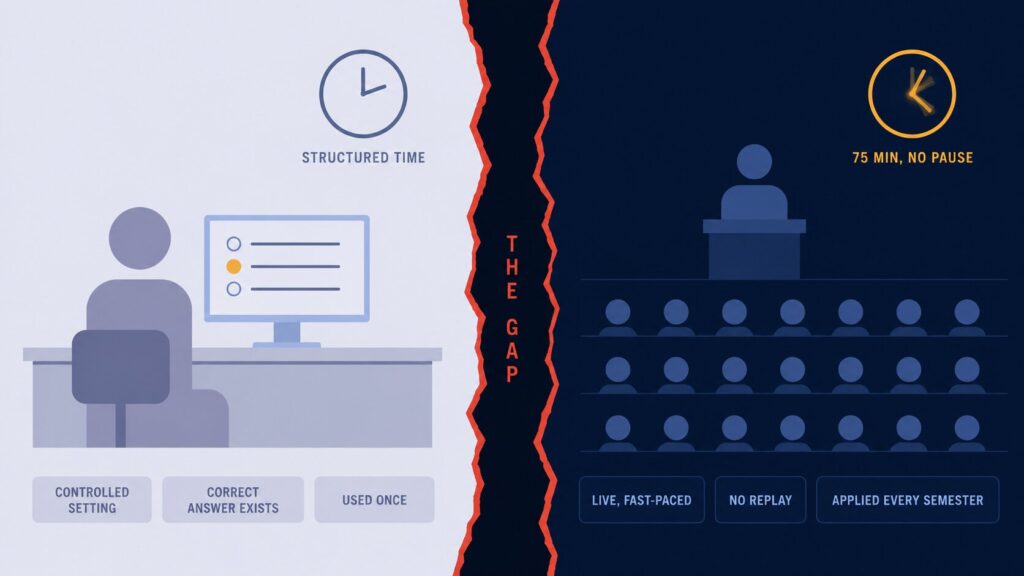
DSO teams and ESL instructors see this pattern often. A student who scored 85 on the TOEFL sits in their first academic lecture and freezes. Not because they do not know English. They passed the test. But the test and the lecture are entirely different things.
The TOEFL gap is real. A test score shows that a student can pick the correct answer to a structured question in a controlled setting. It does not show that the student can follow a 75-minute lecture on an unfamiliar topic, ask a clarifying question mid-lecture, or write a first draft of a persuasive argument in 45 minutes. These are mastery tasks. Tests do not build them. Classrooms do.
This gap is not a personal failure. It is a structural one. It comes from preparing for a test rather than for the environment the test is meant to predict. Students who close this gap fastest are the ones who spend time in a structured, immersive English program where every class is practice for a real academic or professional situation.
The Four Skills International Students Actually Need to Master
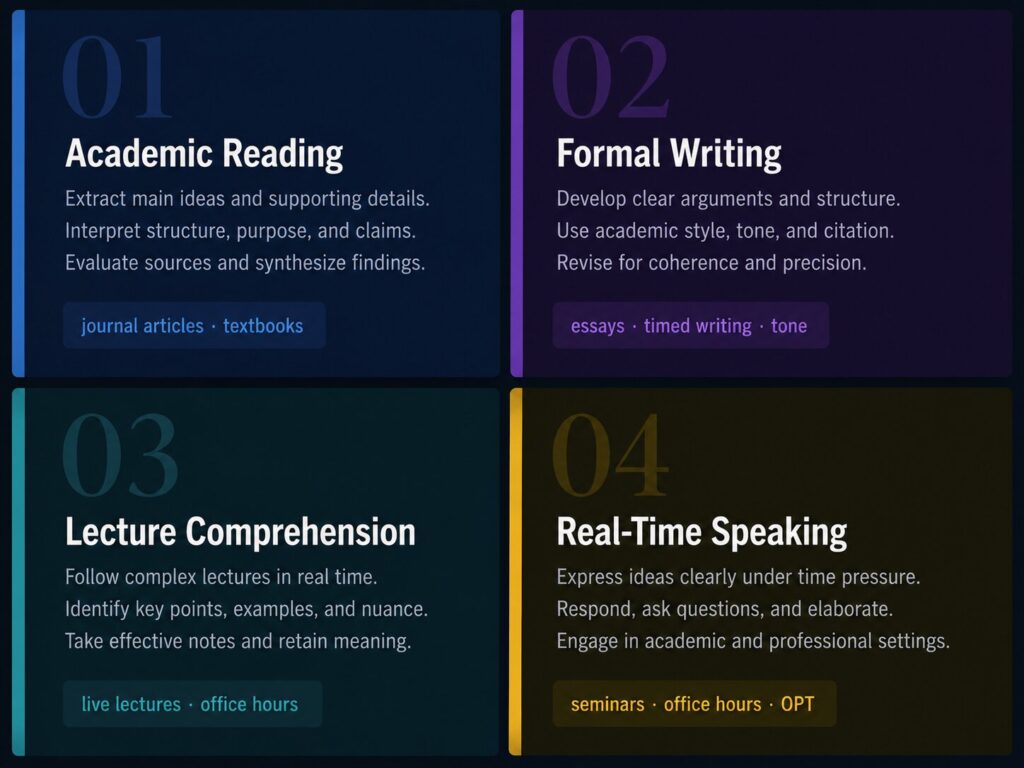
Academic Reading
University coursework requires reading dense, argument-driven texts: journal articles, textbooks, and primary sources. Reading for mastery means reading for structure, not just vocabulary. It means finding the author’s main argument, weighing the evidence, and using it in your own writing. Test preparation programs teach students to find answers in a passage. Academic English programs teach students to read the way a scholar reads.
Formal Writing
Writing in an academic or professional setting is not the same as writing correctly. It requires knowing how to build an argument, bring in evidence without just summarizing it, write a conclusion that ties ideas together, and adjust your tone to fit the context. These skills require feedback from a qualified instructor, multiple drafts, and exposure to strong models. They cannot be self-taught.
Lecture Comprehension
Following a lecture in a second language is hard work. The speaker does not pause, repeat, or check whether you understood. They use idioms, subject-specific words, and sentence structures that may be very different from anything on a standardized test. Building this skill takes regular practice in settings that match real academic listening conditions, not just watching videos with subtitles.
Real-Time Speaking
This is the skill students most often name as their biggest barrier. They know what they want to say. They just cannot get it out quickly enough, or confidently enough, in the moment. Real-time speaking mastery means holding a position when someone questions you, explaining a complex idea without notes, and recovering when a conversation goes somewhere unexpected. It is built through structured speaking practice with real feedback, not passive listening.
Why International Students Choose AF International
Building English mastery requires more than self-study or test preparation. International students often benefit from a structured environment where they can practice reading, writing, listening, and speaking every day while receiving guidance from experienced instructors.
At AF International, students study in small classes designed to encourage active participation and individualized feedback. Our accredited Intensive English Program helps students strengthen academic English, improve communication skills, and prepare for future university study in the United States.
Students can study at our Pasadena and Thousand Oaks ESL campuses in Southern California while receiving support throughout their English-learning journey, including F-1 enrollment guidance, I-20 issuance for qualified students, and ongoing academic advising.
Many students choose AFINT as a bridge between English language study and future academic or professional goals in the United States.
How AF International Builds These Skills
Knowing what English mastery requires is the first step. The second is studying in a place built to develop it.
Many students arrive at AFINT with TOEFL scores that meet minimum admission requirements but still struggle with classroom discussions, lecture comprehension, and academic writing. Through structured speaking practice, academic reading, listening activities, and writing support, students often gain the confidence needed to transfer into colleges and universities throughout California.
At AF International, both our Pasadena and Thousand Oaks campuses are SEVP-certified and hold the required accreditation from a U.S. Department of Education-recognized accrediting agency. This means we meet both the SEVP certification standard and the separate accreditation requirement for ESL programs under the Accreditation of English Language Training Programs Act. The program meets federal standards for enrolling F-1 students and maintaining SEVIS compliance from enrollment through graduation.
The curriculum is built around the four areas described above, not test preparation alone. Students practice academic reading on texts that match what they will encounter in degree programs. They write under feedback conditions that reflect real assignment pressure. Listening instruction uses lectures, not simplified audio. Speaking is practiced in structured conversations and presentations, not basic dialogues.
For students planning to transfer to a U.S. college or university, this preparation is what separates surviving the first semester from doing well from the start.
Using English automatically under pressure, in a seminar, a meeting, or a conversation with a professor who challenges you, requires structured repetition in a real classroom. That is exactly what our intensive English program at AFINT is designed to build.
Related Resources for International Students
If you’re planning to study English in the United States, these guides may also help:
- ESL vs EFL: Which English Program Is Right for You?
- Beginner’s Guide to Choosing the Right ESL Course
- Intensive English Programs: Everything You Need to Know
- F-1 Visa and I-20 Guide for ESL Students
- 7 Essentials to Do Every Day for Speaking English Fluently
- How to Find Quality SEVP-Certified ESL Schools in the U.S.
Frequently Asked Questions
Set a specific goal, receive focused instruction, practice with feedback, apply the skill in a real situation such as a timed essay or presentation, review what did not work, and repeat. Each cycle builds on the last.
Conversational English covers daily interaction, and most students develop it within two years of immersion. Academic English requires building arguments, analyzing texts, using subject-specific vocabulary, and writing in formal registers. Based on Cummins’ research on second-language academic proficiency, reaching academic fluency without structured instruction typically takes five to seven years. That timeline is based on K-12 learners in naturalistic settings. Adults in structured intensive ESL programs generally progress faster.
Some students succeed despite language gaps, especially in fields that rely more on numbers than words. But peer-reviewed research consistently confirms that insufficient English proficiency hinders academic performance. Students with weaker proficiency struggle to participate, ask for help, and produce strong written work. Building mastery before entering a degree program reduces this risk significantly.
OPT and CPT are only available to F-1 students in degree programs, not ESL-only students. Once you are in a degree program, English mastery determines how competitive you are. U.S. employers expect clear communication in meetings, emails, and under pressure. Students who arrive at OPT eligibility with test-level English but not mastery-level English often find the workplace transition harder than the degree itself.
ESL instructors and applied linguistics researchers highlight these core principles:
- Practice in real conversations, not scripted exercises
- Speak at a natural pace, not artificially slower
- Use vocabulary you know well before reaching for unfamiliar words
- Listen as much as you speak, since speaking fluency follows listening fluency
- Get feedback from qualified instructors, not just more exposure
- Practice in the register you need, since academic speaking differs from casual conversation
- Keep speaking when you are unsure. Fluency grows fastest when students stop waiting to be perfect
Yes. Under 8 CFR 214.2(f)(1)(i), F-1 students must be proficient in English or enrolled in courses leading to it. This is a federal eligibility requirement. A SEVP-certified and accredited ESL program satisfies this requirement. Confirm that any program you consider holds both SEVP certification and recognized accreditation, since both are required to legally enroll F-1 students.
This post is for informational purposes only. F-1 requirements are governed by federal law and are subject to change, including through the DHS proposed rule published August 28, 2025, which remains pending as of mid-2026. For guidance specific to your situation, consult your DSO or refer to USCIS Students and Employment guidance for official regulatory information.