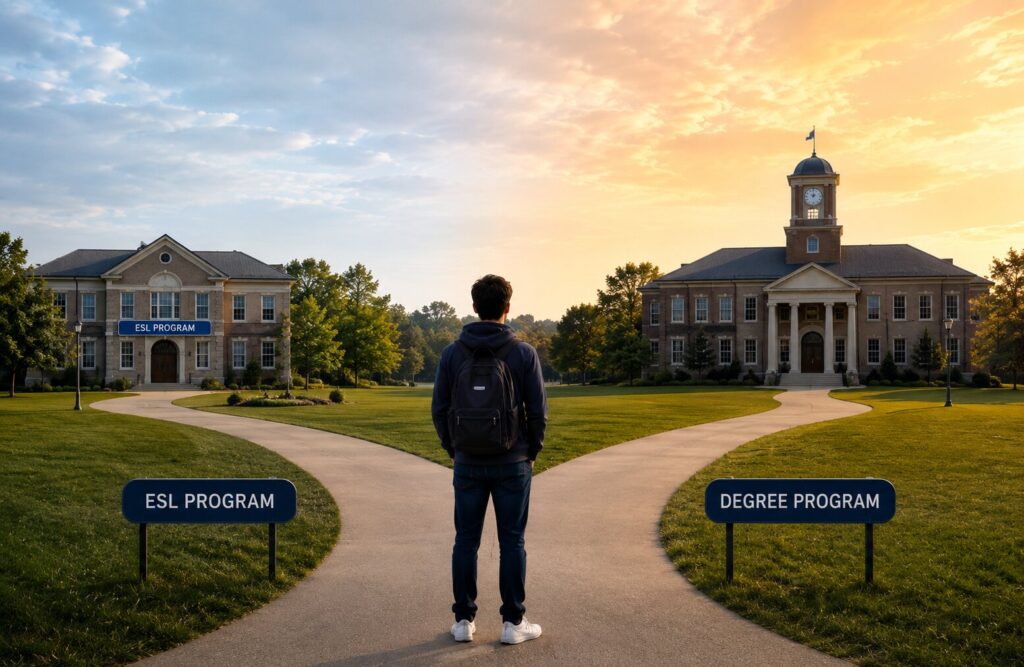
Quick Answer
Yes. ESL students on an F-1 visa can transfer directly to a SEVP-certified college or university without leaving the United States. To do so, you must:
- Receive admission from the new school.
- Request a SEVIS transfer from your current DSO.
- Stay within the 5-month transfer window.
- Obtain a new transfer-pending I-20.
- Report to your new school within 15 days of your program start date.
Transferring from an ESL program to a U.S. college or university is one of the most common goals among international students, and it is absolutely possible on an F-1 visa. Many students begin their journey in an Intensive English Program (IEP) before pursuing a degree. If you’re new to English language education in the U.S., you may also want to read What Is an Intensive English Program (IEP)? and ESL vs EFL: What’s the Difference?
But this is not simply a matter of applying and getting accepted. Your SEVIS record, your Form I-20, and your F-1 status must all be handled correctly during the move, or you risk losing the legal standing you worked to maintain.
This guide covers every part of the process: the two main transfer pathways, the step-by-step SEVIS transfer procedure, English proficiency requirements, and what changes about your F-1 benefits once you are enrolled in a degree program.
Key Takeaways
• Transfer Legally on F-1 Without Leaving: ESL students in valid F-1 status can transfer to a SEVP-certified college or university without leaving the United States or applying for a new visa.
• Know the 5-Month Window: Under 8 CFR 214.2(f)(16)(i)(C), your new program must begin within 5 months of your program end date or your SEVIS release date, whichever comes first. Miss this window and your record is no longer eligible for transfer.
• Get Your DSO to Release Your Record: Your DSO (Designated School Official) must set a transfer release date in SEVIS before your new school can issue a valid Form I-20. This does not happen automatically.
• Report Within 15 Days of Your Start Date: Federal regulation 8 CFR 214.2(f)(8)(ii)(C) requires you to contact your new school’s DSO within 15 days of the program start date on your new Form I-20. Failing to do so can result in automatic SEVIS termination with a “No Show” reason.
• Gain OPT and CPT Eligibility: ESL-only students on F-1 are not eligible for Optional Practical Training (OPT) or Curricular Practical Training (CPT) under 8 CFR 214.2(f)(10). Enrolling in a degree program changes that. Note that 12 months or more of full-time CPT eliminates OPT eligibility at the same degree level.
What “Transfer” Actually Means for an F-1 Student
For a domestic student, transferring schools is an academic process. For an F-1 visa holder, it is also a federal immigration process.
When you transfer, your SEVIS record (the government database entry that tracks your enrollment, status, and compliance) must be moved electronically from your current school to your new one. Until that transfer is complete, your new school cannot issue you a valid Form I-20, and you cannot legally begin studying there. Admission alone does not authorize enrollment.
Your F-1 visa stamp does not change. If it is still valid, you can use it to re-enter the United States after travel. What changes is which institution is responsible for your SEVIS record and your I-20. This matters more than most students expect. The wrong sequence of steps can make an otherwise valid transfer ineligible.
One more thing worth stating plainly: not every English language school in the United States is SEVP-certified. If you are currently enrolled at a school that is not SEVP-certified, your F-1 status is not valid regardless of your enrollment. Always confirm SEVP certification before enrolling in any language program.
| Transfer Type | What Moves | Who Initiates It |
|---|---|---|
| ESL school to another ESL school | SEVIS record moves between language programs | Your current school’s DSO |
| ESL school to a college or university | SEVIS record moves from a language program to a degree-granting institution | Your current school’s DSO |
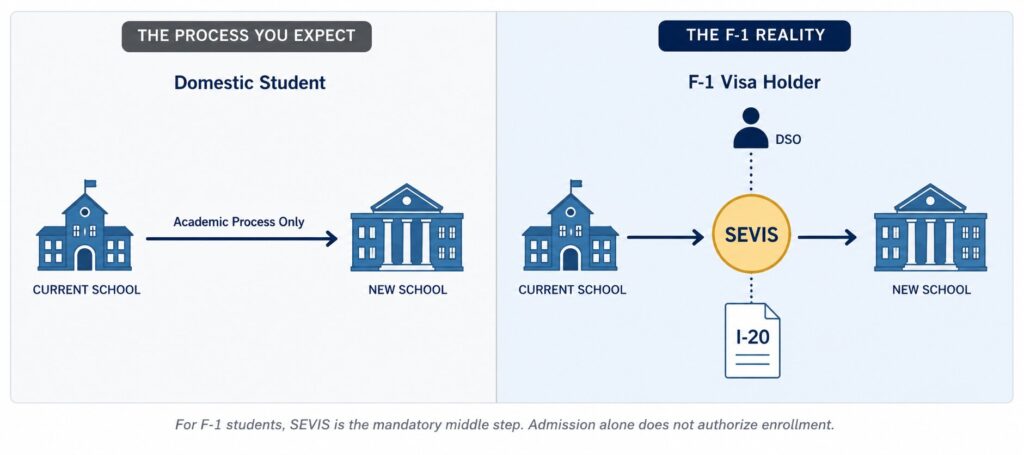
This post focuses entirely on the second type: moving from an ESL program into a credit-bearing college or university program.
One question students commonly ask at this stage: “Am I applying as a transfer student or a freshman?” If your ESL program was not credit-bearing, which is the case for most standalone language programs, universities will classify you as a freshman, not a transfer student. This surprises many students who assume any time spent studying in the U.S. gives them transfer status. It does not. The classification depends on whether you completed credit-bearing coursework, not how long you studied here.
Most students pursuing a university transfer begin in an Intensive English Program (IEP) designed specifically for international students on F-1 visas.
The Two Main Pathways from ESL to a U.S. Degree Program
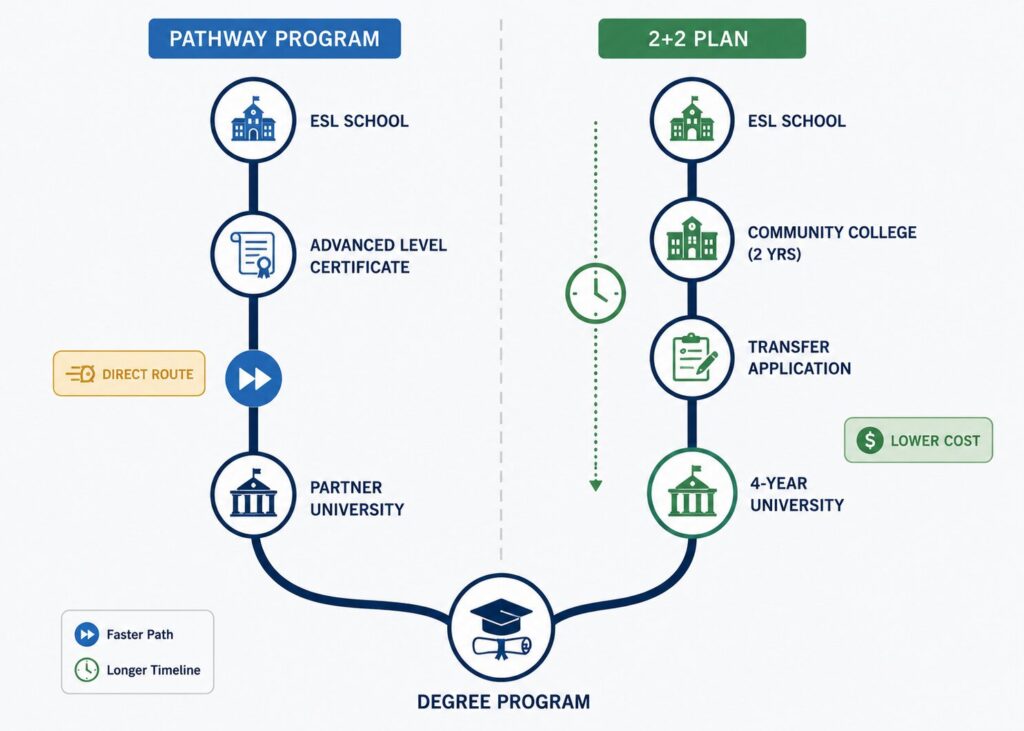
Pathway 1: University Pathway Programs
Many SEVP-certified ESL schools have formal partnerships with four-year universities, structured as pathway or conditional admission programs. When you reach an advanced proficiency level in your ESL program, the partner university waives the TOEFL or IELTS requirement and may offer guaranteed admission, provided you meet the required GPA or proficiency benchmark.
This is the most direct route for students who want to avoid standardized testing. Your completion certificate from the advanced ESL program serves as proof of English proficiency for the partner university.
Note: Not every ESL school has university pathway partnerships. Before enrolling in any ESL program, ask directly whether the school has formal agreements with partner universities, which schools those are, and at what proficiency level the TOEFL/IELTS waiver applies. Get this in writing.
Pathway 2: The Community College 2+2 Plan
The second route is to enroll at a U.S. community college, complete two years of credit-bearing coursework, and then transfer to a four-year university to finish a bachelor’s degree. This is widely known as the 2+2 plan.
Community colleges generally have lower tuition, smaller class sizes, and more flexible English proficiency requirements than four-year universities. Many have transfer articulation agreements with nearby state universities, which means your credits transfer cleanly and directly.
If you take this route, your Form I-20 is issued by the community college, not a language school. You are in academic F-1 status from day one, not ESL status, and full-time enrollment requirements apply immediately.
| Pathway Programs | 2+2 Community College | |
|---|---|---|
| TOEFL/IELTS required | Often waived for partner university | Varies; generally more flexible than four-year schools |
| Admission guarantee | Conditional, if GPA/level met | Not guaranteed; apply as any international student |
| Time to university | Typically one or two semesters | Two years before transferring to a four-year school |
| Best for | Students who want a direct bridge to a specific university | Students who want lower cost and more time to build academic foundation |
Step-by-Step: How to Transfer Your SEVIS Record to a New School
Step 1: Apply to the New School and Get Your Acceptance Letter
You cannot initiate the SEVIS transfer until the new school accepts you. Apply through the university’s international admissions process. Most schools will ask for:
- A copy of your current Form I-20
- Academic transcripts from your home country and any U.S. programs you have completed
- Proof of English proficiency (TOEFL, IELTS, or an advanced ESL certificate if the school accepts it)
- Financial documentation: bank statements or a sponsor letter showing you can fund your studies and living expenses
Once accepted, the new school will send you an acceptance letter and, in many cases, a transfer verification form to bring to your current DSO.
Step 2: Notify Your Current DSO and Set the Release Date
Inform your DSO at your current ESL school that you intend to transfer. Bring:
- Your acceptance letter from the new institution
- The transfer verification form from the new school (if required)
Your DSO will log the transfer release date in SEVIS. This is the date on which responsibility for your record shifts from your current school to the new one. On that date, your current school loses access to your record and your new school gains it.
Important: Your new school’s program start date must be within 5 months of your program end date or SEVIS transfer release date, whichever comes first. Work closely with your DSO to ensure your transfer timeline remains compliant.
Step 3: Receive Your Transfer-Pending Form I-20
After your SEVIS transfer release date, your new school’s DSO will issue a Transfer-Pending Form I-20. This document confirms your transfer status and allows you to remain in the United States while preparing to begin your new program.
Before your program starts, review your new I-20 carefully and make sure all personal information matches your passport.
Step 4: Check In With Your New School
After arriving at your new school, you must check in with the international student office or DSO and complete any required enrollment and orientation procedures.
This typically includes:
- Submitting your signed Form I-20
- Providing your current U.S. address
- Completing any required orientation
- Registering for a full course load
Failure to complete the check-in process could affect your F-1 status.
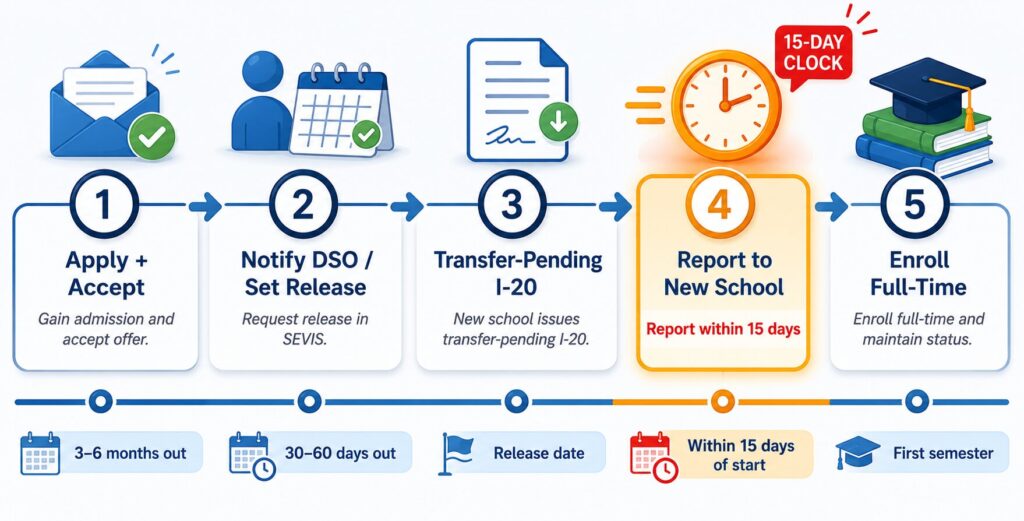
Step 5: Maintain Full-Time Enrollment
Once enrolled, full-time status is mandatory. For most undergraduate programs, that means at least 12 credit hours per semester. Dropping below full-time without an authorized reduced course load from your DSO is a status violation, even by one class.
Pre-Transfer Checklist
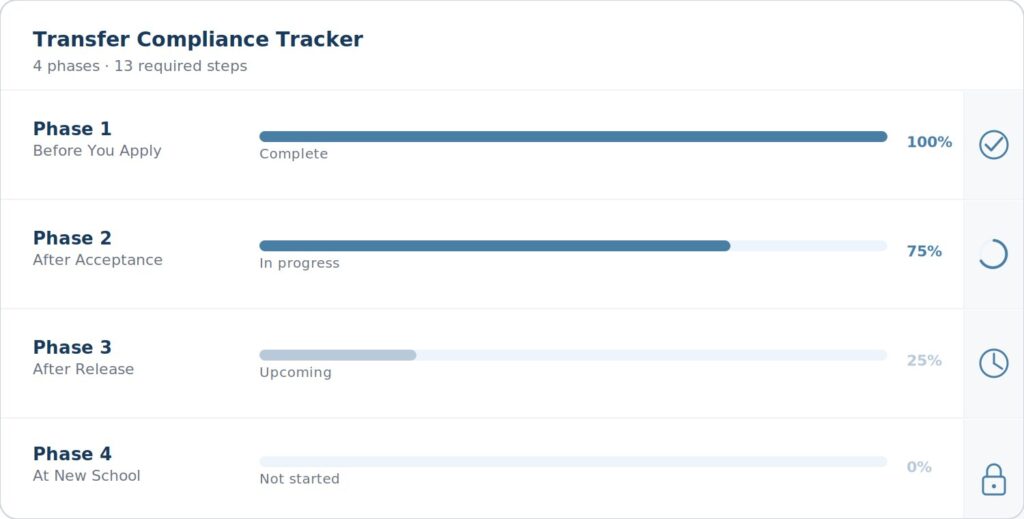
Before transferring from an ESL program to a college or university, make sure you:
- Confirm the new school is SEVP-certified
- Maintain valid F-1 status at your current school
- Obtain admission from the new institution
- Notify your current DSO of your transfer plans
- Coordinate a SEVIS transfer release date
- Receive your Transfer-Pending Form I-20 from the new school
- Complete all check-in requirements at your new school
- Enroll full-time and maintain F-1 compliance
Working closely with your DSO throughout the transfer process can help prevent delays and avoid status issues.
What English Proficiency Documentation Do You Need?
There is no single federal standard for English proficiency. Each university sets its own requirements for international applicants.
| Proof of English Proficiency | Accepted By |
|---|---|
| TOEFL iBT score (typically 61–80+ for general undergraduate; 90–100+ for competitive or research universities) | Most U.S. universities as the standard requirement |
| IELTS score (typically 5.5–6.5 band for general undergraduate; 6.5–7.0+ for competitive programs) | Most U.S. universities as an alternative to TOEFL |
| Certificate from an advanced ESL or pathway program | Universities with formal pathway partnerships only |
| Completion of credit-bearing English courses at a U.S. college | Many universities with articulation agreements |
| Four years of prior secondary education taught entirely in English | Some universities offer a test waiver on this basis |
Score requirements vary by institution and by department within the same university. Competitive research programs and graduate-track pathways often require scores 10 to 15 points higher than general undergraduate admission minimums. Confirm in writing which pathway your target university accepts, and which department you are applying to, before you rely on an ESL certificate or a specific test score as sufficient proof.
Learn more: The DHS Study in the States resource center provides official guidance on F-1 student rights and SEVIS transfer procedures.
What You Gain When You Transfer to a Degree Program
This is a point most guides skip entirely, and it matters.
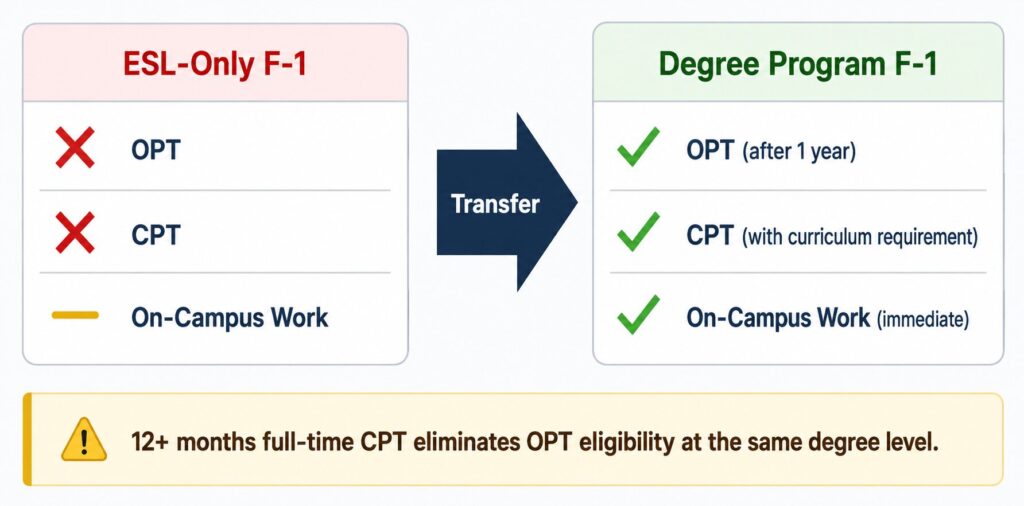
F-1 students enrolled in English language training programs are not eligible for OPT or CPT under federal law. 8 CFR 214.2(f)(10) states directly that “students in English language training programs are ineligible for practical training.” The USCIS Policy Manual (Volume 2, Part F, Chapter 5) and ICE SEVP practical training guidance both confirm this exclusion applies regardless of how long the student has been in F-1 status.
Once you transfer your SEVIS record to a degree-granting institution and enroll in a credit-bearing academic program, that changes. After one full academic year in valid F-1 status in your degree program (ESL time does not count toward this requirement), you become eligible to apply for OPT. CPT eligibility opens as well, provided your program of study requires it as part of the curriculum.
Critical CPT/OPT tradeoff: These two benefits are not independent. Under 8 CFR 214.2(f)(10)(i), if you are authorized for 12 months or more of full-time CPT at a given degree level, you become permanently ineligible for OPT at that same degree level, even if your EAD card has not yet expired. Part-time CPT does not affect OPT eligibility, and CPT at a different degree level does not carry over. If you are considering a program that requires significant full-time internship work, understand this tradeoff before committing.
For students planning to work in the United States after completing their education, even an internship or practicum during the degree, transferring from an ESL-only program to a degree program is not just an academic step. It is what activates your work authorization eligibility. Students who stay in ESL programs without ever transferring to a degree program have no practical training pathway at all.
For a full breakdown of maintaining your F-1 status through this transition, see our guide on maintaining F-1 status after an ESL transfer .
Common Mistakes That Can Derail Your Transfer
Most transfer problems are not caused by bad intentions. They come from a small number of misunderstandings that DSO teams see repeatedly. Students often assume the process is similar to a domestic school transfer, or that acceptance to a new school automatically protects their status. Neither is true. These are the four mistakes that derail otherwise valid transfers.
Misunderstanding the 5-Month Window
The 5-month rule runs from the earlier of your program end date or your SEVIS release date, not simply from when you finish your last class. Both 8 CFR 214.2(f)(16)(i)(C) and the ICE SEVIS transfer guidance confirm this: the clock starts from whichever date comes first. If you set your release date before your program ends, the clock starts from that earlier date. Many students miss this and find that their new program start date falls outside the window, making the SEVIS transfer ineligible.
At that point, your new school must issue a new initial I-20 with a new SEVIS number, and you lose credit toward CPT eligibility and other benefits tied to your current record.
For more on how the SEVIS record update process works, see our step-by-step SEVIS record update guide .
Assuming Your Visa Stamp Covers the New School
A valid F-1 visa stamp allows you to enter the United States. It does not authorize you to study at a school that is not reflected in your active SEVIS record. After your release date, your current school’s I-20 is no longer valid as a travel document. If you travel internationally during the transfer period, you must re-enter with the Transfer-Pending I-20 from your new school.
Withdrawing Before Initiating the Transfer
If you withdraw from your ESL program without first having an active SEVIS transfer in place, your DSO is required to terminate your SEVIS record. A terminated record means you are out of F-1 status. Your options at that point are applying for reinstatement through USCIS, a process with no guaranteed outcome, or departing the U.S. and reapplying for an F-1 visa abroad. Always initiate the transfer process before withdrawing from your current program.
Enrolling Part-Time Without Authorization
Once enrolled at your new school, full-time status is not optional. Some students reduce their course load while adjusting to a new academic environment. Without a formal reduced course load authorization from your DSO, any term below full-time is a status violation, starting with the very first semester.
Planning to Transfer to a U.S. College?
The best time to prepare for a university transfer is before your ESL program ends. Students who plan early have more options for university admission, English proficiency pathways, and SEVIS transfer timing.
At AF International, our DSO team helps students understand transfer requirements, maintain F-1 compliance, and prepare for the next step in their academic journey.
How AF International Prepares Students for This Transition
Understanding the transfer process is the first step. The second is making sure your school handles it correctly.
At AF International, both our Pasadena and Thousand Oaks campuses are SEVP-certified. Our DSO team handles SEVIS record management, Form I-20 issuance, and transfer release coordination directly. Students who plan to transfer to a college or university work with our DSO from early in their program, not two weeks before it ends.
Many international students choose AF International’s Pasadena and Thousand Oaks campuses as a pathway to California community colleges, California State Universities, and other U.S. degree programs. Our team helps students prepare academically while maintaining F-1 compliance throughout the transfer process. Our small class sizes, personalized instruction, and SEVIS support help students build the English skills needed for academic success in the United States.
For students pursuing the pathway route, our intensive programs are structured to build the academic English skills that degree-level coursework demands: reading academic texts, constructing formal written arguments, and engaging with lectures delivered entirely in English. Those are skills that test scores measure but cannot teach.
Start your enrollment at AFINT Pasadena or AFINT Thousand Oaks to begin an ESL program that supports your full transfer path. For information on F-1 visa and enrollment requirements at AFINT, see our F-1 visa and I-20 information page.
Related Resources for International Students
- ESL vs EFL: What’s the Difference?
- What Is an Intensive English Program (IEP)?
- F-1 Student Visa and I-20 Guide
- Maintaining F-1 Status After an ESL Transfer
- Best ESL Schools in California
- How to Choose an ESL Program
Frequently Asked Questions
Yes. F-1 students in valid status can transfer to a new SEVP-certified school without leaving the U.S. The transfer is processed through SEVIS by your DSOs. A still-valid F-1 visa stamp remains usable for re-entry after travel.
If your ESL program was non-credit-bearing (most standalone language programs), universities classify you as a freshman. Credit-bearing coursework at a U.S. community college makes you a transfer applicant. Confirm with each school’s admissions office, as policies vary.
Your DSO must terminate your SEVIS record, ending your valid F-1 status. You would then need to either apply for reinstatement through USCIS or leave the U.S. and reapply for an F-1 visa. Never withdraw without first confirming a transfer is already underway.
The SEVIS transfer itself usually takes only a few business days. However, admission decisions, document collection, and coordination between schools can take several weeks. Most students should begin planning 1–3 months in advance.
On-campus employment is available immediately upon enrollment. OPT and CPT require one full academic year in a degree program — ESL time does not count. During the transfer period, work authorization at the new school begins only when your SEVIS record is activated.
Most SEVP-certified institutions do, provided English proficiency and academic requirements are met. Community colleges are the most accessible entry point and often have articulation agreements with four-year universities. Pathway program conditions depend on the specific ESL-university partnership agreement.
If your TOEFL score does not meet a university’s requirement, you may be able to retake the exam, apply to a school with different requirements, or complete a pathway program that accepts advanced ESL coursework in place of a test score.
Disclaimer: This article is for informational purposes only and does not constitute legal advice. Immigration regulations may change. Students should consult their DSO and refer to official SEVP guidance for the most current requirements. Contact your DSO for guidance specific to your situation, or refer to ICE/SEVP guidance on F-1 student transfers at ice.gov/sevis/f1-transfers for official regulatory information.